Entries Tagged 'development' ↓
March 17th, 2009 — development
Readers Question: I have to debate why multinational corporations are good for developing countries, and I know the arguments for them being bad are strong so are there any really good positive arguments I could use to smash the opposition? Thankyou so much
Arguments for Multinational Corporations in developing countries.
- They Provide an inflow of capital into the developing country. E.g. the investment to build the factory is counted as a capital flow on the financial account of the balance of payments. This capital investment helps the economy develop and increase its productive capacity.
- The Harod Domar model of growth suggests that this level of investment is important for determining the level of economic growth.
- The inflows of capital help to finance a current account deficit. (foreign investment enables developing countries to buy imports)
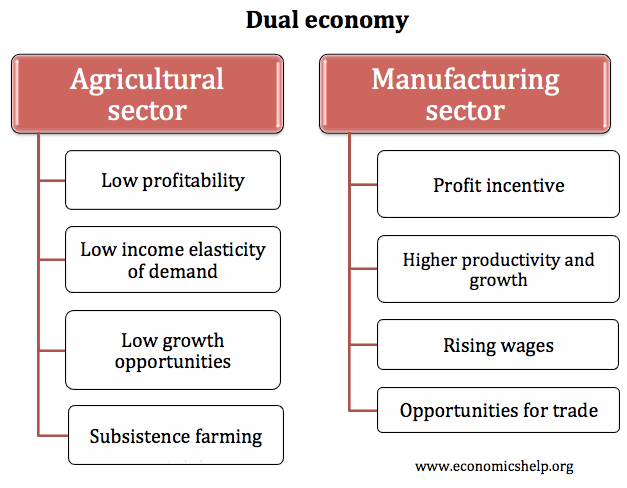
- Multinational corporations provide employment. Although wages seem very low to us, people in developing countries often see these new jobs as preferable to working as a subsistence farmer with even lower income.
- Multinational firms may help improve infrastructure in the economy. They may improve the skills of their workforce. Foreign investment may stimulate spending in infrastructure such as roads and transport.
- Multinational firms help to diversify the economy away from relying on primary products and agriculture – which are often subject to volatile prices and supply.
January 23rd, 2009 — development
Readers Question Q:4.What is the difference between Growth and Development? Explain the factors affecting macro-economics growth in a under development country?
Economic growth measures an increase in Real GDP. (real Output). Development looks at a wider range of statistics than just GDP per capita. Measures of economic Development will look at:
- Real income per head – GDP per capita
- Levels of literacy and education standards
- Levels of health care e.g. number of doctors per 1000 population
- Quality and availibility of housing
- Levels of environmental standards
Factors affecting growth in developing countries
- Levels of infrastructure – e.g. transport and communication
- Levels of corruption
- Educational standards and labour productivity
- Labour mobility
- Flow of foreign aid and investment
- Level of savings and investment
June 4th, 2008 — development
Some essays on development economics
Living Standards
Economic Development
Aid
Continue reading →
April 28th, 2008 — development
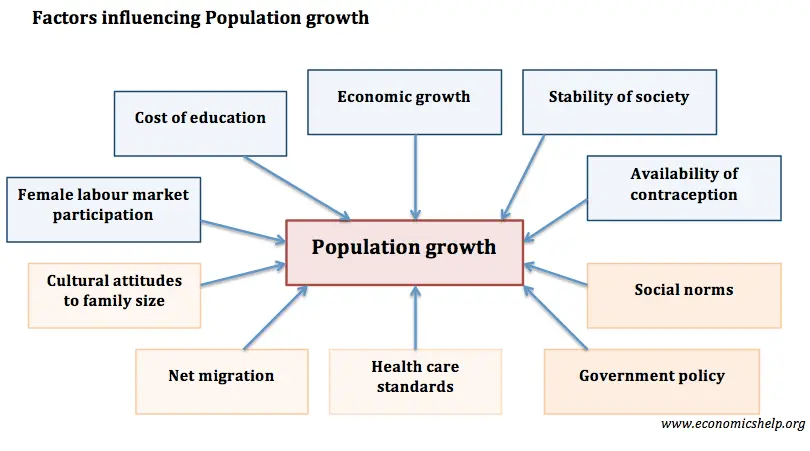
Explain the main factors which affect population size.
Not really an Economics question, so I’m not sure. But, these are some factors.
Economic Development. Countries who are in the early stages of economic development
State Pensions. A generous state pension scheme means couples don’t need to have children to provide an effective retirement support when they are old. Family sizes in developing countries are higher, because children are viewed as ‘insurance’ to look after them in old age. In modern societies this is not necessary.
Social and Cultural Factors. India and China (before 1 family policy) had strong social attachments to having large families.
Death Rates – Level of medical provision. Often death rates are reduced before a slowdown in birth rates, causing a boom in the population size at a certain point in country’s economic development
February 5th, 2008 — development
Readers Question: If there is a increase in GDP why is development often unseen?
Higher GDP means an increase in National Output and National Income but it doesn’t necessarily lead to economic development this is for the following reasons:
- Investment takes Time. It takes time for improvements in statistics like education and literacy rates. Higher GDP can be used to increase spending on education. But, it will take many years before education standards actually improve. Other types of investment like infrastructure and health care will also take a long time
- Inequality. Higher GDP may not ‘trickle down’ to the rest of society. Often increased GDP tends to benefit a small section of society. This problem is worse if corruption is a serious problem
- Environment. If Higher GDP causes environmental problems, living standards can seem to worsen, rather than improve.
- What is GDP spent? It depends on how the proceeds of Growth are used. There is no guarantee that the proceeds of growth will be used in areas which benefit economic development like education and infrastructure. If GDP is used for military spending or debt repayments, there may be little improvement.
February 4th, 2008 — development
(a) If you were asked as an economist to show the average person in Namibia is better off than ten years ago, explain what information you would need. (12m)
See Measuring Living standards
(b) Comment on the difficulties of comparing living standards between countries. (13m)
I have previously written an answer – To what extent does GDP measure living standards?
When comparing living standards between different countries, the only other point to add is the importance of measuring living standards in terms of purchasing power parity. PPP.
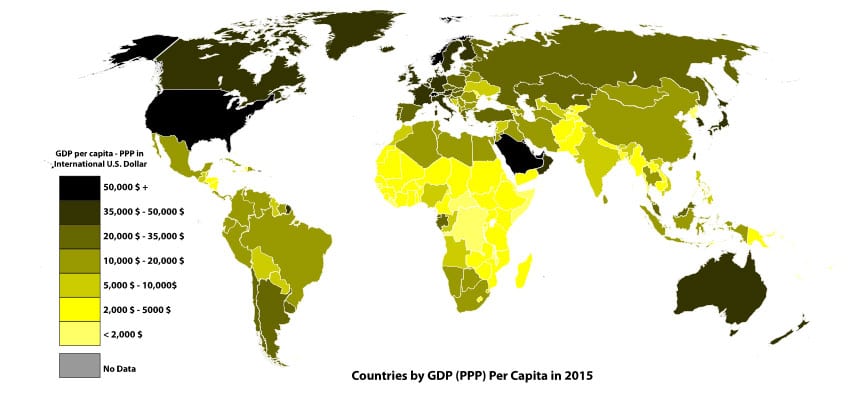
GDP per capita in $ terms does not necessarily reflect the local purchasing power of a country. For example, in Namibia incomes may be quite low say $1,000 per capita. However, living costs are likely to be much lower in Namibia than say the US. With $1,000 you can buy a lot more in Namibia than in the UK or US. Therefore, it is important to take these factors into consideration when comparing living standards.
Also a country like Namibia is likely to have a significant % of economic activity that is not measured by the government. e.g. subsistence farming and the black economy.
See also:
Does economic Growth increase happiness?
January 15th, 2008 — development
Debt forgiveness is a programme to cancel or reduce the amount of debt a person, or usually country, has.
Debt Forgiveness is an emotive issue because many feel it is wrong that low income developing countries suffer from high debt burdens, when they really need the money to invest. Many developing countries spend a high % of GDP on servicing the debt burdens.
For example, it has been estimated that for some sub Saharan African Countries the interest on their debt burden is over 200% of their total export value.
Therefore, in the West there has been much pressure for Government to write off third World Debt.
In 2005 Live 8, raised the issue again, with Governments taking some steps to cancel Third World Debt. However, critics argue this debt was cancelled by merely using existing Aid money. Therefore, in practice little was done to improve the Third World Development Continue reading →
January 11th, 2008 — development
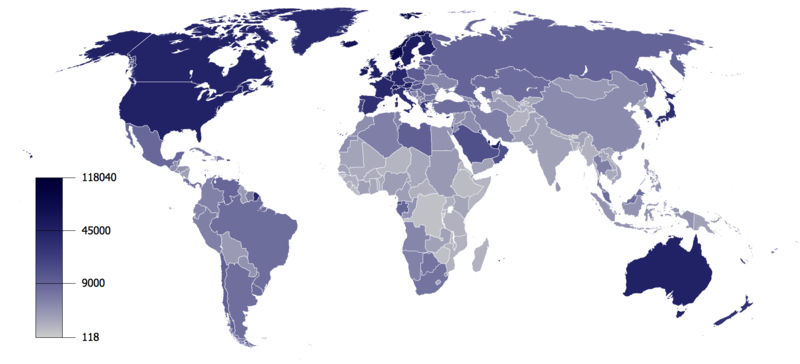
An economist is concerned with measuring and explaining living standards. However, when we look closer at measuring living standards we see it is not straight forward and there are many different approaches that we can take. The most common measure of living standards is real GDP per Capita
GDP per Capita – GDP measures National Output / National Income. Per capita is the average income per person in the economy. This is a rough guide to living standards but as these essays show GDP has many limitations in measuring living standards
GDP – Purchasing Power Parity PPP
Another important factor in measuring living standards is GDP measured at Purchasing power parity. This means that the statistics take into account the actual cost of living. For example, some countries may have lower GDP, but the cost of living is much cheaper. PPP adjusts for these different costs of living.
Poverty and Living Standards
An important factor in measuring living standards for the economy is the number of people living below the poverty line.
The poverty line is defined as:
The level of expenditure necessary to buy a minimum level of nutrition and other basic necessities. The World Bank say that the poverty line can vary somewhat from country to country, reflecting different costs of living for taking part in the everyday life of society. Continue reading →