Readers Question: Hello can you please tell me what the disadvantages of using interest rates would be for the economy?
Interest rates can be both beneficial and damaging for an economy. Essentially it depends on how they are used.
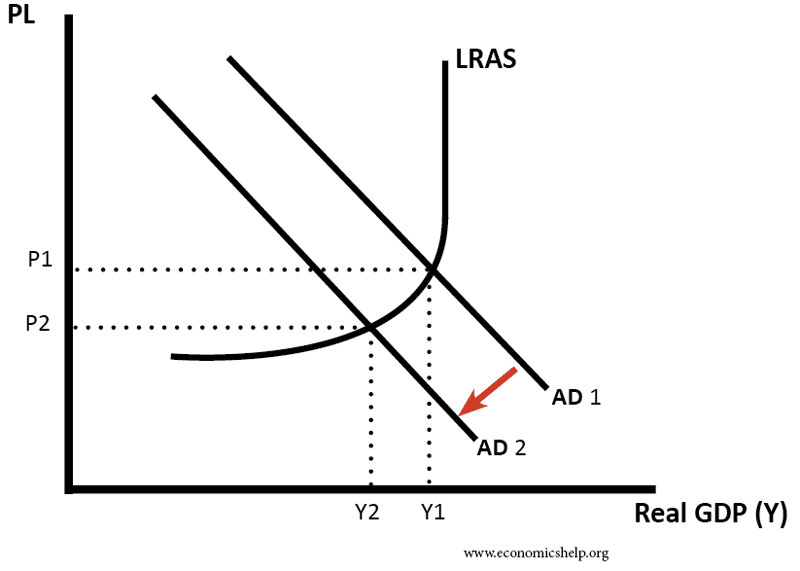
For example, if an economy is overheating (with inflation increasing), a rise in interest rates can help to reduce growth of aggregate demand and reduce inflationary pressure. If implemented correctly, this can avoid a boom and bust economic cycle. See: Effect of Increasing interest rates
In a recession, interest rates can be cut. This reduces cost of borrowing and helps firms and householders avoid being overwhelmed with debt repayments. Low interest rates can help the economy to recover and achieve positive growth.
When Are Interest Rates Damaging for an Economy?
Conflicting With different macroeconomic Objectives.
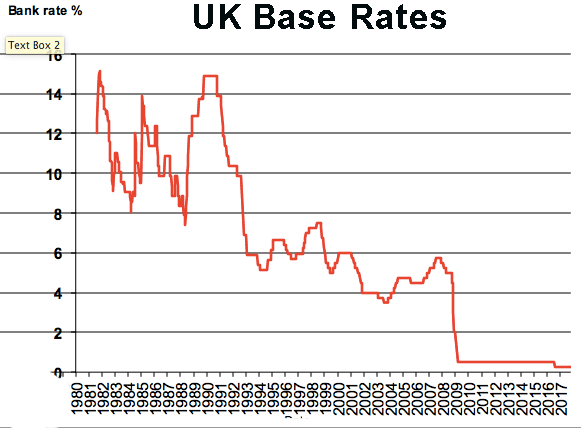
In 1990, the UK had high inflation and was a member of the ERM – a semi fixed exchange rate. The pound was falling to the lower limit of the exchange rate band. Therefore, between 1990 and 1992, the government increased interest rates to 12% (and for a few hours to 15%). This did help reduce inflation, and for a short period enabled UK to remain in ERM.
However, arguably, interest rates were far too high for the economic situation. The government persisted with high interest rates, even when the economy was in recession and unemployment rising. The government were pursuing a strong exchange rate, when this shouldn’t have been their primary macroeconomic objective. see: Recession of 1991-92
High interest rates created several problems
Demand in economy fell creating unemployment
Homeowners were faced with very high mortgage interest payments. This led to a record rise in home repossessions.
It caused a bust in the housing market, which caused house prices to fall for four years.
Problems of Relying on Interest Rates
Relying on interest rates to reduce inflation, disproportionately hits debtors and homeowners.
Cutting interest rates to boost growth, disproportionately hits savers (currently many savers have negative interest rates)
The impact of interest rates can be limited. For example, we are currently in a liquidity trap, which means zero interest rates are being ineffective in boosting growth.
This doesn’t mean interest rates are always bad. With hindsight, the government should have raised interest rates earlier to prevent inflation and reduce the size of the boom. When the economy went into recession, they should have been quicker to reduce them.
This is an interesting graph showing the movements in UK Base interest rates and the two measures of inflation, CPI and RPI.
The official measure of inflation is CPI. The interesting thing is that in the boom years, real interest rates were reasonably high. For example, in January 2005, base rates are 4.5% and CPI inflation is just less than 2%. This means real interest rates were +2.5%.
Now, real interest rates are negative. In March 2009, Base rates were 0.5%, CPI inflation was 2.2%. This means a negative real interest rate of – 1.7%. In theory this should boost spending and investment, but, of course many other factors are at work.
For a student just starting to learn Economics, this may prove a little confusing. One of the first things you may learn is how a cut in interest rates, should boost spending, investment and economic growth. Ceteris Paribus, a cut in interest rates should lead to higher inflation. However, since base rates were cut in the autumn of 2008 from 5% to 0.5%, inflation has continued to fall.
This reflects the scale of the recession and how loose monetary policy has been insufficient to prevent the rapid decline in output and fall in inflation.
However, forward looking indicators such as purchasing surveys and manufacturing orders suggest that the loose monetary policy (and depreciation, Q.E. and loose fiscal policy policy) is starting to have an effect. Hopefully, these forward looking indicators will mature into a real economic recovery. When looking at how interest rates effect inflation and growth, always consider the time lag and how a cut in interest rates may take upto 18 months to effect real variables.
The ECB cut interest rates to 1% as they slowly face up to the extent of the recession in the Eurozone.
The German economy is facing a large drop of 6% in GDP this year due to the global recession and strong Euro.
The lower interest rate may make the Euro less attractive as Euro rates become closer to US and UK rates. A fall in the Euro would help German and Euro exporters regain competitiveness.
Lower interest rates may encourage borrowing and consumption. But, in the current climate, the impact on boosting investment and spending is likely to be low.
However, the ECB approach still shows a greater hesitancy to provide a strong monetary boost. This reflects the historical tendency for the ECB to give greater importance to the threat of inflation.
The ECB may still need to do alot more to deal with the scale of the recession and prospect of deflation in the Eurozone area.
Today the Bank of England announced a huge cut in interest rates of 1.5%. The Bank mentioned
- deteriorating economic situation
- rising unemployment
- Financial uncertainty
- Expectations of falling inflation in 2009.
Readers Question: What is the negative and positive impact of rising in the interest rate on financial market?
Higher Interest Rates and Stock Markets
Higher interest rates are often seen as bad news for the stock market.
Higher interest rates tend to slow down economic growth. Borrowing is more expensive therefore, firms will invest less and consumers will spend less. Because higher rates lead to lower growth, companies will make lower profits and therefore pay less dividends.
Futhermore, higher interest rates make it relatively more attractive to save in banks rather than invest in the stock market.
Of course, there are many variables affecting stock markets other than interest rates, but, ceteris paribus higher rates tend to be seen as bad in the short term.
Readers Question Expansionary stance of monetary policy will lead to a lower interest rate thus discouraging hot money (portfolio I) leading to less outflow of Y and improve CAD. (based on lecturer’s notes)
Doesn’t the discouraging of portfolio I lead to spending more than S and Outflow>inflow thus leading to worsening of CAD??? I’m awfully confuse now. Please clarify and thank you.
If interest rates are cut, there will be less hot money flows into the UK. The UK will be less attractive as a place for investors to save. Therefore, there is less demand for sterling on the foreign exchange markets. This causes a depreciation in the exchange rate.
However, just because there is less demand for sterling on the foreign exchanges doesn’t mean lower Consumer spending. (I assume CAD = consumers Aggregate Demand)
A lower exchange rate will actually boost Aggregate demand in the UK. Firstly exports are more competitive therefore higher demand for exports. But, also imports will be more expensive therefore, people will be discouraged to buy imports and therefore buy more domestic goods.
Lower interest rates will increase consumers spending in the UK because:
Less attractive to save
Mortgage payments are lower therefore more disposable income
For manufacturing investment, the real Interest Rate is important for determining the viability of investment. Generally, industry prefers real interest rates to be low, to encourage investment. High real interest rates discourage investment.
The Real Interest Rate is the Nominal Base rate – Inflation. If The Official Interest Rate is 7% and inflation is 5%. It means savings would increase in value by 2%. The real Interest rate is important for many reasons.
Reflects the cost of borrowing. A higher real interest rate increases the cost of borrowing and makes investment less profitable. (This is not an issue if the finance is raised in UK) However, if it is necessary to borrow in the particular country the real interest rate is very important for determining the profitability of investment.
Determines Economic activity. Interest rates influence the level of economic activity in the economy. Higher rates discourage borrowing and encourage saving. Therefore, in countries with high interest rates, consumption and investment tend to be lower. This could reduce domestic demand for your manufactured goods.
Influences the exchange Rate. A high interest rate causes an appreciation in the exchange rate, making exports less competitive. If the manufactured goods are to be exported a high exchange rate can be quite a problem.
(However, a strong exchange rate will make imports cheaper)
Readers Question: The Bank of England has released £15bn into the economy. That increase in the money supply will surely cause inflation? So interest rates having fallen will be raised, worsening the housing market and making the credit crunch even worse, not better….surely?
The Bank of England is planning to inject money, primarily into the mortgage markets. It will be unveiling a plan today to release money into the money markets to help banks finance mortgages.
This particular increase in the money supply is unlikely to cause inflationary pressure.
Even if the Bank of England increased the Money Supply by £50billion, it is still a small % of total GDP. (over £1,200bn).
Total UK Mortgage debt stands at £1.19 trillion — or about 84% and there mortgage companies are struggling to raise sufficient funds because credit has dried up on the money markets. Many analysts suggest that this £50billion is unlikely to sovle the problem of credit shortages. (BoE plan to inject money)
The injection of £50billion will have a positive effect on the Money supply, but, it comes at a time of declining credit and availability of money. Demand pull inflation is not a problem at the moment.
If the Bank had injected £50 billion at the height of the lending boom in 2006, then the injection of money at that time may have caused inflationary pressure, but at the moment, they are merely trying to restore a semblance of normality to the mortgage sector – it will not cause a lending boom.
The most serious threat to inflation at the moment is coming from cost push factors. But, it maybe that the Bank feel they need to allow inflation to go above the target rather than risk a recession.
Readers Question: Hi, Please could you explain this question…
Contrast the likely effects of monetary policy decisions on the price of housing and shares.
Monetary Policy involves changing interest rates to try and influence aggregate demand and target low inflation and high growth.
If inflation was increasing above the governments inflation target, they would increase interest rates to reduce inflationary pressures.
Effect on Housing
Higher interest rates increase the cost of mortgage interest rate payments. Therefore, it makes it less attractive for people to buy a house. If interest rates increase too much, some people may not be able to afford their mortgage payments and default on their mortgage. This means they will have to sell their house. This effect will be to reduce demand for houses and therefore lead to lower house prices.
Note: In the US, many people took out risky mortgages in the period 2001-06. These mortgage payments were a high % of their disposable incomes. Therefore, a small increase in interest rates from 2% to 4% had a serious adverse effect on the US housing market. In France or Germany, these kind of mortgages are less common and therefore, higher interest rates would have much less impact on house prices.