economics blog

taxes | Economics Blog

Entries Tagged 'taxes' ↓

2p Fuel Tax Increase Dropped

As widely expected, the Chancellor Alistair Darling cancelled the proposed rise in petrol tax. Keeping petrol tax rates at 50p a litre.

I have previously written why I disagree with this populist move – 10 Reasons not to cut Petrol Tax

The difficult thing is how the Chancellor is going to finance this tax cut? (£2.6 billion)

  • Government Borrowing is already reaching record levels.
  • Stamp duty tax is falling
  • A recession would lead to lower income tax and VAT revenues.
  • People don’t like paying petrol tax, but, I doubt they will be overjoyed to have a 1p increase on the basic rate of income tax.

Council Tax Payments and Pensioners

Readers Comment: I’m a pensioner. Since introduction my Council Tax has increased by 103%,my pension by 29%. Mine is the sole income,why should I pay the same as a family of 4 all working and living in a house in the same tax band;does only one of them receive help from the police, firebrigade, does only one of them create rubbish? No local (income) tax is the only fair answer but apart from Lib Dems is any other party prepared to talk about it. Bill Davies - Discuss

Thanks for comment Bill. It is interesting to see feedback from someone’s personal perspective. From my perspective the Council tax is unfair and poorly designed. It was rushed through with the idea  that – anything other than the poll tax must be better. Well, it isn’t the poll tax, but, that is hardly an endorsement. Given how important local tax is and how much it effects people’s living standards, it is suprising that it makes so little impact on the current political scene. The only time we see it on the news is when some 90 year old is threatened with jail for non payment of council tax. Continue reading →

Council Tax Banding – A Fair Tax?

The argument was that the poll tax was so bad that anything had to be an improvement. So with little thought, the Conservative government brought out the Council Tax. The council tax aims to introduce a degree of proportionality and fairness by charging a tax equal to the value of a house. The argument is that people who are wealthy have a high house value and therefore can afford to pay more.

However, this policy has been widely criticised. These are some of the criticisms of the Council Tax

Problems of the Council Tax

  1. Wealth is not the Same as Income. Just because your house is worth £200,000 doesn’t mean you have a high income. For example, a pensioner may own their own house, but, their pension may give a very meagre income. People living in the same valued house can have widely varying incomes and therefore ability to pay. Continue reading →

Poll Tax – Riots and the definition of a good tax.

For those studying Economics A-Level at the moment, you will probably not remember the poll tax. This tax introduced by Mrs Thatcher was probably one of the most unpopular taxes ever introduced. It was widely condemned as being unfair and inequitable. The principle of the council tax was that everyone would pay the same. Whether you were wealthy or low paid, you received the same council services so therefore, the argument went, you should pay the same amount. The problem was that if the poll tax was £500, it could be a high % of a low income workers disposable income. Another problem with the poll tax was that the amount could vary widely from one borough to another. Some rich boroughs were able to charge very low poll tax, others charged a very high %.

After a long campaign, including the infamous poll tax riots in London, Mrs Thatcher responded to the criticism by offering a rebate, to reduce the cost of the poll tax. But, she wasn’t  willing to compromise on the principle that everyone pay the same amount.

Continue reading →

Should We Ban or Tax the Plastic Bag?

Ireland have introduced an interesting law, which has placed a 15 cent tax on the plastic bag. Combined with an advertising campaign to make the plastic bag unacceptable, use has fallen between 90-94%. Within a few weeks, there was a visual improvement in the number of plastic bags littering the environment. Other countries such as Bangladesh and China have gone further and banned the plastic bag.
Due to its relative success many are suggesting we should implement this policy in the UK. These are some of the economic, social and environmental arguments in favour of banning the plastic bag.

Advantages of Plastic Tax

  1. Reduces costs to shops. Usually shops are reluctant to charge for plastic bags. But, if they have to charge, people will be increasingly likely to use alternatives and reuse old bags.
  2. Reduces Litter. Around Oxford I see a real problem with litter, 50% of which seems to be plastic bags. They get blown into hedgerows and get stuck for years, causing visual blight to the environment. If plastic bag use was discouraged the amount of litter would significantly be reduce.
  3. Plastic Bags not Biodegradeable. Plastic bags take 1000s of years to disintegrate, therefore our landfills are full of plastic bags which don’t breakdown
  4. Bad for Wildlife. Because plastic bags can float around they can often cause problems for wildlife.
  5. Reduce dependence on oil based products. Because plastic bags are made from oil they increase our dependence on oil imports. With rising prices of oil there is an increased desire to avoid oil products where necessary.
  6. Aesthetically pleasing. For those who yearn for the good old days of high street shopping in paper bags, before the advent of the out of town supermarket, banning the plastic bag would encourage people to go back to the basics of shopping.
  7. Tax Raises Revenue. An estimated 10 million Euros
  8. Tax makes people may the social cost. Using plastic bags creates negative externalities, a tax will make people pay the social cost. At the moment, plastic bags are usually free and therefore, firms subsidise the use of goods with negative externalities.

Continue reading →

How Would You Raise the £8billion Shortfall?

The institute of Fiscal Studies have made an indepth analysis of the UK economy and have come to the conclusion that the UK government will need to raise taxes by £8billion or cut spending by £8billion.

The chancellor has been overoptimisitc in projected tax revenues, assuming that rates of growth would always remain high. However, as the economy begins to slowdown tax revenues are likely to be less than expected – leaving the government with the prospect of breaking its own golden rule on borrowing.

The instinctive response is to perhaps say, well the government shouldn’t have wasted so many opportunities in the past. With high levels of growth they could have taken the opportunity to reduce national debt, rather than add to it. Continue reading →

Should Tax on Alcohol Be Increased?

Readers Question: evaluate the economics for and against the uk government further increasing the tax on alcohol in order to reduce its consumption?

I have answered a similar question before: Should government increase tax on Cigarettes?. There are many similarities and if you understand the basics of market failure you can easily apply the same arguments to different types of goods.

The main reasons for increasing taxes on alcohol include:

  1. Raise Revenue for the government.
  2. The Social Cost of alcohol are higher than the private cost. Therefore, a tax is an attempt to make people pay the social cost.
  3. Discourage a De Merit Good. Alcohol is a demerit good, in that people often underestimate the cost of drinking excessively – i.e. alcohol is one of the main causes for premature death amongst young adults, it is also one of the main causes of fatal accidents

The difficult is working out the optimal tax because taxes on alcohol are already relatively high. To evaluate the social costs of alcohol we need to try and place a monetary cost on: Continue reading →

Should Government Cut all Taxes?

Readers Question: What the benefits and the negative effects of reducing all taxes?

I wrote an Essay on the advantages and disadvantages of tax cuts

The idea of cutting all taxes is key element of libertarian politics. Cutting taxes is often a mantra repeated by conservative parties, although in practice, they usually find it more difficult to cut taxes than their rhetoric would suggest.

Firstly Cutting all taxes has an opportunity cost, it requires either:

  1. Cutting Government Spending
  2. Increasing Government Borrowing

Of the two, cutting government spending, is the only policy which is sustainable in the long term.

Generally, to cut all taxes, you need to make a good argument about why the Government is spending too much. Most politicians will start from the premise that ‘it is good to cut taxes’ but when they get into power they realise it is actually very hard to cut spending.

The answer may depend on the country. For example, some countries with high tax burdens may find that cutting taxes may increase incentives. However, for a relatively low tax country like the US, I am very sceptical of this argument.

Should we increase Taxes on Cars?

Readers Question: over the next 10 years, should the government make greater or lesser use of measures such as road pricing or taxes on fuel to reduce road use? (15 marks) AQA

In the UK, Road use creates many external costs. This includes increased pollution, congestion, and accidents. Therefore, the social cost of using a road is greater than the private cost. In a free market, this leads to over-consumption, (people ignore external costs when deciding whether to drive). This causes economic costs such as lost output due to congestion. Therefore, there is a good argument for governments to intervene to overcome market failure.
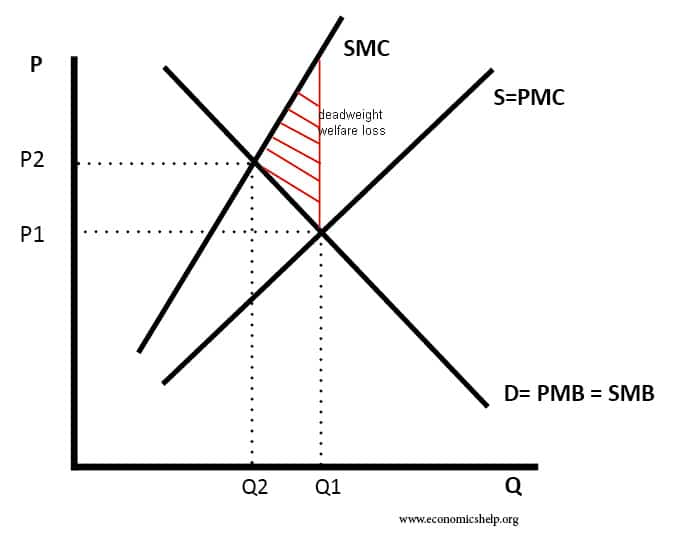
Diagram for market Failure with negative externality 

A tax on fuel will reduce demand for car use and make people pay the social cost. This increases social efficiency and also raises revenue for the government. This money can be spent on subsidising alternatives to car use.

Continue reading →