economics blog

Economics Help.org Revision Guide

Model Economics Essays

unemployment — Economics Blog

Entries Tagged 'unemployment' ↓

Reducing Unemployment By Using Monetary Policy

Readers Question: how to solve unemployment by tools of monetary policy?

Monetary policy effectively means changing interest rates to influence aggregate demand, economic growth and therefore demand for workers.

The UK is heading into recession and unemployment is rising. It is argued a cut in interest rates would help reduce unemployment.

  • Lower interest rates reduce the cost of borrowing encouraging spending and investment.
  • Lower interest rates reduce the cost of mortgage payments giving homeowners more disposable income and therefore spending increases.
  • Therefore, lower interest rates should help increase consumer spending and investment. Therefore, aggregate demand will rise. If there is spare capacity in the economy, there will be an increase in economic growth and therefore firms will demand more workers. This will help reduce demand deficient unemployment.

However:

  • Lower interest rates may not increase consumer spending if confidence is very low. (e.g. in a recession, people may not want to borrow to invest, even if interest rates are very low)
  • Cutting interest rates will only solve demand deficient unemployment. It will not reduce supply side unemployment - the natural rate

Types of Unemployment

Readers Question: What are the types of unemployment?

Firstly, we can make a distinction between:

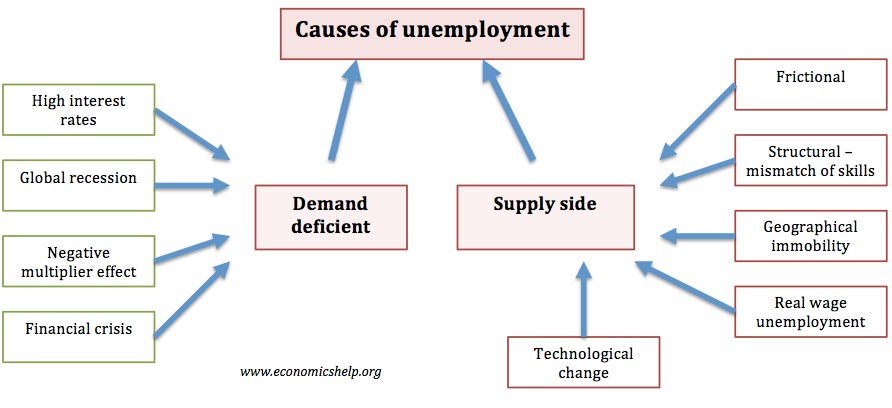
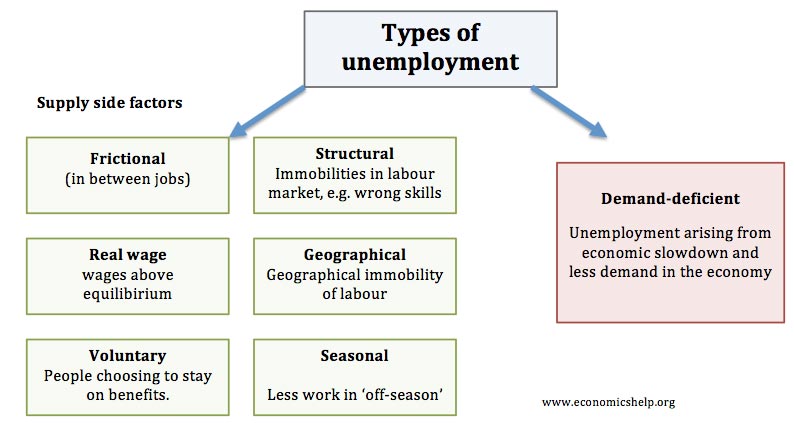
  • Supply side unemployment (the natural rate of unemployment). These are usually microeconomic imbalances in labour markets.
  • Demand side unemployment (Unemployment caused by lack of aggregate demand in the economy). In the coming recession, we can expect demand deficient unemployment (sometimes called cyclical unemployment) to increase significantly.

Amongst Supply side unemployment Different types include:

  • Frictional - when people are in between jobs.
  • Structural - Unemployment due to occupational or geographical immobilities. Often occurs after structural change in the economy. E.g. closure of mines, left many miners struggling to find suitable work.
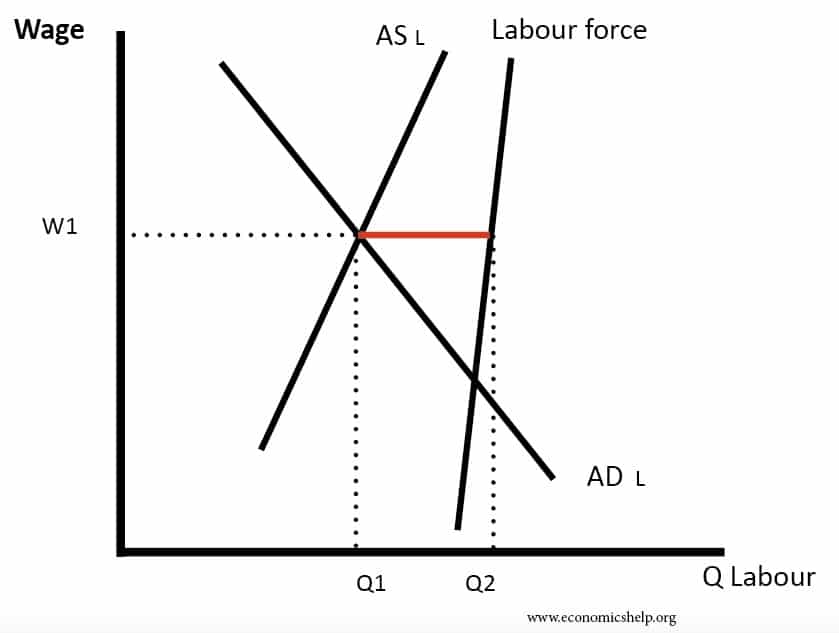
  • Real Wage Unemployment. e.g. powerful trades unions bargaining for wages above the equilibrium. (this may be exacerbated by fall in aggregate demand)
  • Voluntary unemployment. Some debate exists over this form of unemployment. But, arguably high benefits may encourage some to stay on benefits rather than take low paid jobs.
  • Seasonal Unemployment

See also causes of Natural Rate of Unemployment to change

Investment and Aggregate Demand

Readers Question: What are the effects of increased investment on aggregate demand in the short term and the long term.

Investment is a component of AD. AD+ C+I+G+A-M. I think, Investment spending takes about 15% of AD; it is not as significant as Consumer spending which is 66%.

If Investment increases, then ceteris paribus, AD will increase. However, it depends on circumstances. e.g. in present situation with falling house prices and lower consumer spendin, increased investment may be insufficient.

In the long term, higher investment may increase productive capacity and increase Aggregate supply. Therefore, you could argue, invesment enables a more sustainable increase in AD.

People often ask whether increased AD leads to an increase in Real GDP. Often the suggested answer is yes in the short term, but not in the long term.

See also:

Economics of the 1970s

Readers Question I’m currently looking at stagflation in the mid 1970s in the UK, and the policies the then-Government undertook to solve the economic crisis.

Was the Government right to widen the budget deficit 1974-5 in order to stimulate demand, or should it have run less expansionary policies to temper the effect of rising prices?

I’m afraid I don’t have access to many statistics from the 1970s, so it is hard to make much analysis. But basically, the government faced a twin problem of rising prices (mainly cost push) and falling demand. (Stagflation) By pursuing expansionary fiscal policy, they were attempting to maintain full employment ( a noble objective). However, it led to a rise in inflation and inflation expectations. Combined with powerful trades unions in the 1970s, this led to a sharp rise in inflation (25% by 1979). Arguably these rates of inflation were costly for the economy and led to an almost inevitable recession in 1980. see: recession 1980-81

Continue reading →

Unemployment in India

Readers Question: Suggest how the current economic policy of India has reduced unemployment in the present scenario.

The estimated unemployment rate in India has fallen this year from 8% to 7%. However, it is worth bearing in mind, it is notoriously difficult to measure unemployment in India because of high levels of disguised or ‘under-employment’. Underemployment occurs when people are not classed as being unemployed, but, they make very little from their job.

A particular problem for the Indian economy has been the agricultural sector which has a high % of the workforce but is struggling to create sufficient jobs. This has led to a shift in the working population from rural to urban areas; and there is a difficulty in creating sufficient jobs for this new sector of the population.

Economic Growth and Unemployment

The biggest factor in helping reduce unemployment in India is probably the strong economic growth. India has seen growth rates reach 7%; this increased output is creating new demand. However, economic growth alone cannot solve India’s unemployment problem because the growth tends to benefit some sectors of the economy much more than others. The growth has failed to deal with rural poverty.

Continue reading →

Trade Off Between Unemployment and Inflation

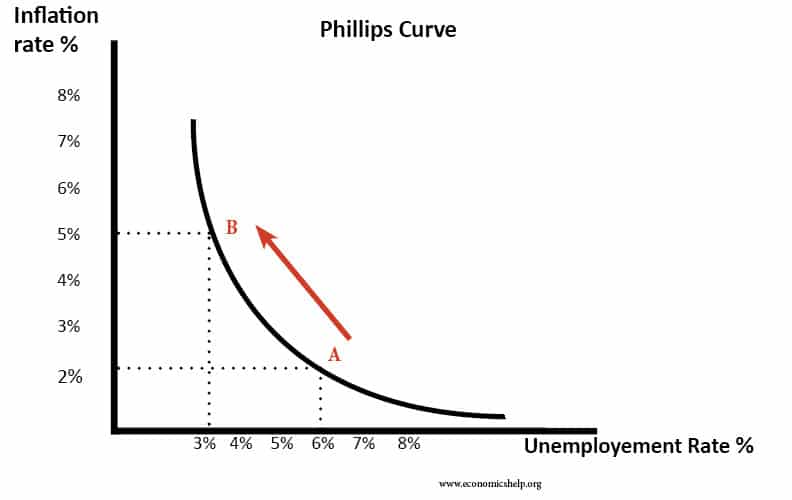
Readers Question “Discuss the view that the Phillips Curve is irrelevant in explaining relationships between unemployment and inflation in the UK”

If  you take the 1950s and 60s you could argue there was a trade off between unemployment and inflation.

As AD increased, it caused higher output, this lead to inflation as the economy came close to full employment. However, as output increased unemployment (demand deficient unemployment) fell.

Increase In AD causing Inflation Diagram

This Keynesian view of the AS curve suggests there can be a trade off between inflation and demand deficient unemployment.

However, this view is criticised by the Monetarist view, which argues increased AD only causes inflation and no increase in Real GDP in the Long term.

Continue reading →

Unemployment Levels and Inflation

Readers Question “To what extent can government use demand management policies to reduce unemployment without affecting inflation?” (60)

1. Monetary and fiscal policy can be used to increase AD and therefore increase economic growth. For example, if the MPC cut interest rates, this makes borrowing cheaper and therefore encourages investment and consumption. This will cause a rise in AD. If there is spare capacity in the economy then there will be an increase in Real Output; as firms produce more they will demand more workers and this will reduce demand deficient unemployment.

Continue reading →

Supply Side Policies for Reducing Unemployment

a)An explanation of supply-side economics.

Supply side policies are government attempts to improve productivity and efficiency in the economy.
See: Supply side policies

b)The remedies supply-side economists put forward to reduce unemployment.

  1. Better job information to help reduce frictional unemployment.
  2. Lower unemployment benefits to increase the incentive to get a job. It is argued generous unemployment benefits create an unemployment trap, where those on benefits would not get any extra income after tax if they decided to work.
  3. Reduced Power of Trades Unions. Trades unions can cause real wage / classical unemployment. If you reduce the power of unions, wages will fall to equilibrium levels leading to less unemployment. Also reducing minimum wages
  4. Increased labour market flexibility. eg. make it easier to hire and fire workers; this should encourage firms to set up and hire workers.
  5. Better education and training.

See also: supply side policies and reducing unemployment

The Rate of Unemployment Benefits

Readers Question. Explain the benefits of increasing the rate of unemployment benefit for 1.the unemployed, 2. society. Identify and costs that may result from such a policy.

Benefits of Increasing Unemployment benefits

  1. Provides more income, reducing relative poverty and improving living standards.
  2. Gives them support in finding the best job. If benefits are low, then they will be forced to get the quickest job they can find. But, this may not be suitable for their skills. Higher benefits enable the unemployed to take more time and find a job which matches their skills. This is also a benefit for society. For example, if someone leaves university, with a degree in astrophysics, we don’t want them working in McDonalds because unemployment benefits are too low to support their job search on leaving university. Basically, frictional unemployment is not a bad thing; sometimes it takes time to find the right job.
  3. Low Unemployment benefits could fuel social unrest and encourage the unemployed to resort to crime to supplement their income. Unemployment is often associated with a feeling of social alienation leading to riots such as Brixton 1981 and Paris in 2006. Continue reading →

Disadvantages of Full Employment Definitions

explain 3 different ways in which full employment can occur and identify any disadvantages of each?

In previous post I identified 4 different way to define full employment

Optimal Level of Unemployment

Rather abitary; there could be disagreement on what constitutes the ‘optimal level of unemployment’. For example, how much frictional unemployment is necessary in a modern economy.

Continue reading →