economics blog

unemployment | Economics Blog - Part 2

Entries Tagged 'unemployment' ↓

Unemployment in India

Readers Question: Suggest how the current economic policy of India has reduced unemployment in the present scenario.

The estimated unemployment rate in India has fallen this year from 8% to 7%. However, it is worth bearing in mind, it is notoriously difficult to measure unemployment in India because of high levels of disguised or ‘under-employment’. Underemployment occurs when people are not classed as being unemployed, but, they make very little from their job.

A particular problem for the Indian economy has been the agricultural sector which has a high % of the workforce but is struggling to create sufficient jobs. This has led to a shift in the working population from rural to urban areas; and there is a difficulty in creating sufficient jobs for this new sector of the population.

Economic Growth and Unemployment

The biggest factor in helping reduce unemployment in India is probably the strong economic growth. India has seen growth rates reach 7%; this increased output is creating new demand. However, economic growth alone cannot solve India’s unemployment problem because the growth tends to benefit some sectors of the economy much more than others. The growth has failed to deal with rural poverty.

Continue reading →

Trade Off Between Unemployment and Inflation

Readers Question “Discuss the view that the Phillips Curve is irrelevant in explaining relationships between unemployment and inflation in the UK”

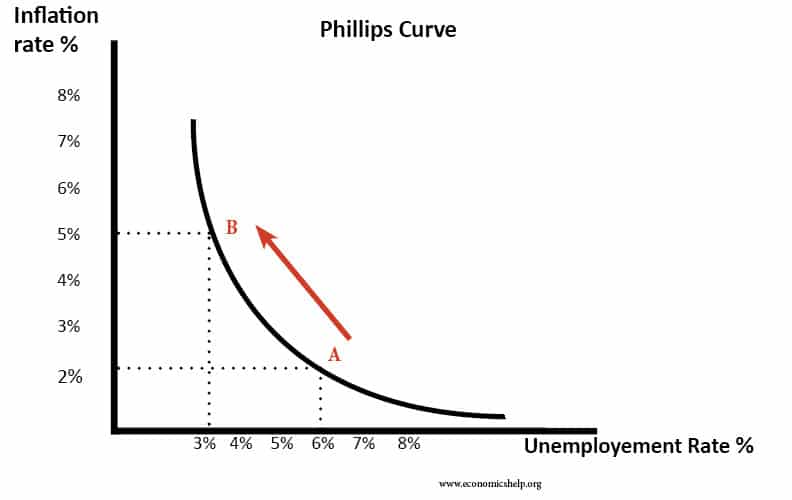
If  you take the 1950s and 60s you could argue there was a trade off between unemployment and inflation.

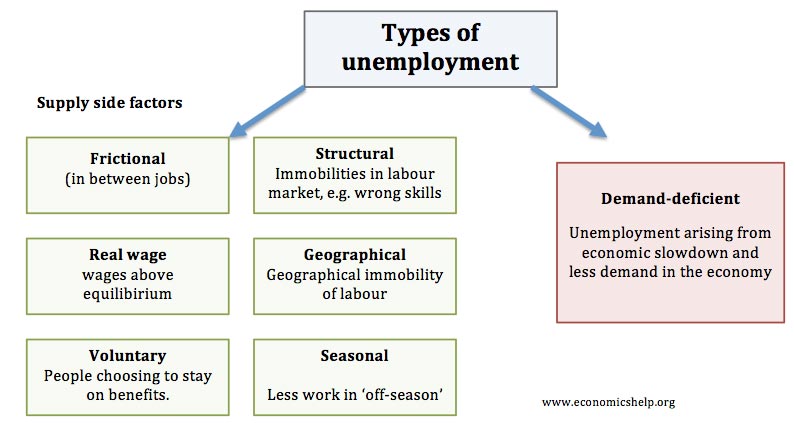
As AD increased, it caused higher output, this lead to inflation as the economy came close to full employment. However, as output increased unemployment (demand deficient unemployment) fell.

Increase In AD causing Inflation Diagram

This Keynesian view of the AS curve suggests there can be a trade off between inflation and demand deficient unemployment.

However, this view is criticised by the Monetarist view, which argues increased AD only causes inflation and no increase in Real GDP in the Long term.

Continue reading →

Unemployment Levels and Inflation

Readers Question “To what extent can government use demand management policies to reduce unemployment without affecting inflation?” (60)

1. Monetary and fiscal policy can be used to increase AD and therefore increase economic growth. For example, if the MPC cut interest rates, this makes borrowing cheaper and therefore encourages investment and consumption. This will cause a rise in AD. If there is spare capacity in the economy then there will be an increase in Real Output; as firms produce more they will demand more workers and this will reduce demand deficient unemployment.

Continue reading →

Supply Side Policies for Reducing Unemployment

a)An explanation of supply-side economics.

Supply side policies are government attempts to improve productivity and efficiency in the economy.
See: Supply side policies

b)The remedies supply-side economists put forward to reduce unemployment.

  1. Better job information to help reduce frictional unemployment.
  2. Lower unemployment benefits to increase the incentive to get a job. It is argued generous unemployment benefits create an unemployment trap, where those on benefits would not get any extra income after tax if they decided to work.
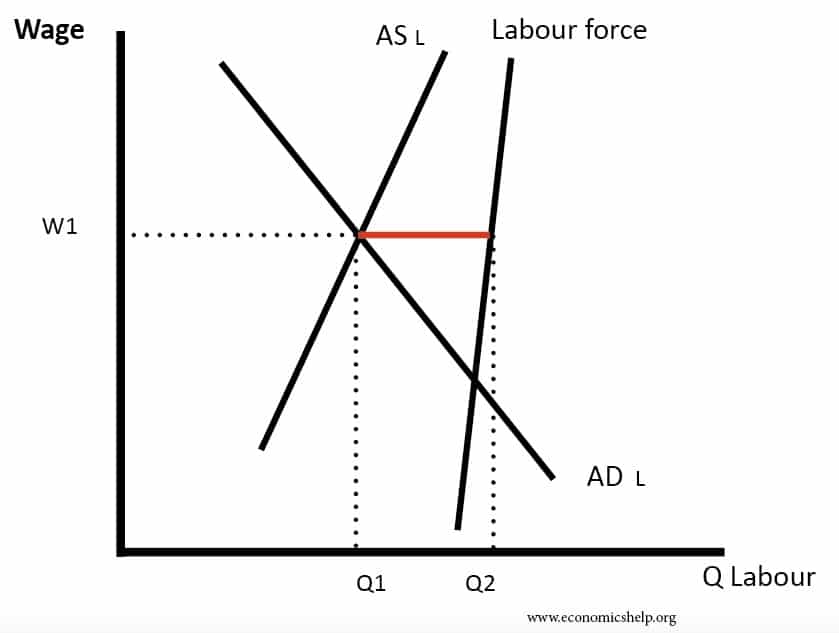
  3. Reduced Power of Trades Unions. Trades unions can cause real wage / classical unemployment. If you reduce the power of unions, wages will fall to equilibrium levels leading to less unemployment. Also reducing minimum wages
  4. Increased labour market flexibility. eg. make it easier to hire and fire workers; this should encourage firms to set up and hire workers.
  5. Better education and training.

See also: supply side policies and reducing unemployment

The Rate of Unemployment Benefits

Readers Question. Explain the benefits of increasing the rate of unemployment benefit for 1.the unemployed, 2. society. Identify and costs that may result from such a policy.

Benefits of Increasing Unemployment benefits

  1. Provides more income, reducing relative poverty and improving living standards.
  2. Gives them support in finding the best job. If benefits are low, then they will be forced to get the quickest job they can find. But, this may not be suitable for their skills. Higher benefits enable the unemployed to take more time and find a job which matches their skills. This is also a benefit for society. For example, if someone leaves university, with a degree in astrophysics, we don’t want them working in McDonalds because unemployment benefits are too low to support their job search on leaving university. Basically, frictional unemployment is not a bad thing; sometimes it takes time to find the right job.
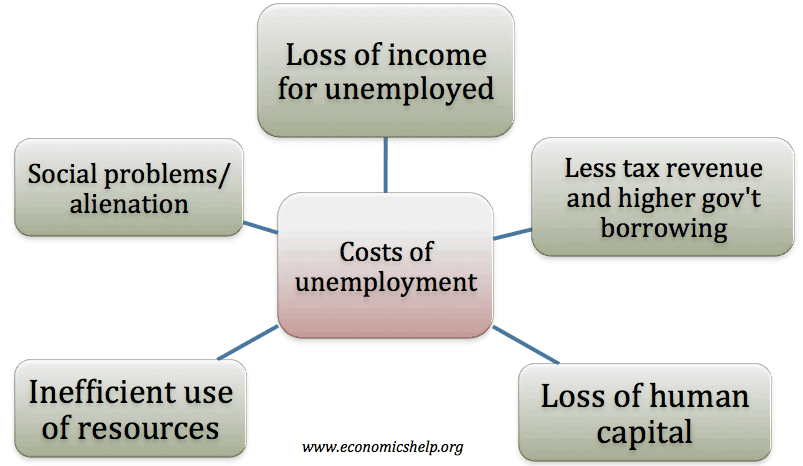
  3. Low Unemployment benefits could fuel social unrest and encourage the unemployed to resort to crime to supplement their income. Unemployment is often associated with a feeling of social alienation leading to riots such as Brixton 1981 and Paris in 2006. Continue reading →

Disadvantages of Full Employment Definitions

explain 3 different ways in which full employment can occur and identify any disadvantages of each?

In previous post I identified 4 different way to define full employment

Optimal Level of Unemployment

Rather abitary; there could be disagreement on what constitutes the ‘optimal level of unemployment’. For example, how much frictional unemployment is necessary in a modern economy.

Continue reading →

Definition of Full Employment

Readers Question: explain how economists define ‘full employment’?

The first definition of full employment would be the situation where everyone willing to work at the going wage rate is able to get a job.

This would imply that unemployment is zero because if you are not willing to work then you should not be counted as unemployed. To be classified as unemployed you would need to be actively seeking work. This does not mean everyone of working age is in employment. Some adults may leave the labour force, for example, women looking after children.

Optimal Unemployment Level

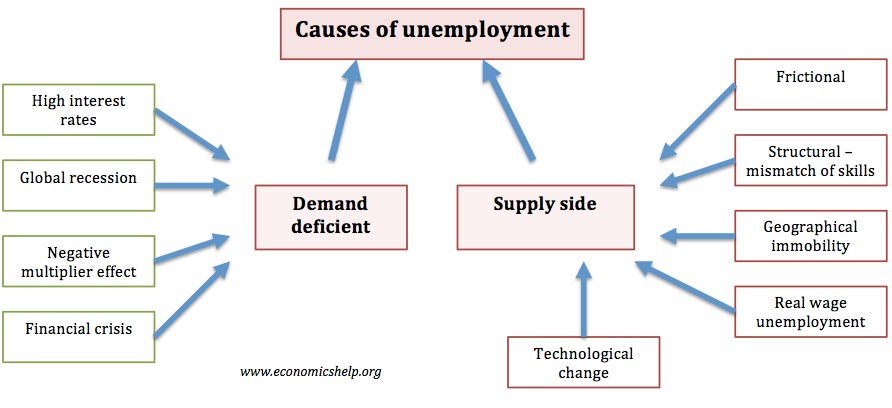
Another definition of full employment would be the ‘optimal’ level of unemployment. In practise, an economy will never have zero unemployment because there is inevitably some frictional unemployment. This is the unemployment where people take time to find the best job for them. Frictional unemployment is not necessarily a bad thing. It is better people take time to find a job suitable for their skill level, rather than get the first job that comes along.

Full Employment and Full Capacity.

Another way to think of full employment is when the economy is operating at an Output level considered to be at full capacity. i.e. it is not possible to increase real output because all resources are full utilised. This would be a point on a Production possibility frontier. It can also be shown by AD/AS diagram.

Continue reading →

Reducing Natural Rate of Unemployment

Readers Question: What is the difference between reducing the rate of unemployment below the natural rate and reducing the natural rate of unemployment? Are the government fiscal policies the same?

The natural rate of unemployment is the unemployment which occurs when the labour market is in equilibrium. It is supply side unemployment, such as frictional and structural unemployment. (see: natural rate of unemployment)

If you reduce unemployment below the natural rate, you risk inflation occuring. This is because to reduce the rate of unemployment below the natural rate of unemployment requires an increase in Demand and economic growth.

Monetarist view of Natural Rate.

Monetarists use a slightly different concept called the NAIRU. Non accelerating inflation rate of unemployment. They argue that reducing unemployment below the NAIRU will only cause inflation and the fall in unemployment will be temporary. Therefore, to keep unemployment below this natural rate requires an ever increasing rate of inflation. Continue reading →

Disguised Unemployment

Readers Question: what is the difference between disguised unemployment and involuntary unemployment

Definition of disguised unemployment. This is when people do not have full time employment, but are not counted in the official unemployment statistics. This may include:

  • People on sickness / disability benefits (but, would be able to do some jobs)
  • People doing part time work.
  • People forced to take early retirement and redunancy
  • Disguised unemployment could also include people doing jobs that are completely unproductive, i.e. they get paid but they don’t have a job.
  • See: The true level of unemployment

Definition of Involuntary Unemployment

This is when people are unable to work because there are insufficient jobs available in an economy. For example, during a great depression. Classical economists argue unemployment is voluntary ‘ie. wages are too high’ but involuntary unemployment says that people are unemployed for a lack of aggregate demand. Keynes argued a cut in wages would not solve unemployment because it would only reduce AD further.

Involuntary unemployment would be measured by government statistics. E.g. in the 1930s, unemployment rose to 25% in the UK. This was involuntary unemployment.

Note: the definition is somewhat disputed

Unemployment Spain – How to Reduce

Readers Question: how we can reduce the unemployment (with implication ) in short run and long run and try to give some lively examples except of uk :)

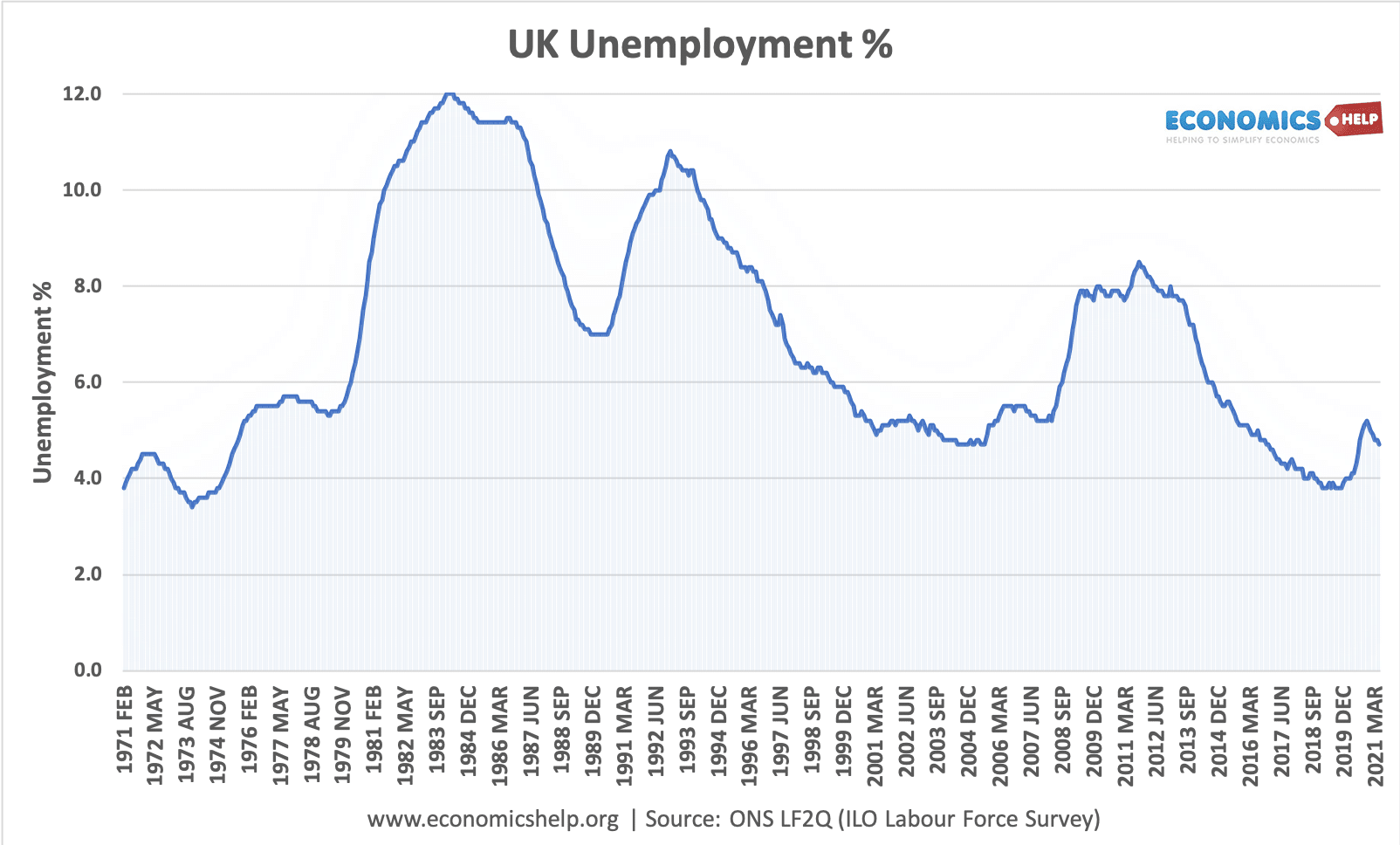
The Unemployment rate in the UK is currently quite low about 4.5%. Therefore, it is difficult for the government to significantly reduce this. Alot of the unemployment is frictional. Therefore let us think about reducing unemployment in Spain, where the unemployment rate is currently 8.7% (Dec 2007)

Spanish Unemployment has also risen in the last two months, due to fall in the construction industry.

Policies to Reduce Unemployment in Spain

1. Boost Aggregate Demand. The government could use reflationary fiscal policy to try and increase AD. For example, the government could cut taxes and increase Spending; this would increase AD and lead to higher growth. As growth increases firms would demand more workers.

However,

  • Could cause inflation. Growth in 2007 was 3.8%. This suggests alot of the unemployment is supply side.
  • Government debt in Spain is already very high. Therefore, in the long term expansionary fiscal policy would make the government debt worse, possibly contributing to crowding out and higher interest rates
  • Continue reading →