
A list of different types of economic goods.
Income elasticity of demand and types of goods
Income elasticity of demand (YED) measures the responsiveness of demand to a change in income.
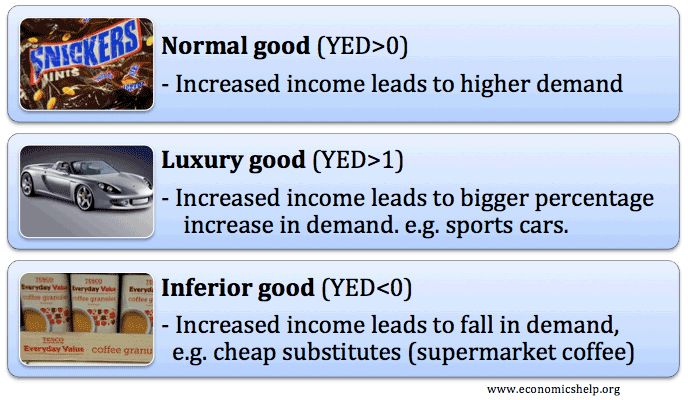
Normal good
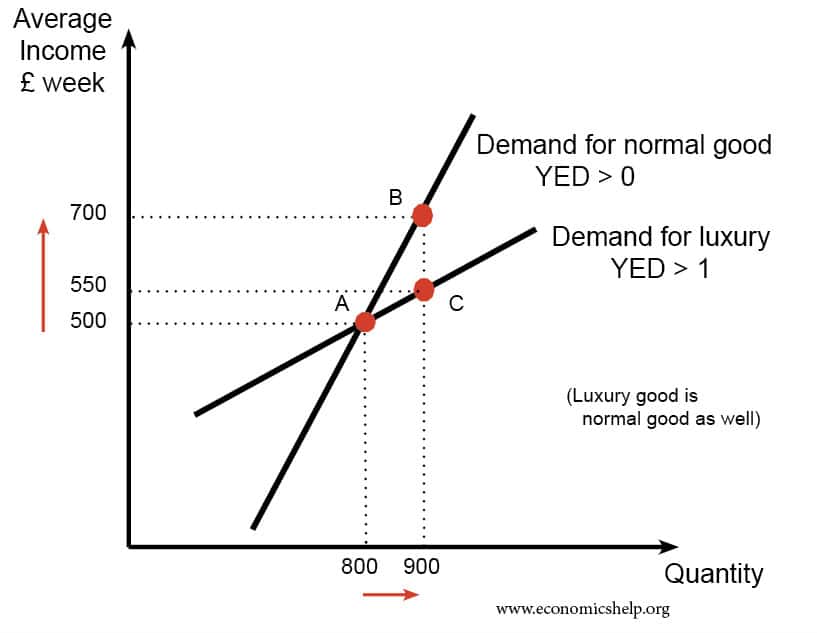
- A normal good means an increase in income causes an increase in demand. It has a positive income elasticity of demand YED. Note a normal good can be income elastic or income inelastic.
Luxury good
A luxury good means an increase in income causes a bigger percentage increase in demand. It means that the income elasticity of demand is greater than one. For example, HD TV’s would be a luxury good. When income rises, people spend a higher percentage of their income on the luxury good.
YED calculations
- In the above example of a luxury good, income rises (500-550) 10%, demand rises 100/800 – 12.5% YED = 12.5/10 = 1.125
- In the above example of a normal good, income rises (500-700) 40%, demand rises 100/800 – 12.5% YED – 12.5/40 = 0.3125
Note: a luxury good is also a normal good, but a normal good isn’t necessarily a luxury good.
Inferior good
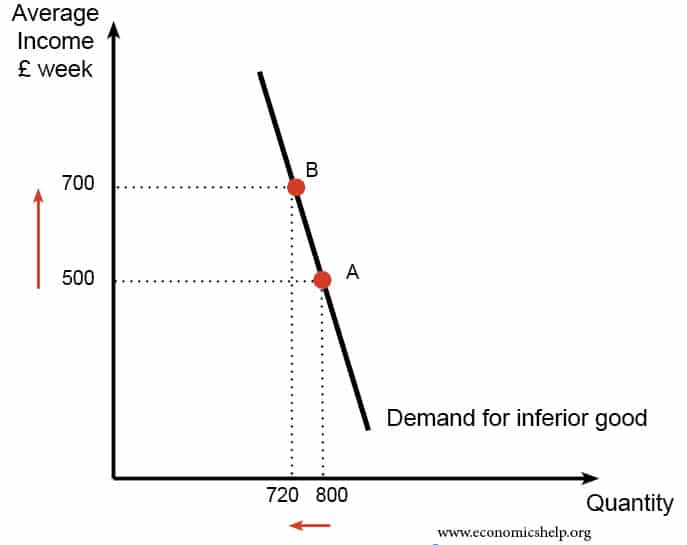
An inferior good means an increase in income causes a fall in demand. It is a good with a negative income elasticity of demand (YED). An example of an inferior good is Tesco value bread. When your income rises you buy less Tesco value bread and more high quality, organic bread.
Examples of different types of good
- Luxury good – Superfast broadband, organic luxury coffee, Netflix tv, Porsche, a foreign holiday to Bali
- Normal good – ordinary broadband, ordinary tv license, Ford Focus car, holiday to somewhere close to where you live
- Inferior good – Supermarket own brand coffee, bus travel, a day out at theme park.
Other types of goods
- Necessity good – something needed for basic human existence, e.g. food, water, housing, electricity. Though this becomes a subjective term, is electricity a necessity? Is broadband internet a necessity?
- Comfort good – a good which isn’t a necessity, but gives enjoyment/utility, e.g. subscription to netflix or take-away food. A comfort good may become a luxury.
- Complementary Goods. Goods which are used together, e.g. TV and DVD player. see: Complementary goods
- Substitute goods. Goods which are alternatives, e.g. Pepsi and Coca-cola. See Substitute goods.
- Giffen good. A rare type of good, where an increase in price causes an increase in demand. The reason is that the income effect of a rise in the price causes you to buy more of this cheap good because you can’t afford more expensive goods. For example, if the price of wheat rises, a poor peasant may not be able to afford meat anymore, so has to buy more wheat. See: Giffen goods
- Possible examples of Giffen good – rice, potatoes, bread.
- Veblen / Snob good. A good where an increase in price encourages people to buy more of it. This is because they think more expensive goods are better. See: Veblen good
- Example of Veblen / Snob good – some forms of art, designer clothes.
Market Failure
- Public goods – goods with characteristics of non-rivalry and non-excludability, e.g. national defence. See: Public Goods
- Quasi-public good – goods which have some of the characteristics of non-rivalry and non-excludability, but not 100%. For example, interest is mostly very cheap to access. Once provided, you can access most website – though some websites may charge to view (e.g. newspapers).
- Merit goods. Goods which people may underestimate benefits of. Also often has positive externalities, e.g. education. See: Merit goods
- Demerit goods. Goods where people may underestimate the costs of consuming it. Often has negative externalities, e.g. smoking, drugs. See: Demerit goods
- Private goods – goods which do have rivalry and excludability. The opposite of a public good See: private goods
- Free goods – A good with no opportunity cost, e.g. breathing air. See: Free good
Related
hello, may i ask what type of good or services is the internet?
Quasi-public good
Your explanation of quasi-public goods is not certained as such
What type of good would people say university accommodation is?
Believe its a private good
subtitute
Necessity good or luxurious good.. I think
Goals and beliefs give people lasting motivation
help full thanks
All luxury goods are normal goods, but not all normal goods are luxury goods why?
Thank you so much but on complimentary goods I would think it would have been better to start with a DVD and a TV than a TV and a DVD
is rice Giffen good?
That is good
What type of good would gambling come under?
Demerit good?
Assuming closeup and perpsodent are substitute good, what happens to closeup when prise of perpsodent increase in terms of demand?