
Readers Question: Discuss whether a widespread shortage of labour might be a major cause of inflation.
Often a shortage of labour causes inflationary pressure. If firms are struggling to employ sufficient labour, workers are in a position to demand higher wages. This can easily lead to wage inflation which causes inflation.
Micro-theory of labour shortages on wages

Why rising wages cause inflation
- If wages rise, firms will try to pass on the cost increases to customers – leading to cost-push inflation.
- If wages rise, workers have an increase in income – leading to higher disposable income and higher spending – this can cause demand-pull inflation.
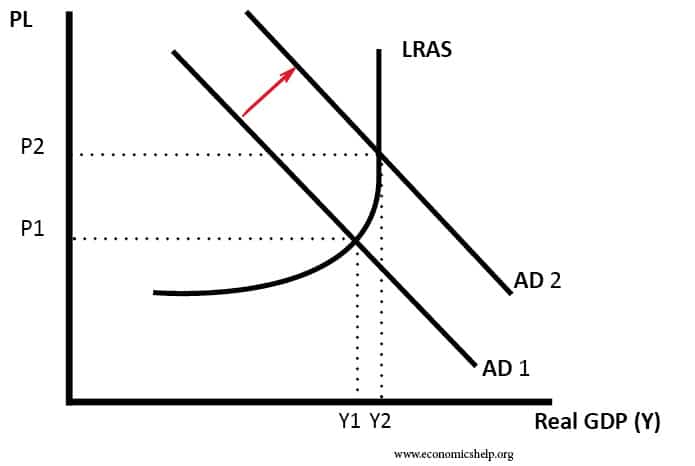
Demand-pull inflation can be caused by rising wages.
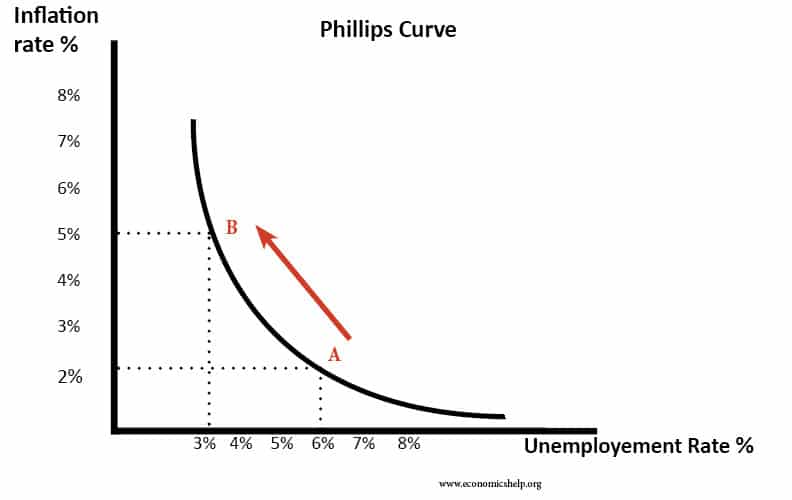
The Phillips Curve suggests a trade off between falling unemployment and rising inflation
Do labour shortages always cause rising rate of inflation?
However, it is possible that, even with a shortage of labour, we may avoid inflation.
- If firms have monopsony power and can avoid paying higher wages despite the shortage
- If vacancies are being filled by migrants from abroad. (Though you could say if migrants can enter the labour market then there isn’t a shortage, but, in the boom years of 2003-07, migrant labour was important for keeping inflationary pressures low in economies like Ireland and UK.
- If other inflationary pressures are muted. A shortage of labour puts upward pressure on wage increases, but, other factors affect inflation. If interest rates are being increased and the economy is experiencing efficiency savings, overall inflation may not be affected very much.
- Raising pay is only one possible response to labour shortages. Rather than put up wages, firms can respond by leaving positions unfilled, trying to retrain current workers or investing in increased automation. If product markets are competitive, then firms may seek ways to avoid raising wages.
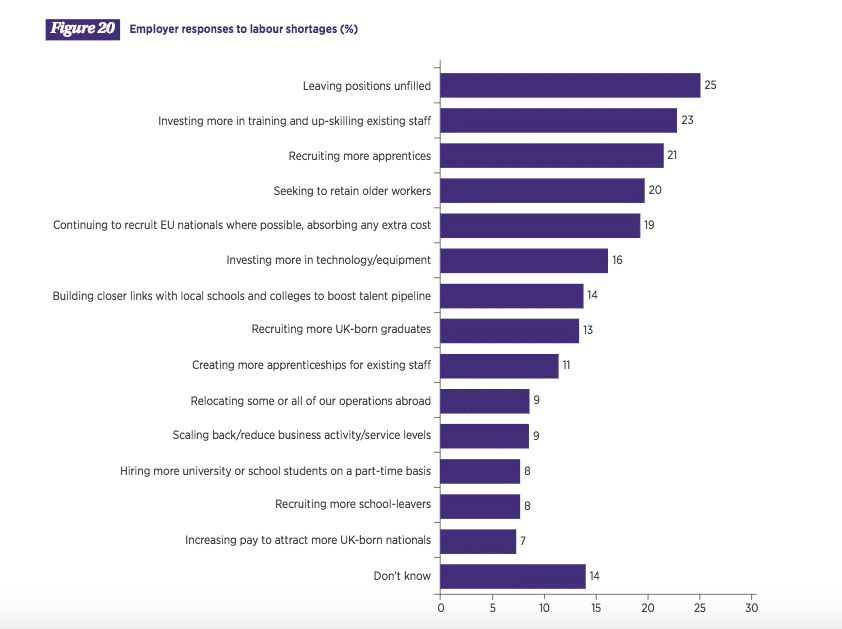
Empirical evidence
- Between 2012 and 2017, the UK saw a fall in unemployment, but real wage growth remained weak. See – UK unemployment mystery.
Related
- Microeconomic impact of labour shortages
- Phillips Curve and Inflation. The Phillips curve suggests that as unemployment falls, inflation rises. However, in the 2000s, we had a fall in unemployment without inflationary pressures. Part of this was due to the fact falling unemployment reflected a fall in the natural rate of unemployment.
- Discuss whether the Phillips curve is irrelevant in explaining relationship between unemployment and inflation
Labour shortages are absolutely fundamental to inflation in the sense that near full employment, firms are short of LABOUR rather than anything else e.g. materials or capital equipment. For example when unemployment declines from a moderately disastrous level (say 10%) to about the lowest it can go (say 3%), there is NOT a dramatic rise in firms which are constrained by lack of CAPITAL EQUIPMENT.
Failure to appreciate this fundamental point can lead to mistakes. For example it is claimed above that inflation can be avoided if employers have monopsony powers. It is very unrealistic to suppose that a significant proportion of employers do have these powers, but let’s say they do, because this gives rise to an interesting theoretical question, as follows.
Say in an economy consisting purely of “monopsony firms”, demand is so high, that these firms cannot meet the demand. What happens? Either prices rise. Or given the abundance of excess demand sloshing around, new firms enter the market, and the monopsonists lose their quasi-monopoly powers. What other possibilities are there?