
Definition – Cyclical Unemployment is unemployment due to a period of negative economic growth, or economic slowdown. In a recession, cyclical unemployment will tend to rise sharply.
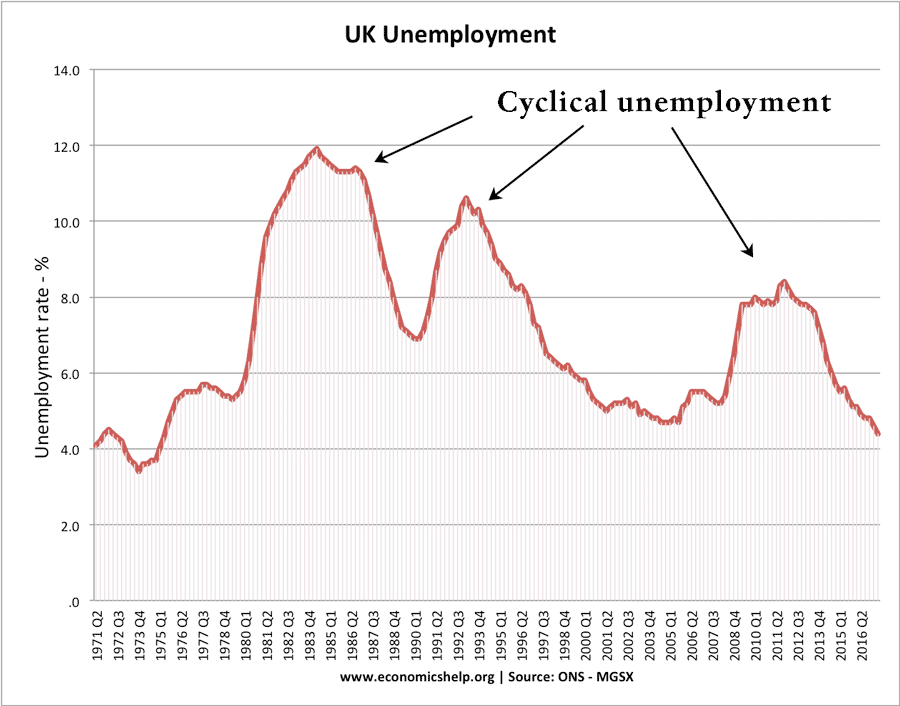
Peaks in unemployment correspond with swings in the economic cycle.
Recessions of 1981,1991/92 and 2008/09
Why unemployment rises in a recession
- If there are fewer orders for goods, firms produce less and therefore there is less demand for workers.
- Negative multiplier effects. If firms are producing less, then there will be less demand for related industries, such as transport – and demand for lorry drivers.
- Firms will try to cut costs to stay afloat during the period of negative growth, therefore, they will cut back on employing new staff – to try and reduce the wage bill.
- In an economic downturn, some firms will go out of business and workers will lose their jobs.
Similarly, when the economy recovers and starts to grow again, firms will begin to rehire workers and cyclical unemployment will fall.
Hysteresis effects
Cyclical unemployment can cause a rise in the natural rate of unemployment. If young people are out of work for a long time in a recession, it can be difficult to get back into employment because of lack of job experience and decline in motivation. This is known as the hysteresis theory. It occurred after the 1981 recession – unemployment took a while to reduce. However, it was less in evidence after the 2009/10 recession.
Cyclical Unemployment in US
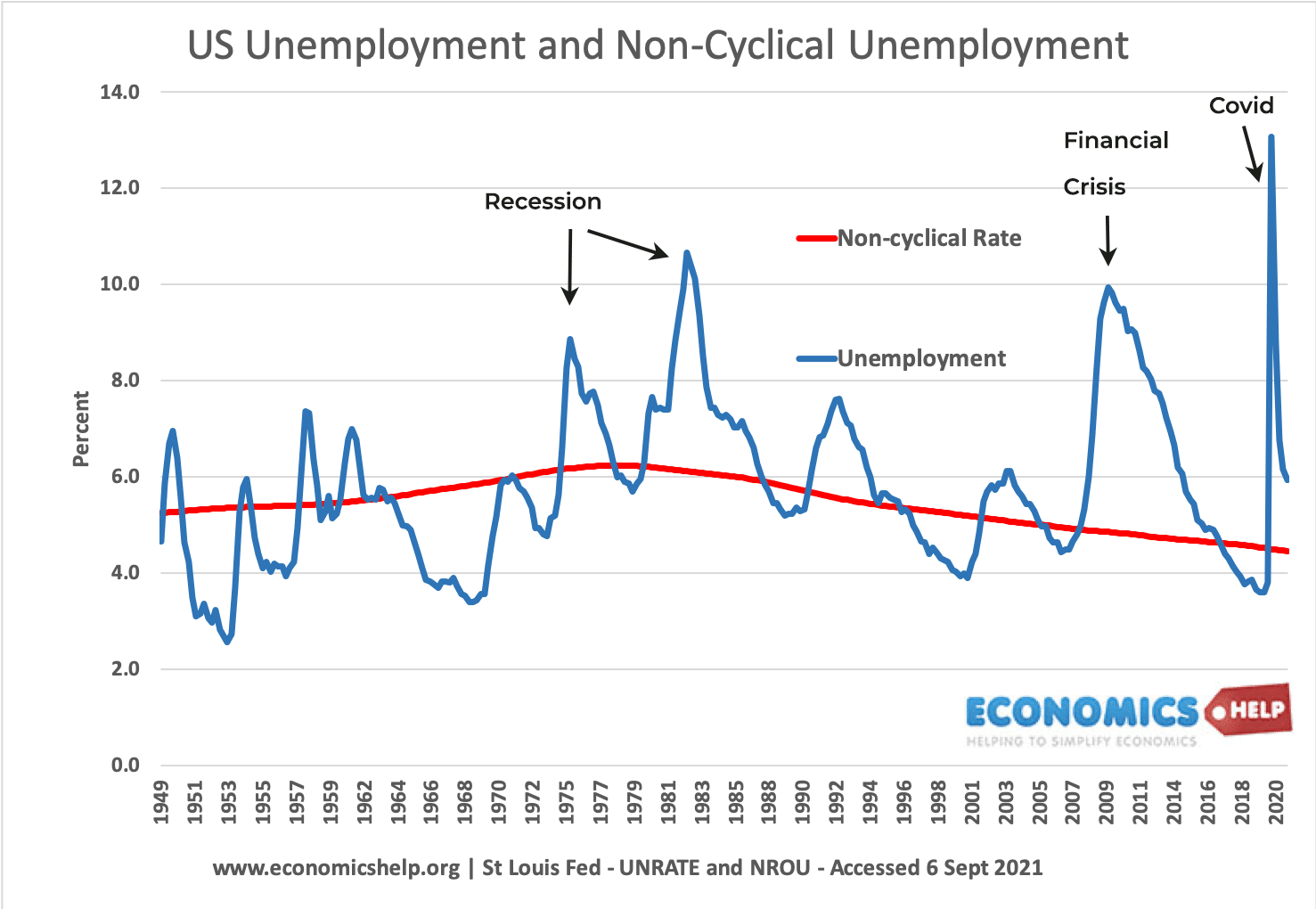
Unemployment in US increased after the 1981/82 economic downturn and sharply following the recession of 2008.
The red line is the non-cyclical unemployment – unemployment due to structural factors.
The difference between the natural rate of unemployment and cyclical unemployment
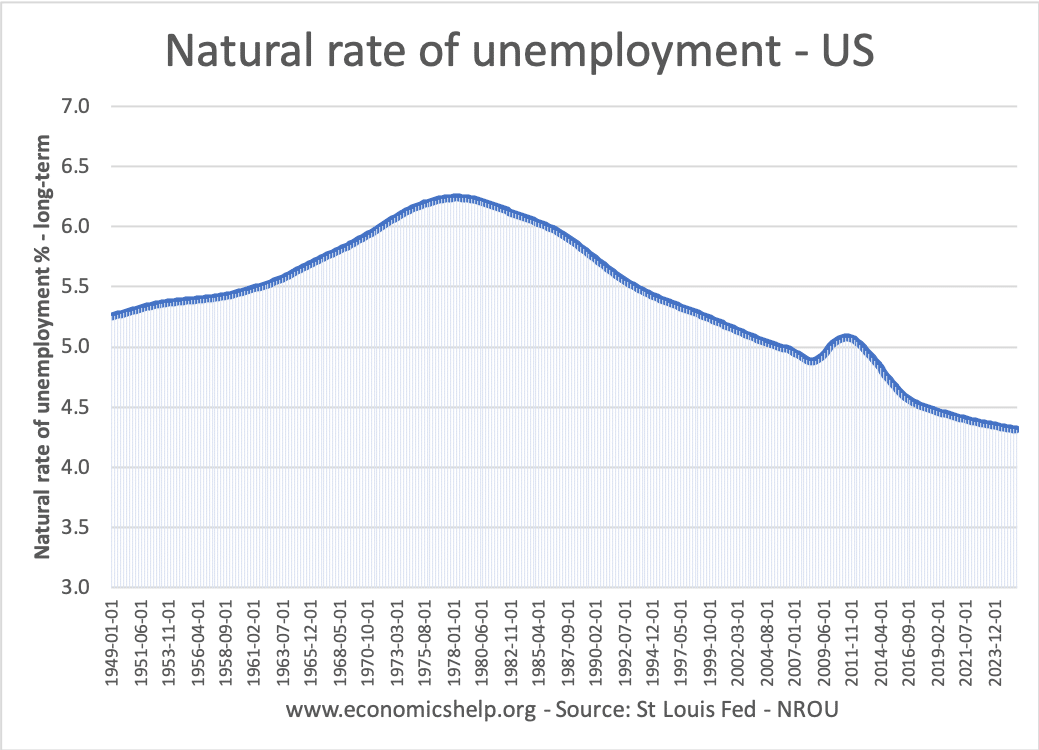
The natural rate of unemployment measures the unemployment when the labour market is in equilibrium. It is composed of supply-side unemployment such as frictional and structural unemployment.
For example, even when the economy is at full capacity / full employment, people may be unemployed because they lack the necessary skills to get a job. Also, even at full employment, there will always be some people in between jobs (frictional unemployment)
In the above graph of UK unemployment, unemployment rises in a recession, but even in periods of growth – e.g. late 1980s, unemployment still exists – suggesting that there is structural unemployment.
Related
This post falls short of your usual high standards.
1. The second para above seems to suggest that being “between jobs” is a fundamental explanation of some unemployment. I don’t agree (if this is the suggestion). A study done in the US showed that the majority of people changing jobs go straight from one job to the next. (See J.P.Mattila, 1974, “Job Quitting and Frictional Unemployment”, American Economic Review.)
I.e. the fundamental explanation for the fact that some people fail to go straight from one job to the next is labour market inefficiencies. Put another way, the “unemployed between jobs” phenomenon is an EFFECT. The CAUSE is labour market inefficiencies.
2. “Cyclical unemployment due to negative economic growth”????? Wouldnt it be more accurate to say that cyclical unemployment is due to cycles, i.e. the fact that market economies are not stable systems. Many complex systems (including electronic and mechanical systems) are not stable. For example, when I was young, the governors on lorry and coach diesel engines were not stable systems: when left to idle, these engines almost invariably speeded up and slowed down in a cycle that lasted a couple of seconds.
Also “negative growth” is not necessary to bring about cyclical unemployment: actual economic growth falling behind potential economic growth (e.g. due to improved technology) could bring cyclical unemployment.
3. Re the final para (hysteresis), there is a fair bit of disagreement on this one. Some researchers claim that unemployment does NOT cause unemployment.
Could you be a bit more specific than “some researchers”?
Do you have a particular piece of research that proves this?
And surely it depends on the type of economy. I.e an economy like Germany’s where a high percentage of their workforce works in manufacturing will be less susceptible to hysteresis than one like the UK because working machinery of a factory floor requires less skill than working in a more technical profession such as banking or teaching and therefore if you take 10 years out from working on a factory floor you will need a small amount of training to deal with updated machinery but if you did the same with teaching or banking you would need a great deal more to learn whole new syllabuses/learn to use completely different financial models etc.
And surely it also depends on the level of investment within the economy, as if there has been no induced investment over the 10 years then the machinery you go back to using will be the same, whereas if there has been a great deal it certainly won’t.
So saying “unemployment does not cause umemployment” is not actually correct.
Rowan: I’m sure “unemployment DOES cause unemployment to a finite extent, but I’ve got doubts about just how serious a problem this is.
Two bits of research casting doubt on the seriousness of hystersis: 1. Webster, D. (2003) Long Term Unemployment, The Invention of
“Hysteresis” and the Misdiagnosis of the UK’s Problem of Structural Unemployment
http://www.econ.cam.ac.uk/cjeconf/delegates/webster.pdf
2. Goldstein, H., Knut, R. and Oddbjorn, R. (1999) “Does
Unemployment cause Unemployment?” Applied Economics Vol 31 No 10 pp 1207 – 18.
Also if it is difficult for those who have been unemployed for two years to get back into work, how come people who have NEVER been in work manage to get work: school leavers and students. And then there are women who leave the world of work to have kids – they manage to get back in if they want: obviously at a reduced skill and pay level, but plenty of them manage it.