
Flexible labour markets involve a minimum of government regulations. Flexible labour markets imply that wages and conditions are determined by market forces and not governments or trades unions. Flexible labour markets have the following features:
- Easier to hire and fire workers
- Limited, if any, regulations
- Downward pressure on wages
- Greater variety of job contracts, e.g. temporary, part-time, several small jobs “The gig economy“
Disadvantages of flexible labour markets
- Lack of training. Part-time and temporary staff may not get sufficient training from firms because they only have short-term contracts. A firm has less incentive to develop their worker’s human capital if they are only short-term. Therefore many low skilled workers will remain under-skilled because they never gain job stability and the training this encourages
- Lower productivity. Due to less investment in workers, it can adversely affect labour productivity – a key determinant of long-term economic growth.
- Flexible labour markets create greater job insecurity and stress. Job security is often as important to workers as the level of wages. This insecurity could lead to lower morale and lower productivity for the firm in the long-run
- Rising inequality. Non-unionised part-time workers get smaller pay increases. Arguably flexible labour markets have created a bigger gap between those ‘insiders’ with secure job contracts, and those ‘outsiders’ without job contracts.
- Higher search costs for workers needing to find new jobs. Also, firms may have higher replacement costs for hiring more workers. Firms may end up paying a premium to employment agencies to help fill gaps in their workforce.
Advantages of Flexible Labour Markets
- Firms will be more efficient and competitive. Flexible labour markets help keep costs down for firms. For example, firms can get rid of surplus workers. This may help prevent the firm go bankrupt and protect jobs in the long term. Arguably with globalisation, it is increasingly important for firms to remain competitive within the global economy.
- Increased trade. With lower labour costs, there could be an increase in output and exports. There could be a lower rate of natural unemployment and lower inflation.
- Greater choice. Many workers will prefer flexible employment patterns because it suits their lifestyle and offers a greater range of choice.
- Increased labour market participation rates. Flexible labour markets have played a role in increasing female participation rates.
- May encourage inward investment. Multinational firms may be attracted to invest in countries with more flexible labour markets, creating jobs in the first place.
- Lower rates of structural unemployment. Arguably countries with restrictive labour market practices, such as France and Spain have experienced higher rates of structural unemployment. The UK and US with more flexible labour markets have experienced a lower natural rate of unemployment.
- Stabilises economic cycle. In boom times, a flexible labour market can be responsive to demand labour (e.g. increased net migration). In bust periods, net migration falls, limiting the rise in unemployment.
Case study UK since 1979
Since 1979, the UK has seen increased labour market flexibility. This has included:
Fall in trade union membership
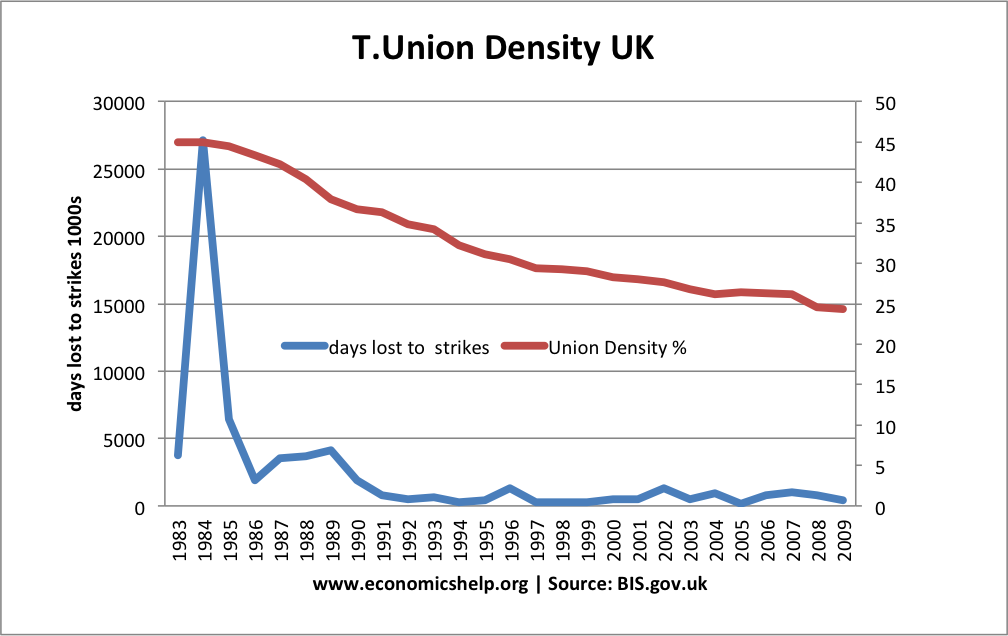
Growth in self-employment
Growth in zero-hour contracts

Increase in part-time contracts
Reduced regulation on hiring and firing workers.
In recent decades the UK labour market has been characterised by
- Unexpectedly low unemployment. Unemployment has fallen faster – despite relatively weak economic recovery
- Poor productivity growth – Workers keener to employ workers but pay lower wage and less investment
- Low real wage growth.
- Increased inequality.
Related