
Monopoly Graph
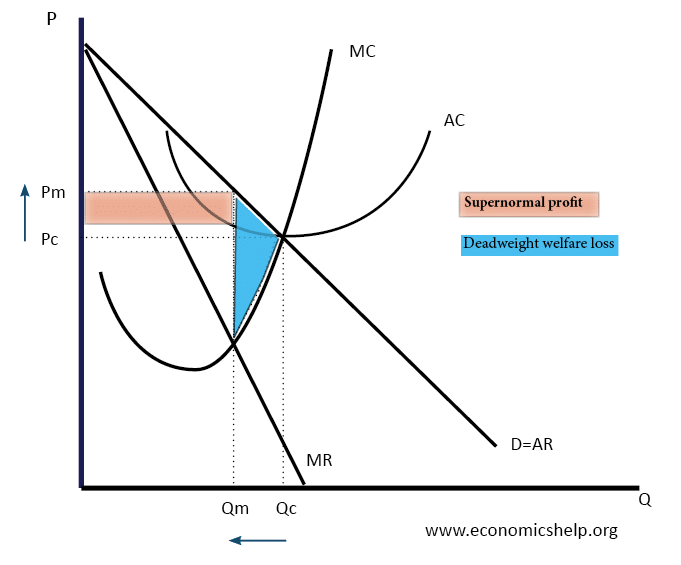
- A monopolist will seek to maximise profits by setting output where MR = MC
- This will be at output Qm and Price Pm.
- Compared to a competitive market, the monopolist increases price and reduces output
- Red area = Supernormal Profit (AR-AC) * Q
- Blue area = Deadweight welfare loss (combined loss of producer and consumer surplus) compared to a competitive market
Disadvantages of a Monopoly
- Higher prices Higher price and lower output than under perfect competition. This leads to a decline in consumer surplus and a deadweight welfare loss
- Allocative inefficiency. A monopoly is allocatively inefficient because in monopoly the price is greater than MC. P > MC. In a competitive market, the price would be lower and more consumers would benefit
- Productive inefficiency. A monopoly is productively inefficient because it is not the lowest point on the AC curve.
- X – Inefficiency. It is argued that a monopoly has less incentive to cut costs because it doesn’t face competition from other firms. Therefore the AC curve is higher than it should be.
- Supernormal Profit. A monopolist makes supernormal profit Qm * (AR – AC ) leading to an unequal distribution of income.
- Higher prices to suppliers – A monopoly may use its market power and pay lower prices to its suppliers. E.g. Supermarkets have been criticised for paying low prices to farmers.
- Diseconomies of scale – It is possible that if a monopoly gets too big, it may experience diseconomies of scale. – higher average costs because it gets too big
- Worse products. Lack of competition may also lead to improved product innovation.
- Charge higher prices to suppliers. Monopolies may use their supernormal profits and monopsony power to pay lower prices to suppliers. For example, supermarkets squeezing prices paid to farmers.
Advantages of monopoly
- Economies of scale
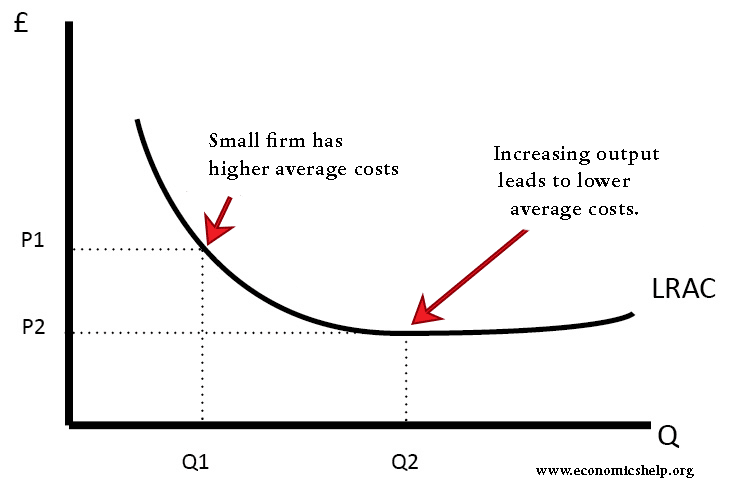
If a firm is in a competitive market and produces at Q2, its average costs will be AC2. A monopoly can increase output to Q1 and benefit from lower long-run average costs (AC1). In industries with high fixed costs, it can be more efficient to have a monopoly than several small firms.

2. Research and development
The supernormal profit can enable more investment in research and development, leading to better products.
3. Good quality firm
A firm may gain monopoly power because it is very innovative and successful, e.g. Google, Amazon, Apple. Therefore, monopoly does not always lead to inefficiency.
Blog Entry