
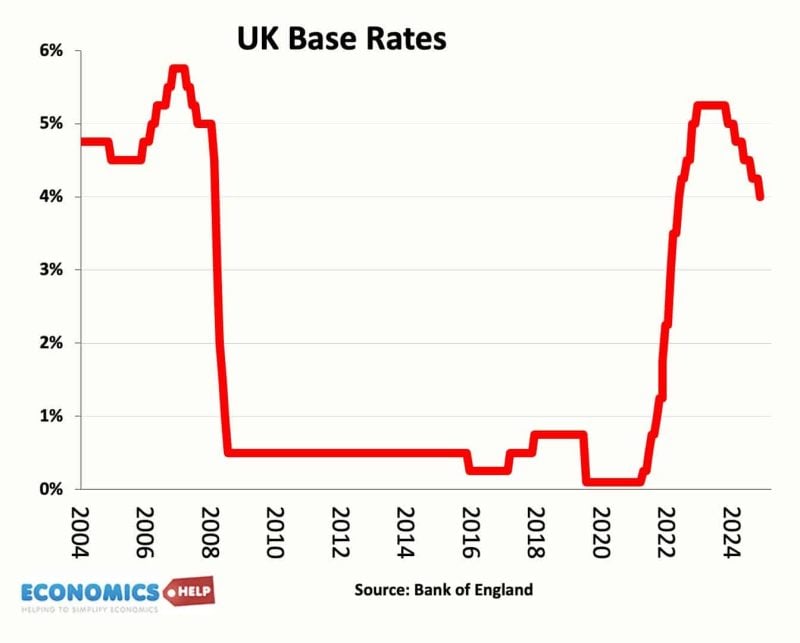
At yesterdays meeting the Bank of England were split 5-4 on cutting interest rates by a quarter of a percent. On the one hand the economy is slowing, unemployment ticking up, spare capacity rising. On the other hand, inflation is proving more stubborn than past predictions.

It makes the UK really something of an international outlier, the Eurozone has reduced inflation to 2%. Only the US has inflation above 2%, and the US have a self-inflicted tariff impact.
For much of the 2010s, the UK had negative real interest rates. Interest rates less than inflation. But, in the last year, the UK had the biggest gap between nominal interest rates and inflation since 2007. But, you can see the recent uptick in inflation is leaving the Bank again facing the prospect of getting close to negative interest rates. No wonder there were grim noises about limited scope for future cuts. It again leaves the UK something of an outlier, with interest rates higher than most other advanced economies. And if President Trump gets his way, US interest rates will soon be slashed.
Why Inflation is Higher
It raises the uncomfortable question of why inflation has been persistently higher in the UK than in European countries like France and Germany.

The Bank have long predicted a spike in inflation which will dissipate, but this spike has proved more long-lasting than expected. The deputy governor remarked this week “The nature of the persistence of inflation has surprised me.”. Usually, with slowing economic growth you would expect inflation to be muted. But, there are several factors pushing up UK inflation. Firstly, there are cyclical factors such as higher food prices, with items like coffee and chocolate surging in price, the biggest driver of food inflation in the UK has actually been a rise in meat prices, with deadweight beef prices rising 40% – an effect of falling UK cattle numbers. The post-Brexit trade arrangements have also not helped with food costs.
Also, there has been large increases in utility bills, energy and water which are responsible for nearly 50% of the excess inflation. But, the problem is that as inflation persists, the bank fear it leads into a self-reinforcing cycle of rising inflation expectations. In particular, workers seek higher wages, and relatively strong wage growth has been a factor behind service sector inflation. Secondly, government fiscal policy has also worked against inflation. The rise in NI costs for firms has mostly been passed onto consumers, with industries with many low-paid workers like bars and supermarkets, passing on higher prices. If you include housing costs, CPIH is even higher at 4.1% and this doesn’t even include the full cost of renting, which has increased in recent years by more than inflation.
Limitations of Monetary Policy
An interesting question is given economic difficulties, what can monetary policy actually do to solve the twin conflicting problems of inflation and low growth? The only way higher interest rates help reduce inflation is by slowing demand and slowing economic growth even more. Higher rates make borrowers worse off, reducing investment and leaving households with less disposable income. By, reducing demand, there is more slack in the economy and this creates downward pressure on wages and prices. But, when the economy already has slack and a weakening labour market, this approach has very much diminishing returns, plus of course unwelcome side effects. In short, if the problem is the supply side of the economy, you can’t fix it by reducing demand.
Equally, if you forsook the inflation target as something misleading and not worth bothering about, what would be the effect of a large cut in interest rates to European levels of 2%? Well certainly householders with mortgages would be better off, and probably increase spending higher spending and stronger growth could even start to crowd in investment and encourage more homebuilding. In theory, a growing economy is more likely to see investment and productivity growth, which is what the economy really needs.
Interest Rates of 2%
But, the problem with cutting interest rates is that. Firstly, the impact would be limited. In the 1990s, 40% of homeowners had a mortgage, nearly all variable mortgages, so changing interest rates had a big effect on the economy. Now, fewer households have a mortgage, and they are more likely to have a fixed rate. So cutting interest rates would only have a small belated effect on influencing the buying power of a small number of households. Also, lower interest rates would lead to lower saving returns of the growing number of households who own property outright and live on saving incomes. In recent years, the UK has actually seen large growth in the savings ratio, partly due to an ageing population, partly due to pessimism about the economy. The point is that cutting interest rates may be good for firms borrowing for investment and those households with variable mortgages, but it will make net savers worse off. So there isn’t a straight forward transmission mechanism like in the past.
More than Demand
But, again the bigger point is that the fundamental weakness of the UK economy can not be boiled down to just insufficient demand.

Even though growth has been pretty weak at just over 1% a year, the OBR model only very modest output gap of 0.5%, which means excess supply and that negative output gap will soon evaporate. So, even if you boost demand in the economy, you will soon run into supply constraints, which is when you get demand-pull inflation, in addition to the cost-push inflation factors. And this harks back to why the economy has become very difficult to manage, both for monetary and fiscal policy.
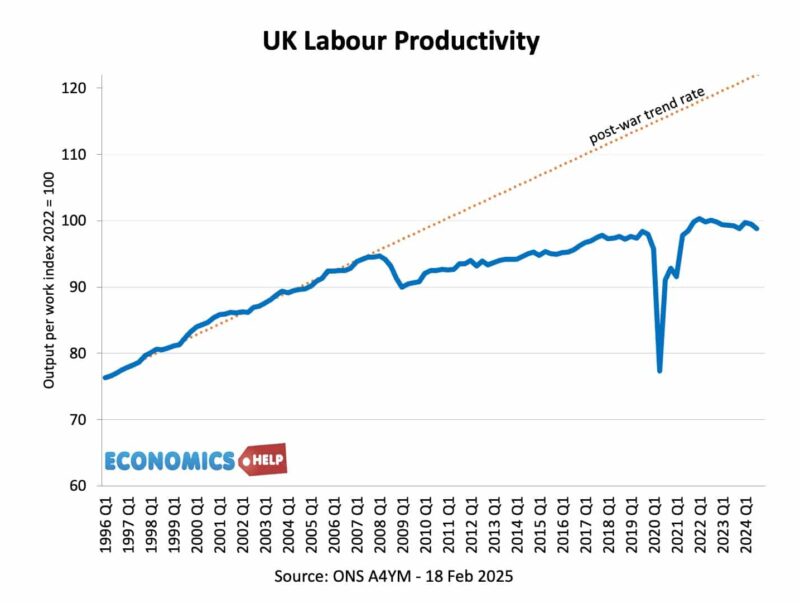
If productivity averages only 0.5%, for a long time, and if anything has slowed more since Covid, it’s very hard to have an increase real wages or economic growth without some inflationary pressures. So the Bank of England have a deteriorating trade-off.
Black Holes
Low productivity growth is also,o of course, why governments have never-ending black holes, low tax revenue and higher demand for spending. The bank are concerned about weakness in labour supply with growing numbers not working due to long-term sickness and disability. Again, this is something where the UK is an outlier, with the UK being alone in seeing a rise in inactivity rates in the past 5 years. This rise is costing the economy in lost productivity and also rising welfare bill. But, getting people back to work is not as simple as switching a monetary lever like changing interest rates.
Doom Loop
The deterioration in public finances is another long-term challenge for the UK economy with the government stuck in a seaming doom loop of worsening fiscal outlook, requiring higher taxes, but higher taxes in a situation of weak growth have played a role in contributing to inflation, low confidence and lower growth. There are alternatives to higher taxes, spending cuts or higher borrowing. But, all three policies have big trade offs.
Low Investment
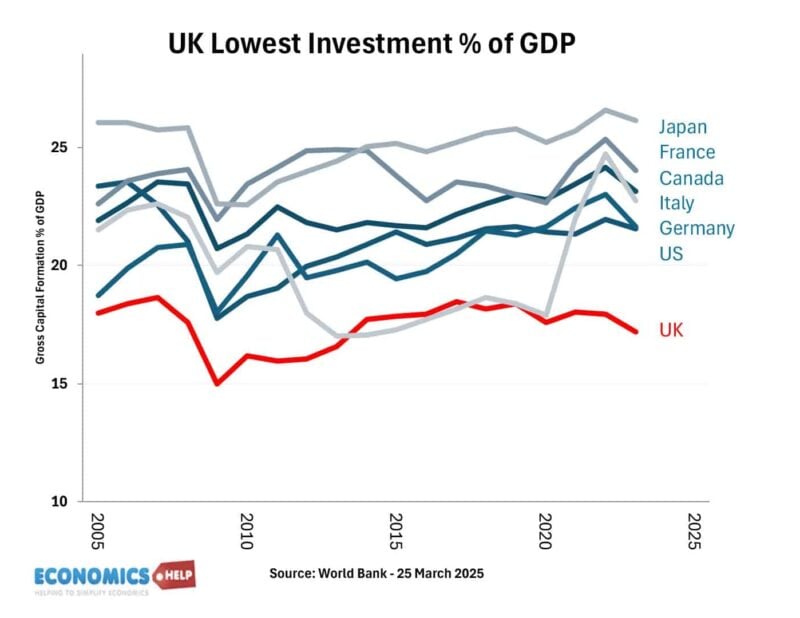
In the long-term, a big problem has been low levels of investment. The UK has consistently bounced along the lowest rate for the G7. Low investment reflects low confidence. Certainly, the best way to improve investment would be a period of strong stable growth; firms only want to invest when demand is rising. So you could make a case that lower interest rates and higher growth may encourage investment. But, also inflation itself can be a disincentive to invest.
Breaking Cycle
So the big question remains how to break this cycle of low growth. Labour market reforms to incentivise increased participation, planning reform to encourage housing investment, cutting regulation and tariffs on exports to Europe are policies which theoretically could help without requiring higher spending.
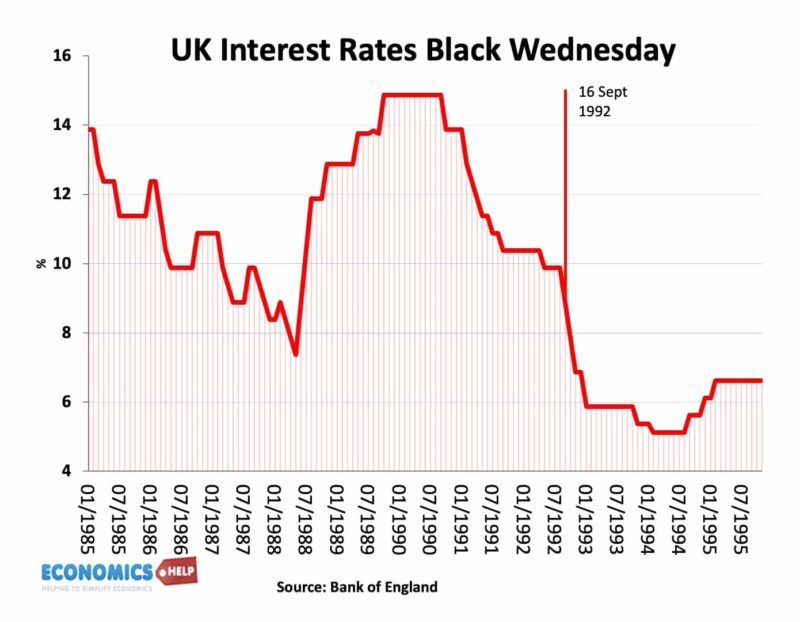
2025 is one of most challenging economic situations. If you go back to say 1992, the UK in deep recession, unemployment 3 million and house prices crashing, but then when the government devalued the pound and let interest rates fall, the economy did recover quite sharply, leading to a long period of economic growth. But, in 2025, a big devaluation and cut in interest rates wouldn’t have the same effect; there’s no easy solution.
Would you fancy the job of chancellor. I would have quite liked it in 1997 or 2010 or even 2016, but 2025 is probably one of most challenging times since 1970s
Sources:
https://www.economicsobservatory.com/why-are-food-prices-rising-in-the-uk
https://obr.uk/efo/economic-and-fiscal-outlook-march-2025/
https://www.bankofengland.co.uk/monetary-policy-summary-and-minutes/2025/august-2025
About The Author
