

In the past four years, the number of recorded shoplifting incidents have more than doubled. But, the problem is worse as many go unrecorded, in 2024, there were an estimated 20 million incidents of shoplifting in England and Wales, resulting in only 31,000 prosecutions. This is a fivefold increase since 2014 with the police seemingly powerless to stop the organised crime wave. Shops have been forced to spend on private security guards and security tags on cheese, milk and baby food. Knife crime has also been soaring, with a near doubling of knife offences and a significant increase in sentencing for the possession of a knife.

Yet, according to the mostly widely used crime survey of England and Wales, we are reporting a sharp decrease in victim-based crime in the past three decades. Down from 12 million to 4 million. It is worth pointing out this is a survey not police statistics and it excludes non-victim-based crimes like shoplifting. Using home office stats for reported crime offences, this has increased since 2015, though it is lower than 2004, the main problem of police stats is that it ignores unreported crimes and methodology can change. But what is going on, and which crime statistics should we be trusting?
“And we are all horrified by the increasing violence on our streets and by the ever rising crime figures.” This is a speech that could be given by any politician over the past 40 years, it was actually Mrs Thatcher in 1982, and she had a point, in the early 1980s, crime by many metrics was even worse. In fact crime soared throughout the 1980s, peaking in early 1990s, but for crimes like burglary, car-related crime and violence there has been a big drop. And this is not a phenomenon related to the UK, it is mirrored in other countries across the globe.
Sceptical of Figures
Yet, many remain sceptical of crime statistics for a number of reasons. Firstly, the reporting of crime is haphazard. Just 25% of headline crime is actually reported to the police, with many respondents saying the police could not do anything or would not have been bothered.
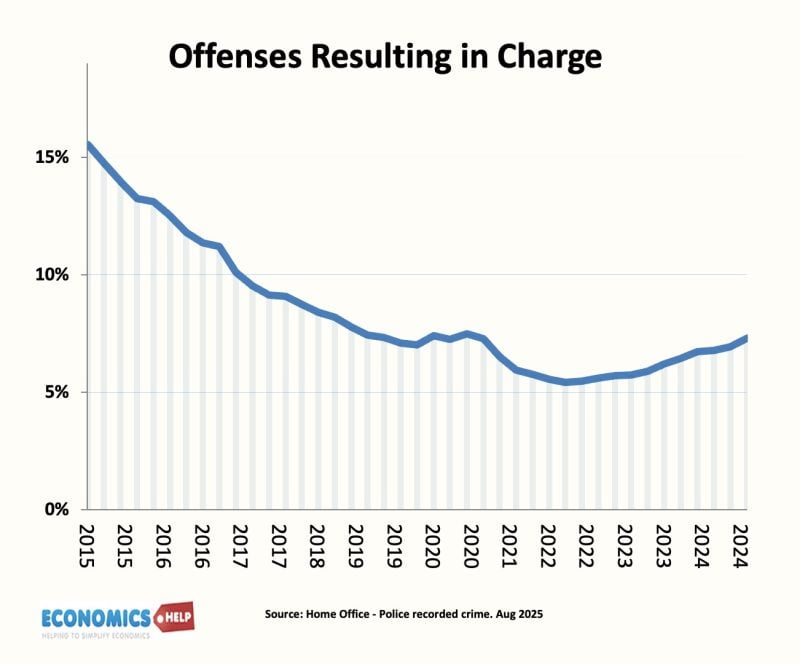
And there is good reason to be sceptical that the police will do anything about crime because whilst crime rates may be coming down, the conviction rate is also coming down from 15% of offences resulting in a charge to 7% in 2024. In fact, this partly speaks to the changing nature of crime. There has been a decline in amateur burglary, car theft and bank robberies, but there has been an increased professionalisation of crime, with shoplifting gangs and mobile phone theft gangs highly organised with long-supply chains for offloading stolen goods and selling on in other countries. The days of Del Boy style local criminals, selling stolen rubber ducks down the pub are declining. Crime is more likely to be more sophisticated for example, fraud is up 65%.
Greater burden of proof
But falling conviction rates are not just down to greater professionalism of criminals; it also reflects a greater burden of proof. The economist reports a police officer who says back in the day, you could just say I saw him do it, now a case may need 20 kinds of evidence. Another reason for falling conviction rates is a big growth in people reporting sexual offences, a reflection of more people willing to come forward. But, the charge rate for sexual offences have always been notoriously low, around 4.2%
Why do we think crime is getting worse?
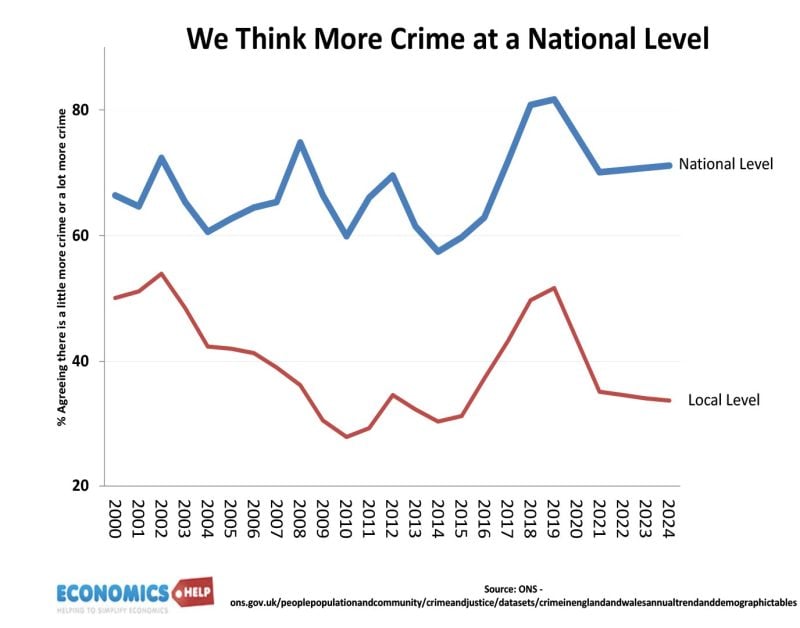
If many types of crime are coming down, why do people think crime is getting worse? Firstly, we tend to think the national situation is worse than our local area. In 2024, 70% think there is more crime on a national level But, only 36% feel there is more crime in our local area. Perceptions of local area are influenced by our direct experience, the national level is more influenced by media and social media, which has a long history of magnifying fears over crime. Also Perceptions of crime are heavily influenced by personal experience, if you’ve had your phone snatched off you on the street, you may well feel unimpressed by the fact that carjacking is 80% down on the 1990s. It doesn’t alter the pain of being robbed.
Is New York/London a dangerous place?
If you ask people who live in other parts of the UK. – respondants are much more likely to think London is a dangerous place to live.
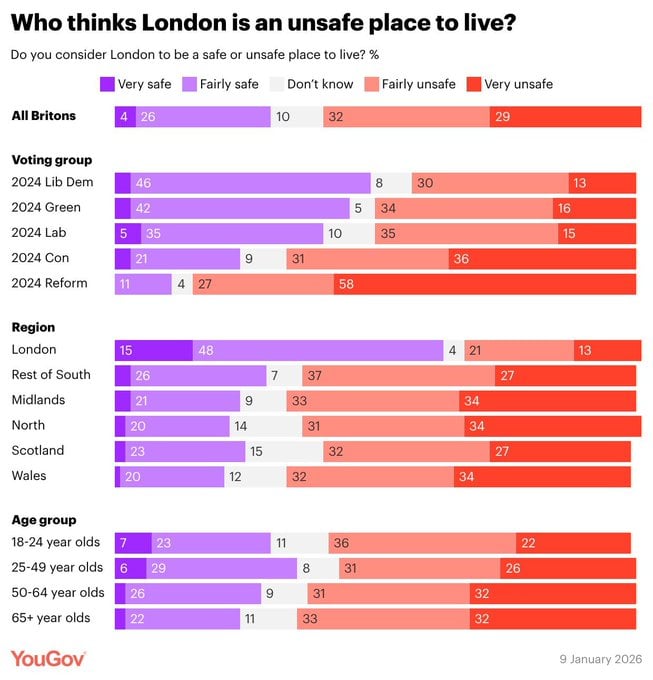
The only people who think London is very safe or fairly safe are those who actually live in London. Which groups is more reliable?
Often the media likes to highlight dangers in big cities, but when you actually live there, you see a different perspective.
Personal experience
Going back to the 1980s, I remember as a young child being keen on football, but my parents wouldn’t let me go watch Leeds United because of the widespread violence and hooliganism of the early 80s. Ironically, the only football I saw was watching non-League, Morecambe FC when visiting relatives. And for all the talk of a moral panic about declining standards, you can’t ignore the fact that era of hooliganism is largely a thing of the past, These days, the problem is more like the daylight robbery of Premier League ticket prices and football clubs going under despite ever more wealth.
Another personal example, when I went to Oxford university, I got the perception that Blackbird Leys was a dangerous council estate – referred to as the joyriding capital of England. But after leaving university, I moved close to the area and ended up cycling through it most days, when you spend time in an area you realised your media influenced perceptions were mostly wrong. By the way when it comes to car crime, whether you use police stats or surveys, the general downward trend is very clear. You just can’t hotwire a modern car for a start. And maybe these days people are happy just playing grand theft auto on a computer.
Record Prison Population
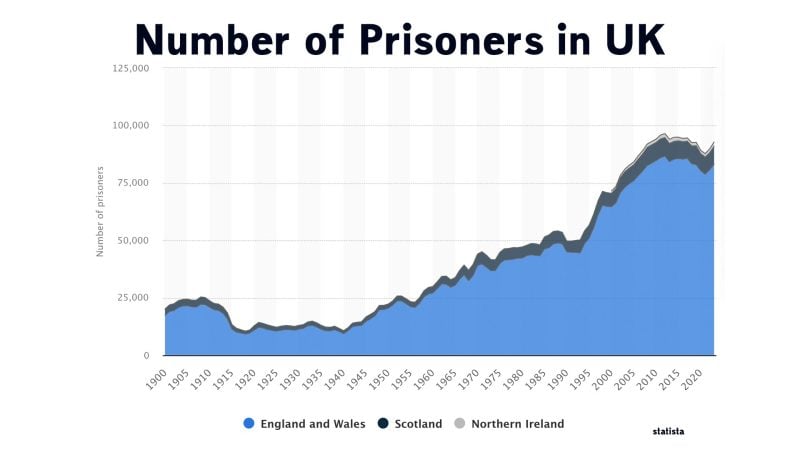
But, a good question to ask is if crime rates are falling, how come the prison population is reaching record levels? And the prison population certainly is rising to record levels, it is one of the highest in Europe. There are 3 main factors behind the rising prison population. Changes to sentencing guidelines has led to longer sentences. Serious offences are 25% longer than 2012. Secondly, there are more prisoners on remand – a reflection of the backlog of criminal court cases and waiting time for cases to be heard. Thirdly, those recalled to prison is up very sharply. Released onto parole and then recalled to prison. The number of people given an immediate custodial sentence fell from 98,000 in 2012 to 67,800 in 2022. Basically, we lock people up for longer, you could ask whether that is partly behind the decline in crime rates.
Hospital Admissions
Another way of measuring crime is through hospital admissions for violence. Hospital admissions for the under 17s has increased, and worryingly, the number of deaths from knife crime amongst young people has increased 141% since 2013/14. Yet, if we look at the total population, the number of assault admissions has fallen from 45,000 to 20,000. If we look at the homicide rate for the UK, it is a similar level to the 1970s, lower than the mid-2000s. Also interesting is the rise in % of women who feel safe walking alone after dark 45% in 1995 68% 2025.
So What is Really Going on?
So what is going on? Some types of crime are down. In particular, much better security for things like cars have helped. Violent offences are also lower than the late 80s and 90s, yet there is a worrying rise in violence and knife crime amongst young people. The decline in crime rates measure in survey is real. Yet, the crime survey also picks up declining confidence in the police which is justified given fall in conviction rates. The crime survey also misses some important factors. You are less likely to have your home burgled than in the past, but shop prices are higher because of a shoplifting epidemic. Also, whilst some crime falls,. There are concerns about a fraying of the social fabric, not helped by cuts to local youth services and decline in community minded instutions. So to answer the question – is crime rising or falling? Well, some crime is falling, some crime is rising. Depending on who you measure, you could argue overall crime rates are lower than 1990s, but it is hardly a new a new paradise of safety and security. So be wary of politicians and crime statistics.
Related posts
Sources:
https://www.thetimes.com/comment/columnists/article/violent-lawless-broken-britain-reform-dt0skh6wf
https://www.instituteforgovernment.org.uk/publication/crisis-prisons
https://news.sky.com/story/tough-on-crime-drive-behind-prison-capacity-crisis-says-sentencing-review-report-13311545
https://www.ons.gov.uk/peoplepopulationandcommunity/crimeandjustice/articles/overviewofvehiclerelatedtheft/2017-07-20
https://lordslibrary.parliament.uk/retail-crime-impact-on-workers-the-community-and-local-economies/
https://www.telegraph.co.uk/news/2025/07/30/nigel-farage-fraser-nelson-crime/
https://www.economist.com/britain/2025/07/24/why-britains-police-hardly-solve-any-crimes
About The Author
