
After this week’s GDP statistics, the UK government could try to boast the fastest growth in the G7 during 2025 so far (depending on Japan data to come). It’s a bit like winning a beauty contest amongst your seven ageing friends; it doesn’t mean much. The bigger story is not so much a UK boom, with growth in the past 12 months (Aug ’24 to Aug ’25) amounting to a paltry 1.2%, but rather a slowing global economy, hit by US tariffs, uncertainty, and lower confidence. Also, if we compare growth for the past 12 months, which is a more useful guide, the UK is mid-table mediocrity amongst a pretty poor showing.

Diving deeper into the data we also see some other interesting features. Firstly, US tariffs are really biting with exports to the US down considerably. In this sense managing growth of 0.3% in Q2, after many firms pre-loaded imports in the first quarter is a relief, if not exactly time to pop the champagne corks. More concerning is the story that growth is very much being led by higher government spending, but private business investment is down. The UK has struggled from low investment from years, and if there is any chance of improved long-term productivity growth, we will need to see much higher business investment not less. It seems that the higher NI and higher labour costs have had the effect of not just increasing unemployment, but also discouraging investment. The economy cannot keep relying on higher government spending for growth. Firstly, like the previous Conservative government, this Labour government is front-loading spending at the start of parliament. It leaves the end of the parliament for really difficult restrictions on government spending which will be hard to achieve.
Mortgage Rates Down
On more positive news, there is a little sign of improving consumer confidence. A hot, sunny summer and mortgage rates falling below 5% for the first time since the Truss era are a welcome boost to some household living standards. Also, helped by higher government pay, real wage growth has been strong in the past 2 years. In terms of good news, that is about as good as it gets. The growth in real pay is not really that sustainable, because so far productivity growth remains pitifully low. Secondly, households still expect tax rises in the autumn budget with all the talk of budget blackholes. But, on this front, there is actually a small piece of good news for the chancellor. The UK press has been full of dire warnings about a millionaire exodus. Henley & Partners claim tax changes has made the UK a world leader in discouraging non-doms to flee and seek shelter in tax havens like Dubai. But these cherry-picked reports using LinkedIn have been largely discredited. And the most recent data by HMRC does suggest that people left in line with OBR forecasts and not the more extreme warnings from certain think tanks. It means that the government is on target to raise more than £4bn in 2026-27 and almost £6bn the following year.
Bigger Picture
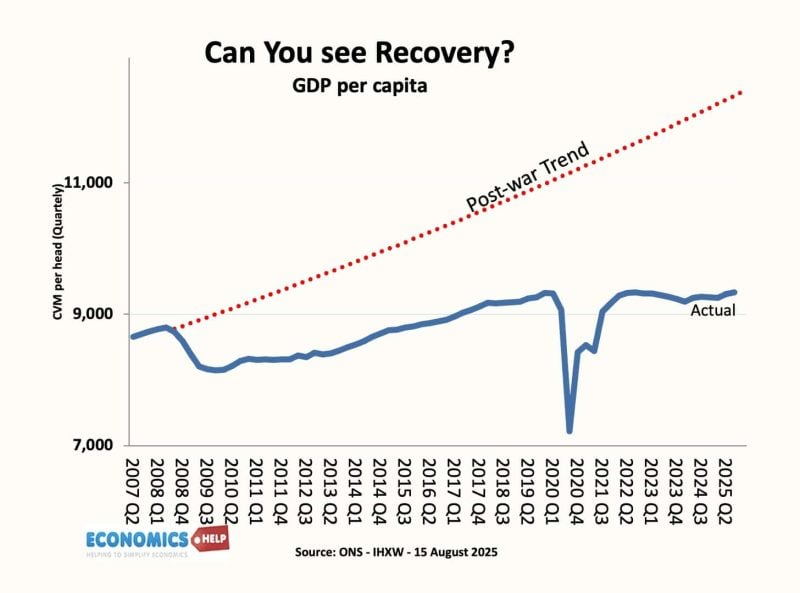
But, when getting amongst the weeds of monthly and quartely data it is always worth zooming out to see the bigger picture. In particular, I like to look at real GDP per capita because often in the past the UK economy has relied on immigration and increasing the population as a way to boost GDP figures, but leaving no visible benefit. If you look closely, you can actually see a small recovery in real GDP per capita in recent quarters. This is very welcome as for a long time post-Covid, post-Brexit, GDP per growth was completely stagnant, the big question is whether this will prove to be a false dawn or the start of something more promising.

Equally, if we zoom out to the bigger picture, we shouldn’t get carried away with the rise in unemployment. It is certainly concerning that unemployment is rising, but it is still relatively low in comparison to past decades. The more immediate problem is looking at unemployment + inactive due to sickness. Arguably, this is disguising some kinds of unemployment; it is certainly harming the economy and public finances. Even with this we are starting to see some better trends in inactivity rates, with the usual proviso that labour market data is somewhat unreliable.
Cost of Living

Also, if you go down your local pub, and start talking about real GDP statistics, you will perhaps at best get a look of bemusement; arguably the more pressing economic reality is the cost of living. I am reliably informed 99% of the population don’t actually visit the ONS website to check the latest economic statistics. But, what people do check is the price of gas bills, the price of a pint, the cost of a weekly shop. The US election of 2024 was arguably a perfect illustration of the political salience of not just inflation but the price level. Even if the inflation rate comes down to 2% in the autumn, we view prices more like this, and we are looking at a near 40% price rise since 2016, a four year inflation rate of 27% On inflation, there is both good news and bad news. The bad news is that inflation has proved more resilient than many expect, worsened by rising food, energy and input costs. Inflation stubbornness has contributed to higher pay settlements and rising inflation expectations. These leave the Bank split between wanting to cut rates to boost weak economic growth and fearing further cuts could boost inflation more. Last month they cut by 0.25% but were split in the vote.
Planning to Rescue?
One reason for optimism at the start of the Labour Government on the economy was the hope that planning reforms could boost housebuilding rates, and this would make a contribution to both boosting economic growth, increasing tax revenue and limiting housing costs. However, despite reforms to the National Planning Policy Framework last December, the number of planning applications in the first six months of the year is actually down. Monthly applications are not even 50% of the required target needed to meet the government’s building target. The planning bill could still lead to higher applications, but given the time lags involved, there are no visible signs of a building boom; if anything, London is seeing some of the lowest new home completions for many years.
Immigration

Also, another target of the government is to bring immigration figures down. Given it reached over 900,000, this should be relatively easy, especially if there is no one-off event like a Hong Kong or Ukraine. However, a fall from 900,000 to 300,000 doesn’t alter the fact, even 300,000 is still pretty high by historical patterns; certainly, the 2020s are uniquely high. Given the housing shortage, inability to build and rise in rents, there are logical reasons to reduce the volume of net migration. But, the question is can the UK wean itself off migrant labour – when firms have become quite used to it, especially for some sectors like care workers, builders and farm workers. The point is that a drastic cut in migration could in theory, cause inflationary pressures, if firms cannot employ skilled builders, it will push up wages and push up the cost of building houses.
Mixed Bag
So overall, recent data is something of a mixed bag, growth last month is welcome, less welcome is the reliance on government spending. The UK is doing relatively well, but that only reflects the fact that the global economy is slowing, tariffs are biting and this bodes well for future growth. If you can’t afford groceries, it is no comfort to know Americans are struggling too. The bigger drag on living standards remains higher inflation, and with higher taxes likely to push up some living costs in Autumn, it is going to be a long, hard slog to get any long-term improvement in living standards.
Sources:
https://www.ft.com/content/14420f4a-06e0-40f6-b5b1-c4e0a36565f0
About The Author
