

In late 2023, the Argentinian economy was experiencing a familiar bout of inflation, capital flight and threat of default, but the radical policies of Javier Milier have seen inflation plummet and, defying many expectations, in 2025 growth has reached 6.5% making it one of the fastest growing economies in the world. Argentina has experienced a big change, austerity on an unprecedented scale, literally taking a chainsaw to government departments. In the past 65 years, Argentina has received 23 IMF bailouts, defaulted on debt six times, but now the debt is finally falling. However, behind the impressive headlines, there has been a rise in unemployment, poverty and growing discontent. Is this a real economic turn-around or will it just prove to be another false dawn for Argentina and also are there any lessons for the UK economy?
We often examine how the UK economy has slipped behind compared to other countries like Poland, Slovenia, US. But, in a comparison with Argentina, the UK has clearly done much better.
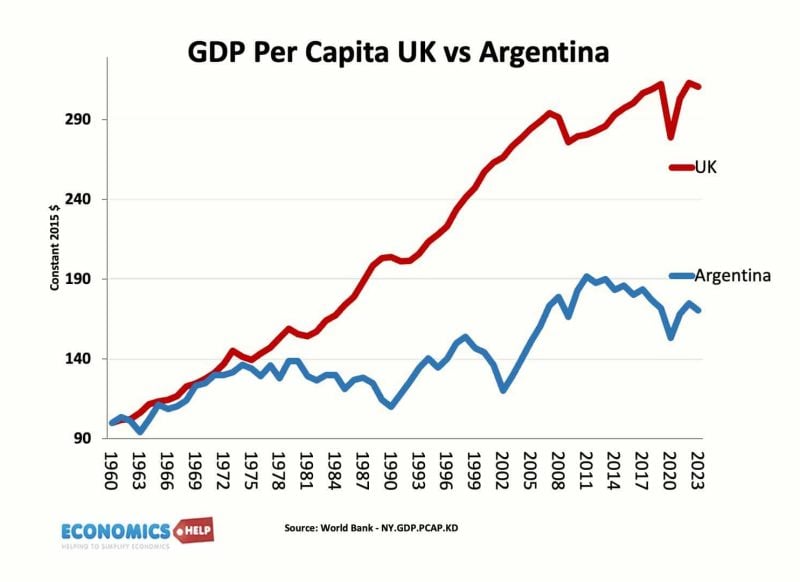
The Argentinian economy has been struggling for decades. At the end of the nineteenth century, Argentina was one of the richest economies in the world, an embarrassment of natural resources; Argentina was actually an economic powerhouse. But, throughout the twentieth century, Argentina became an abject lesson in how not to run the economy, with corruption, overspending, no fiscal discipline, political influence over monetary policy, inflation, devaluation and defaulting on debt. Since 1951 Argentina has defaulted six times, making it a world leader.
Inflation
Argentina is a stark warning that when an economy reaches a critical mass of inflation and debt, it can prove very difficult to fix. In a nutshell, the problem was that to maintain high levels of government spending, the government borrowed heavily from abroad and put pressure on the central bank to increase the money supply. This created inflation, a devaluation in the currency and capital flight. With devaluation, foreign creditors lost out, and confidence plummets. With a history of default ,it then becomes more expensive to borrow, you need to offer higher bond yields to compensate risk.
In the UK, we felt it was a disaster when inflation temporarily rose to 11%, inflation of 3.8% is still a cause for real concern, but Argentina has had bouts of hyperinflation, reaching over 2,000% in the early 1990s. With this kind of inflation, normal behaviour breaks down. People don’t trust the currency or banks, but try and buy dollars and save it literally under the mattress. Even hiding it away in heating systems, which can be disastrous if the pipes burst. Also, to try and prevent inflation, the government have relied on a complex mix of capital controls and fixed exchange rates which don’t reflect the market value. This shows the value of the Argentinian Peso in recent years. It is a sharp devaluation, though it should be remembered this official rate was artificially kept low by capital controls. Official rates might say “200 pesos to the dollar,” but on the street, you’d pay far more. Confusingly there was more than one exchange rate.
Devaluation

A challenge the Argentine economy faces is that, despite the devaluation, markets still feel it is overvalued, and in a floating exchange rate would need to fall further. Because of the overvaluation, Argentinian reserves have fallen further in the past two years. If they run out of foreign reserves, the peso will devalue further, which increases the price of imports and increases inflation.
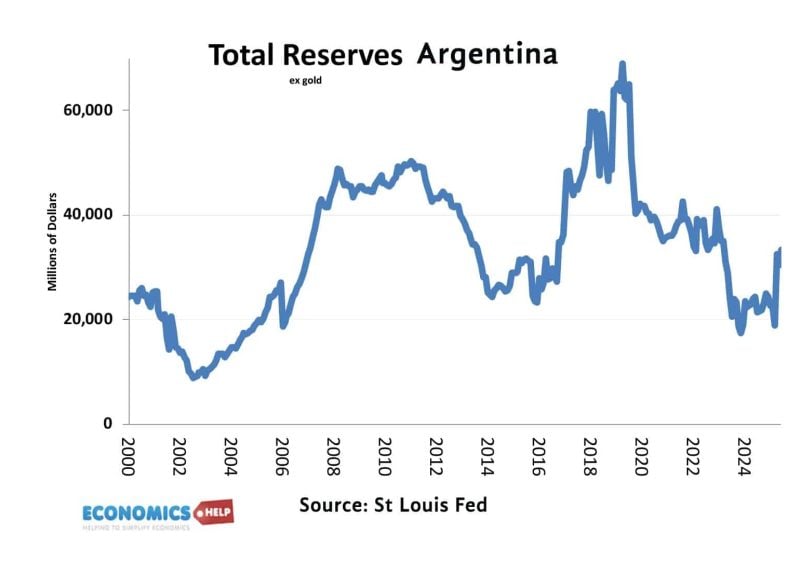
But, unless you float the exchange rate and remove capital controls, it is difficult to attract foreign capital investment the country needs. The fear for Argentina is that when you have a history of inflation, it is much easier for it to spring back, and then all the hard-won efforts to bring inflation down are in vain.
The key to reducing inflation was to cut public spending and reduce the deficit. This deflates demand and enables a tighter monetary policy because the Central Bank no longer need to increase the money supply. It is worth pointing out, a very similar effect could have been achieved by raising taxes rather than cutting spending. Either reduce demand and reduce inflation. Of course some might say taxes reduce incentives to invest, but others will point out the effect on inequality would be better.
Austerity
Javier Milier was elected, promising a very different approach. Literally embracing a chainsaw he slashed government spending. It wasn’t just about 10% efficiency savings, it was whole departments gone. A libertarian dream, but by cutting spending and tightening monetary policy, it was effective in bringing inflation down. From 300% to 30%. Whatever your politics or view of state involvement in the economy, inflation of 300% is destabilising and makes a sustained increase in living standards and poverty reduction difficult.
It is worth pointing out, a very similar effect could have been achieved by raising taxes rather than cutting spending. Either reduce demand and reduce inflation. Of course, some might say taxes reduce incentives to invest, but others will point out the effect on inequality would be better.
But, there is of course a drawback. Cutting spending has led to a rise in unemployment to 7.9%. Austerity tends to hurt the poorest workers in society most. During 2024, Poverty surged from 40% to to 53 percent– the highest recorded jump in two decades. It has since dipped slightly to 50 percent, although the number of people estimated to be living in extreme poverty remains above 6 million.
Trade-off
The trade-off is that a fall in inflation is definitely welcomed and increases the government’s popularity, but spending cuts make people worse off and decreases popularity. One lesson from the Milei experiment was the importance of warning voters things would get worse in the short-term. If you promise everything under the sun and then it fails to materialise, voters are disenchanted. If you say clearly some things will get worse before they get better, you may be given more political leeway. When inflation is 300%, there is no easy way to bring it down without some short-term costs.

Rent Controls
Another interesting report for the Argentinian economy is that abolishing rent controls appears to have led to an increase in supply. The problem is that when rent controls are highly regulated set once every 12 months, but actual inflation is really high and volatile, then landlords may not want to rent out property. During the period of rent controls, 1 in 7 properties were not let out, restricting supply. Ending rent controls saw supply increase significantly, making more properties available.
GDP

The real test of Milei’s reforms will be what happens next. Economic growth of 6.9% sounds good, but this partly reflects a bounce back from austerity-induced recession. Argentina has a long history of stop-start growth. If low inflation is sustained and growth remains positive, then it will enable unemployment and poverty to fall, and all the short-term pain may have been worthwhile. But, if the economy falters and inflation picks up, it could all be for nothing. Unfortunately, for Argentina, the Trump tariffs, low oil prices and global slowdown are particularly affecting the Argentinian economy reliant on exports of commodities. Also austerity increasingly bites, though there is sign that real wages are starting to rise.
Lessons for UK?
What lessons can the UK learn from Argentina? Well, the most important is never let your economy get into a cycle of high inflation, because it is easy to get stuck in a doom loop of inflation, devaluation and default. For all the problems of inflation of 3.8% this kind of 3 digit inflation is not on the radar. What about austerity? Would the UK benefit from axe of spending cuts? The real logic for austerity in Argentina was inflation of 300%. The UK situation is very different the UK’s problem is more economic stagnation, severe austerity would depress demand but with no real benefit. However, in the long-term the UK does needs to make choices which involve difficult trade-offs. Spending is set to rise much faster than tax revenues, and you can’t ignore it forever.
I was critical of UK austerity in 2010s, because there was no need, inflation was low, interest rates were very low and the economy was depressed. In Argentina the opposite was true, inflation, high, interest rates high and devaluaing currency.
About The Author
