
In one corner, we have a beleaguered chancellor. In the other corner the bond market. The bond market is just a collection of big investor, who buy the £300 billion yearly gilt sales from the government. Who will prove the strongest…

Last Friday, bond yields jumped on reports that the chancellor had given up on the idea of increasing income tax. Until 2022, bond markets gave Britain the benefit of the doubt, and UK yields were pretty average, but since 2022, the UK has experienced what is technically known as a moron premium. This is the cost of markets lacking faith in long-term economic strategy.
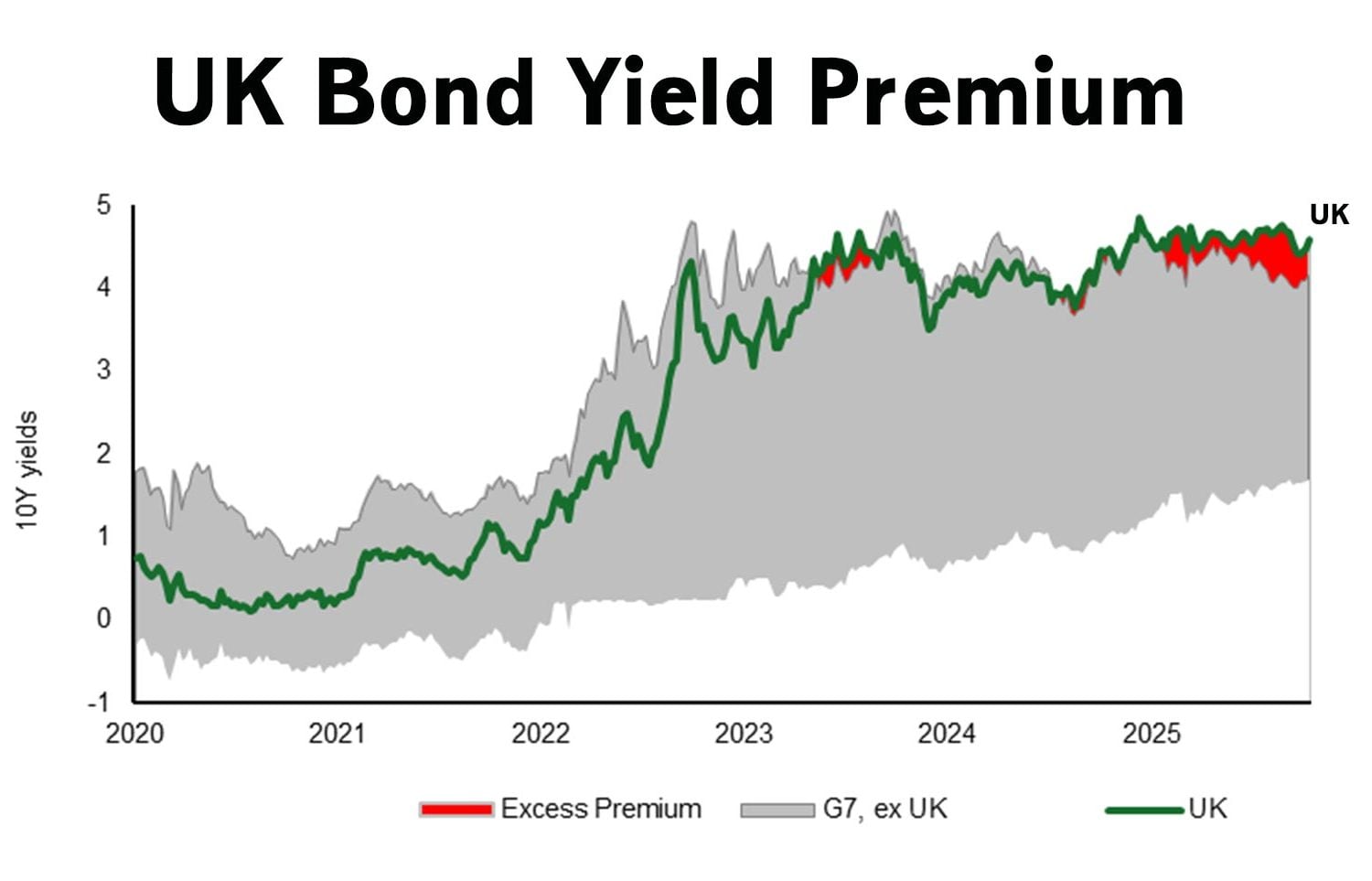
Rather than rates at around 3.5%, the UK faces rates of 4.5%. This means the government spend more on debt interest payments. The higher rates also encourage saving rather than spending and crowd out private investment.


The UK’s high rates are not just due to fears over debt; it also reflect the UK’s high inflation and high interest rates. But the adverse reaction on Friday shows that markets do pay attention to strategy or lack thereof of governments. A rise in income tax may break manifesto commitments, but it would have raised nearly £9 billion, collected from a wider source of payers and is less disruptive to growth than say, higher NI contributions. In fact, there is a good case for replacing NI with just one income tax, which is broader-based and less disruptive to employment, which has suffered in recent months.
Anyway, if the chancellor could reduce this bond premium, there would be big benefit. The UK is forecast to spend £111bn on debt interest payments this year, the reason for the big jump was partly rise in bond yields. This is effectively wasted money. So much effort is going into finding an extra £30 billion, which ironically is fairly close to the amount interest payments jumped in recent years.
We need to be less in hock to the bond market…
Now, recently, Andy Burnham said that the UK should become less in hock to the bond market, and it generated a predictable set of jokes, like how it would be nice to become less in hock to my mortgage provider. Great in theory, not so easy in practice. However, what he actually meant is that the fundamental problem the UK faces is that it has lost control over the cost of living and cost of spending. What we tend to forget about the Liz Truss crisis was that it was preceded by a jump in energy costs which led to a generous government bailout of £50 billion. Even with gas prices falling, energy prices have remained stubbornly high. For many reasons, dating back decades, the UK has lost control over energy prices, leading to some of the highest in the world. The UK energy market got all the costs of privatisation with none of the benefits. Andy Burnham’s point is that selling state-owned assets has increased living costs like anything. Case in point, the UK government used to spend money building social housing, keeping down costs, now we can’t afford to build houses because we spend that money on subsidising expensive private rents.
If you look at the reasons for the UK’s exceptionally high inflation rate, it can be traced back to big jumps in bills water, gas, electricity. If you want to be less in hock to the bond market, reducing cost of living would be a start.
UK Debt is it really a problem?

You could easily make a case, UK debt is not actually that bad. At 97% of GDP, it’s not an outlier (IMF measures slightly different). In recent years, despite record levels of gilt sales, there has actually been quite strong demand. For all the talk of UK default, the bond market doesn’t suggest anything like that. The UK may have higher interest rate costs, but it’s a long way from being Argentina or Turkey. But the problem that the UK faces is not the odd £20 billion here or there, but the long-term projection of government spending and tax revenues, which requires real policy change to avoid. It is worth emphasising if the government could make some sensible choices on tax and spending, this can be avoided.
But, problems remain
However, it’s fair to make these three points. Firstly, the UK interest rate is currently higher than the rate of economic growth. That makes fiscal consolidation much more difficult. The UK is used to a growth rate of above 2%. Secondly, despite a parliamentary system, the government has failed to make any bold decisions which decisively change the narrative. The government have lost public support, even without making any big change. Instead of a clear vision of tax rises or spending cuts, there is a smorgasbord of small-scale efforts like winter fuel, inheritance tax on farmers, and small benefit cuts. These have the unfortunate habit of annoying key groups, saving relatively little and often have to be u-turned because of political pressures. The result is that fiscal policy is a mess, characterised by uncertainty, lack of coherence and complex fiddles which end up hurting economic growth. Another problem for the UK is that demand for gilts may be high, but 30% of this is coming from overseas. Japan had debt of 240% of GDP, but it was largely funded by domestic savers, plus they had their own sovereign investment fund. The UK reliance on overseas investors makes borrowing more vulnerable, global events and falls in sterling.
Just Print Money…
For example, at this point, some may say. Forget the bond market, just get the Bank of England to create money, buy the bonds and start a massive extension of quantitative easing. We create our own currency, so we make use of it to reduce borrowing costs. Now, this worked in 2009, when the economy was on its knees and the economy facing deflation. But, when you already have inflation of 3.8% an increase in the money supply risks more inflation. Also, creating money to buy bonds from foreign investors will push down sterling, creating more inflationary pressures. There is a case for Bank of England to at least halt its policy of quantitative tightening. But, you can’t just fund all spending commitments by creating money out of thin air.
The bond market is not quite as all-powerful as some make it out to be. But the truth is the chancellor still needs the bond market to behave more than the bond market needs the chancellor. A likely scenario is that the budget will scrimp and save to meet fiscal rules, with very small headroom. But, soon into 2026, there will be some shock to push up inflation or slow down economic growth, and then once again, the fiscal rules will be stretched, causing people to speculate about where the next tax rises will be. Uncertainty and speculation is exactly the kind of thing the bond market doesn’t like and so it is hard to see the UK losing its bond premium on the current trajectory.
The sad thing is it doesn’t have to be like this. If you ignored the manifesto commitments. A rise in income tax combined with a more progressive council tax could raise £15bn. Also, the government shouldn’t give up totally on the rising spending. Both pension and health-related benefits are soaring faster than GDP, which is not sustainable. Currently a a person on a combination of health related benefits could receive an income of around £25,000 or more, while a full-time worker on the national minimum wage would have a take-home pay of about £23,795. The rising number of health conditions has caused an explosion in benefit spending. The government hopes that the Timms report will enable a way to at least slow the growth in expected spending. If benefit reform is based on structural improvements rather than panic cost savings, there is a greater chance of it getting past.
On the hand, the UK does not face default, but it is making a mess of fiscal policy, which is slowly storing up trouble. How would you fix the budget?
About The Author
