
Sectoral balances show how the government, private sector, and rest of the world each run surpluses or deficits, and how these positions must add up so that one sector’s borrowing is financed by another’s lending. They reveal who is funding whom in the economy, but they do not explain why these imbalances occur or whether they are sustainable.
The “sectoral balances” framework divides the economy into three broad sectors —
- Public (government),
- Private domestic (households + private businesses),
- External (rest of world)
By accounting definition the sum of net financial balances across all sectors = 0. That is:
If the government runs a deficit (i.e. net borrowing), then the non-government (private domestic + foreign) must have a surplus (net lending). So if the government runs a deficit, it accumulates debt. The private sector + rest of world will be running a surplus. (e.g. buying bonds from government)

- If the government runs a surplus (i.e. net saving), then the non-government (private domestic + foreign) must have a deficit (net saving)
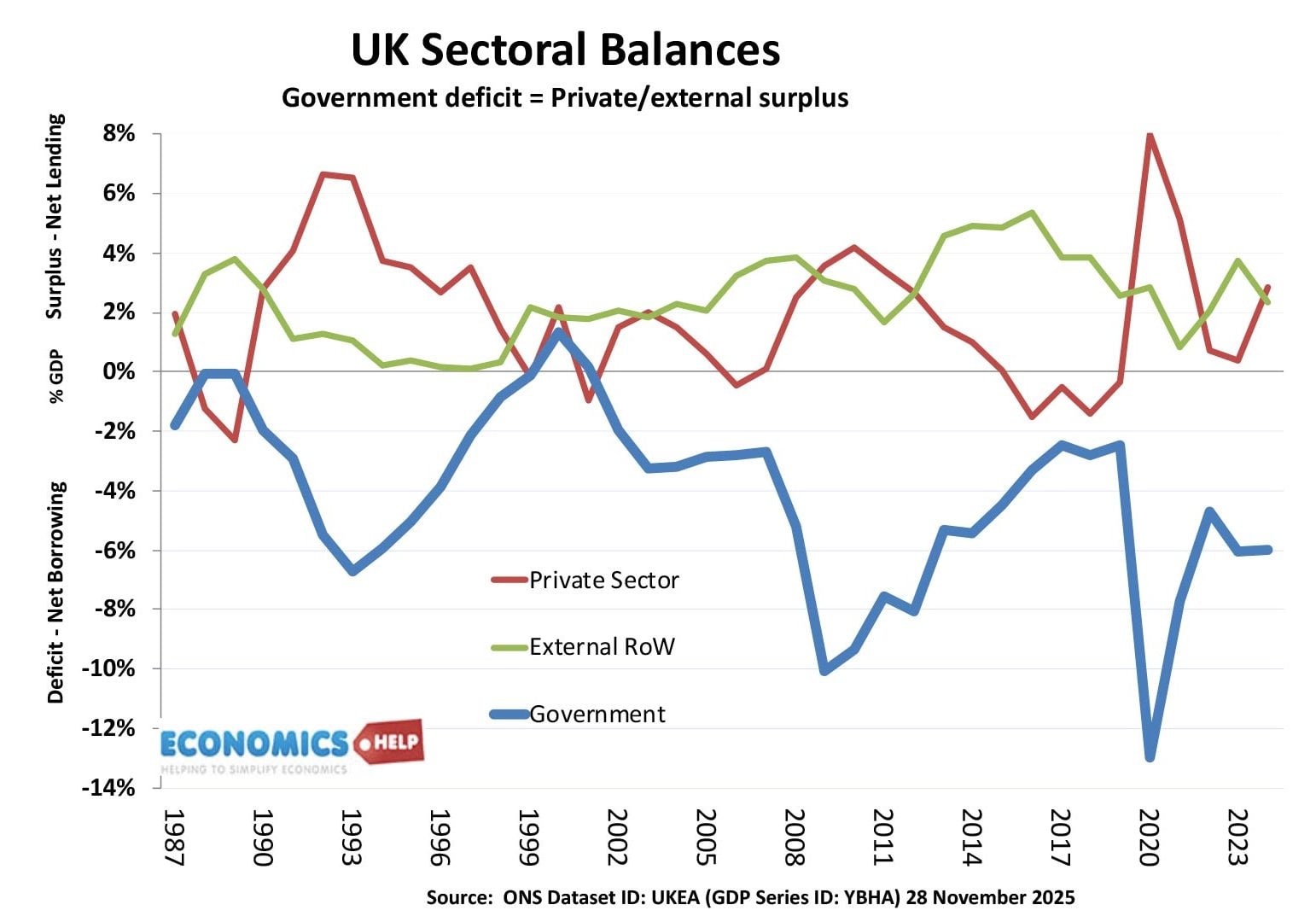
Importance of Sectoral Balances
Sectoral balances show how funds flow between the government, private sector, and the rest of the world, revealing which parts of the economy are saving and which are borrowing. Because every financial surplus must be matched by another sector’s deficit, the balances always sum to zero.
1. Reveals who is financing whom If the government runs a deficit, it must be financed either by:
- Private domestic surpluses (households, firms, banks), or
- Borrowing from the rest of the world (capital inflows).
Sectoral balances show exactly where that financing comes from.
2. Helps identify economic pressures and vulnerabilities
- Large government deficits → rising public debt.
- Large private-sector deficits → rising household or corporate debt (a warning before financial crises).
- Reliance on foreign lending → external vulnerability, current-account deficits.
3. Shows how recessions and booms affect saving and borrowing
- In recessions, households and firms tend to save → private surplus and helps to explain the logic for higher government borrowing. It forces the government or foreign sector to run deficits.
- In booms, private sectors borrow → private deficits, increasing investment and spending this should reduce government deficit..
4. Links domestic activity to the balance of payments
The rest-of-world balance is effectively the UK’s external deficit or surplus.
If the UK runs a current-account deficit, the rest of the world must be a net lender to the UK.
This shows how domestic imbalances interact with international capital flows.
5. Shows that surpluses and deficits are interconnected
One sector cannot save unless another borrows. For example:
- If households save more, either firms, government, or foreign borrowers must take on more debt.
- This explains why attempts to reduce government deficits without changing private behaviour can fail.
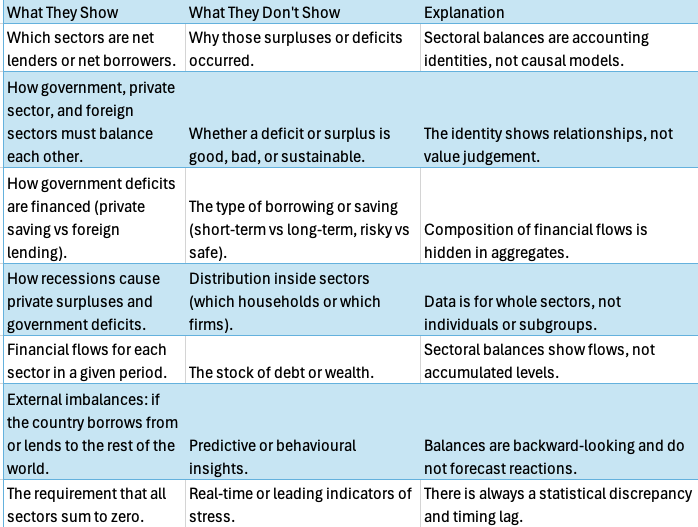
What Sectoral Balances do not show
Sectoral balances are accounting identities, not behavioural explanations. They show that deficits and surpluses must add up — but not why they happened. For Example:
- A government deficit might rise because government pending increased or because private saving jumped during a recession, or because exports fell (current account deficit).
They do not show stock of debt or wealth
- They do not show the type of borrowing (i.e. risky/safe/short-term/long-terms
Example Q2 2025 – UK
Sector % of GDP
- Central government -6.1
- Local government 0.2
- General government -5.9
- Public non-financial corporations (n/a small)
- Private non-financial corporations -1.5 ( this means companies have returned to net borrowing, suggesting investment)
- Financial corporations 0.7
- Households 3.6 (suggesting household saving)
- NPISH 0.2
- Private domestic total 3.0
- Rest of the world 4.1
Sum = 1.2% (which is ONS statistics discrepancy)
What is Happening
Basically the picture is that the UK central government is borrowing substantially. This is being matched by household private sector saving (e.g. households buying UK government bonds, effectively lending government money). The UK is also running an external deficit, capital inflows to finance the current account deficit.
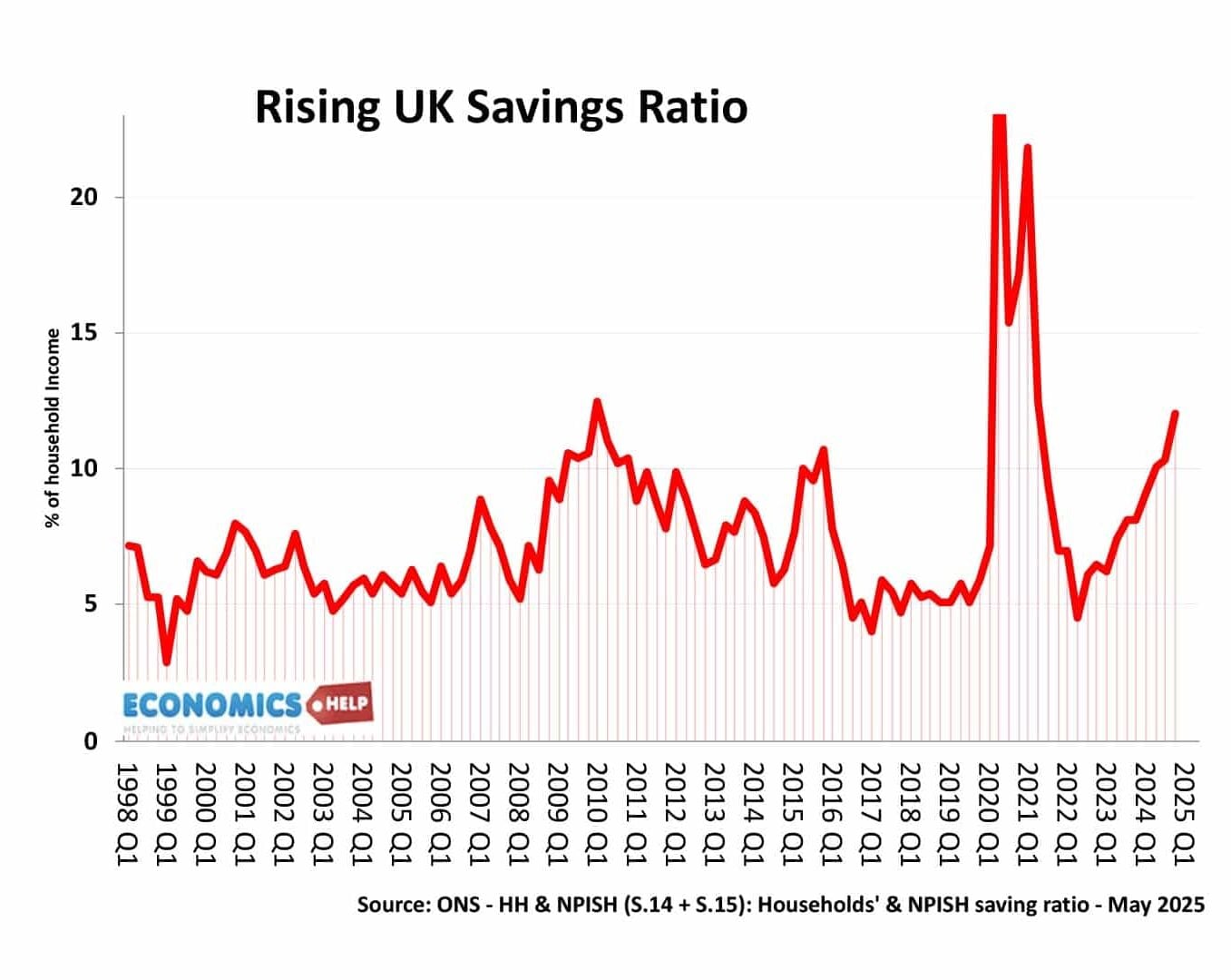
Household savings is rising in the UK.

A current account deficit has to be funded by capital inflows (financial account surplus).
UK Economic Accounts Series – ONS
Sectoral Balances Explained
Explanation of Accounting series,
Government sector includes
- Public non-financial corporations
- Central government
- Local government
Private domestic sector
- Private non-financial corporations
- Financial corporations
- Households
- Non-profit institutions serving households (NPISH)
External sector
- Rest of the world
About The Author

good article, thanks. Learnt a lot about why higher government borrowing has to come from somewhere else