
Earlier this year, the Vice President, J.D. Vance, proclaimed, I want more babies in the United States of America. And he’s not alone in ringing the alarm bells about collapsing birthrates.
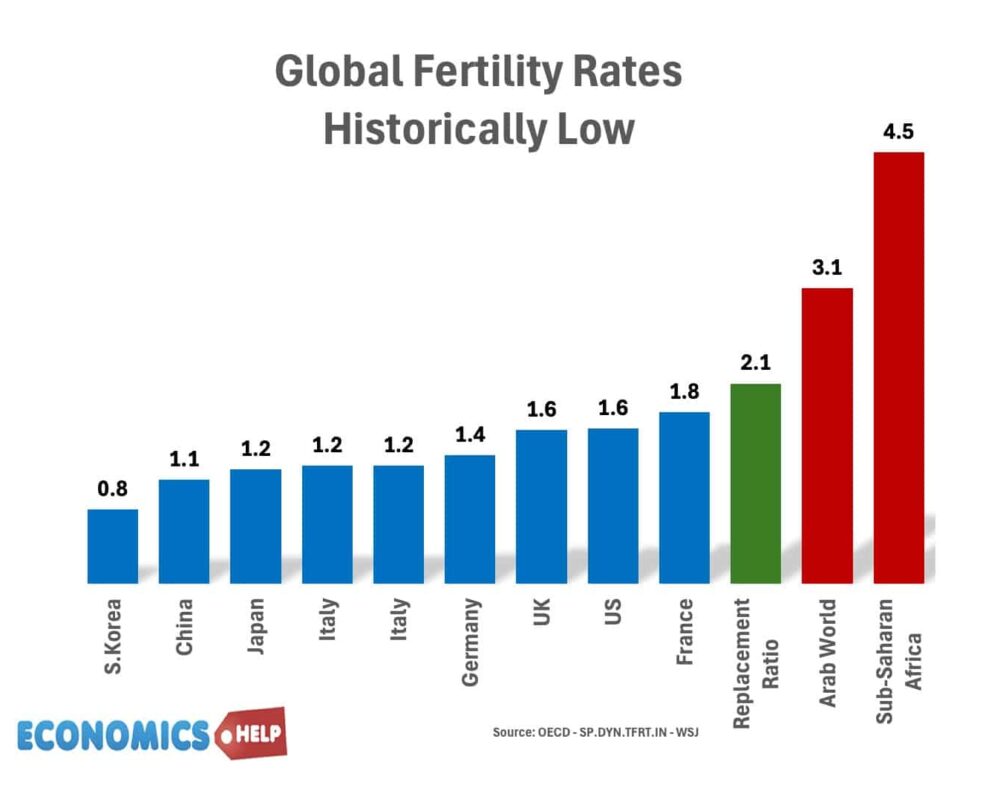
But he will have his work cut out. Nearly one half of all U.S. adults under fifty say they are unlikely to ever have children. Sixty percent of those say they just don’t want kids. Forty per cent say they either can’t afford children, or the state of the world is too depressing to bring children into it. Fertility rates are certainly falling across the world, but they are now falling faster than predicted.

Just ten years ago, the UK government predicted a fertility rate of 1.8, but today it is 1.45 The ONS consistently predict fertility will pick up, but we can see that the main trend is just straight down.
Reasons for Falling Fertility?
Cost of Living. Well, the first thing that springs to mind is simply the cost of living. In 1980, private rents might take ten percent of your income. Today it is closer to thirty per cent. In 1980, house prices four times income. Today, it’s closer to eight times income. It was impossible to buy a three to four-bedroom house. It’s entirely rational to have either one child or no child at all. In 2025, it’s estimated that the cost of bringing up a child to the age of eighteen is around £260,000, which, ironically, is pretty much close to the average cost of a price in the UK.
Which would you prefer an extra child or being able to buy a house? Since 1997, the basic UK state pension has increased fifty percent, but child benefits have fallen in real terms. And now there’s a cap on benefits for more than two children. In the future, there will be a lot more pensioners and fewer children. The effect on government spending and the economy will be huge. Debt is forecast to soar in pretty much every economy. I understand this economic argument myself. If I had two children, I wouldn’t be using this bedroom to record YouTube videos. I probably wouldn’t be on YouTube at all, but it would have to go out and get a proper job with a proper salary.
More than cost of living?
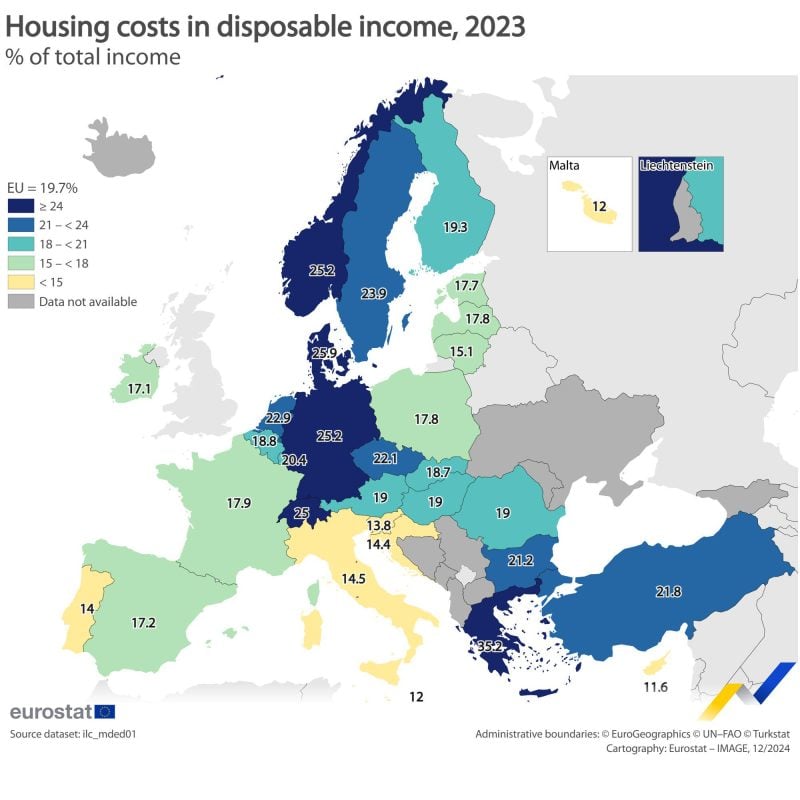
But if the cost of living is a major factor causing falling birth rates, how do we explain falling birth rates in countries where living costs are not so onerous? This graph shows housing costs as a share of income in Europe. Italy and Poland have relatively low housing costs, but a birth rate of 1.3 and 1.5.
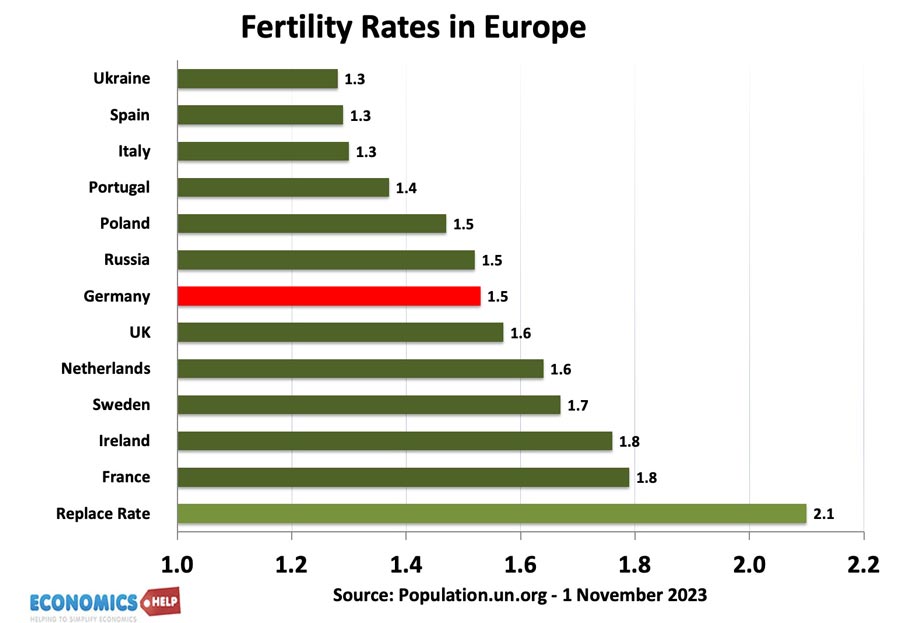
Norway and Germany have relatively higher housing costs, but higher birth rates and zoom away from Europe.
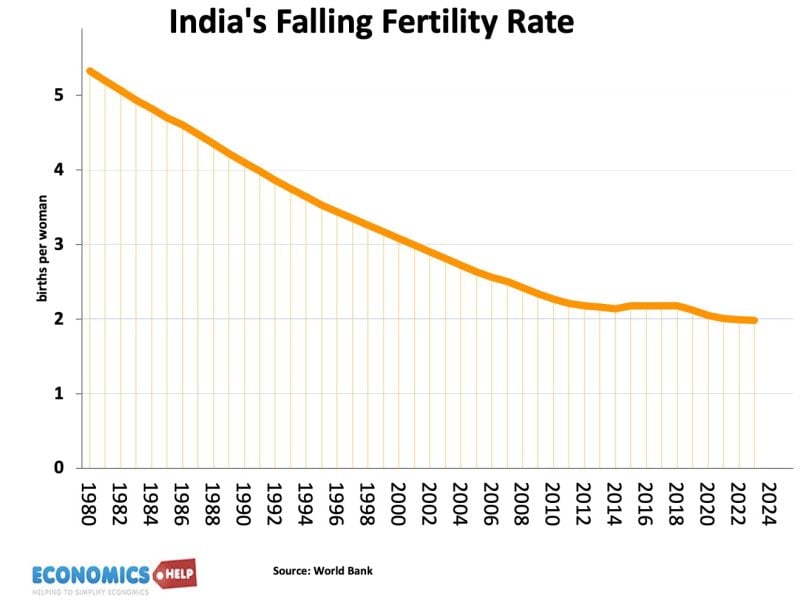
And the bigger picture is that fertility rates have plummeted in nearly every part of the globe. Forty years ago, India had a fertility rate of 5 and the population was exploding. Now the biggest country in the world, of course. Now, though, fertility rates have fallen below the replacement ratio. In that time, living standards have increased a lot. And in fact, there are many good trends behind falling fertility rate.
- Better education improves status of women.
- Higher wages, more access to contraception.
But whilst we want worried about overpopulation, now we’re worrying about the opposite? Too few people. Now, it was widely assumed that this century would be Asia’s century. But something happened around 2016 which caused fertility rates to plummet.
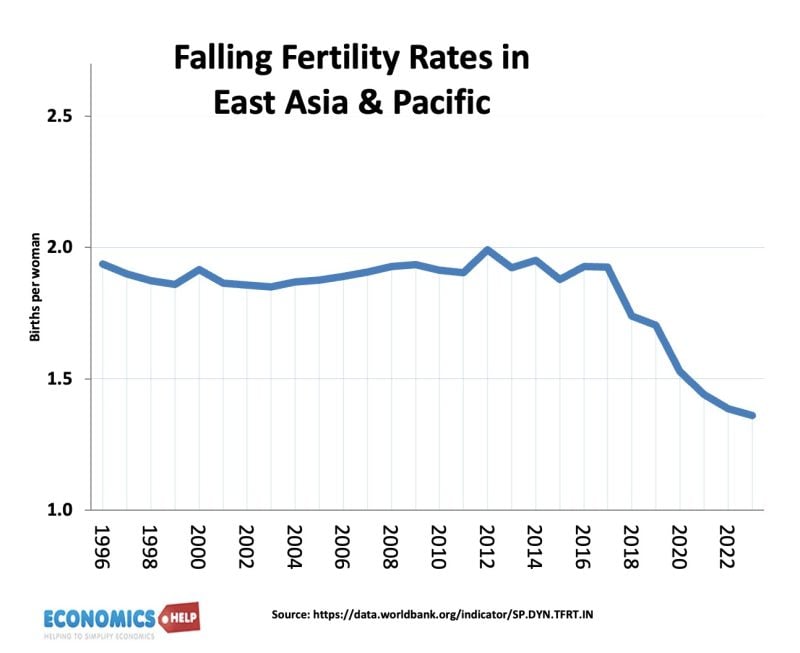
Now there was no economic crisis in 2016, no sudden change in living costs. So why did fertility rates fall so rapidly from that year onwards? One theory is that 2016 was a time when social media, like Instagram really took off, grabbing our attention, rewiring our brains and changing attitudes. The old world was hanging out in a bar. But this has been replaced with hanging out online in a group chat. Now, it may sound speculative and almost fanciful, but there is evidence that higher social media use really is leading to declining fertility rates.
Whether it’s Finland or Africa, higher social media use is linked to lower birth rates. In recent years, we’ve seen a very significant increase in levels of anxiety amongst young people. A rise in the number of single people are falling, dating and falling the number of couples. Rather unsurprisingly, this is causing lower fertility rates in the US. Over half of eighteen to thirty four year olds are neither in a steady relationship or living with a partner. Now, there used to be tremendous social pressure to get married and have children, but since the 1960s, this social expectation has fallen away slowly at first, but now very rapidly. To be a bachelor or a single woman was once a major issue. The source of a Jane Austen novel, something that had to be solved. But now people kind of shrug their shoulders.
And in the past, when large families were the norm, it was much easier for other people to have a large family, too. Now, it is so rare to see a family of three, four or five children, but either consciously or unconsciously, people don’t want to go there. And when your friends are childless, you are no longer feeling left out if you’re the same. Now, there are many reasons, but it does seem that social and technological change is causing something of a divergence between men and women. And we can see this reflected in, say, different political attitudes.
As many commmentators have noted, men have been veering very heavily to the right, women veering largely to the left. But it is also a divergence in where people spend time. Men increasingly spend time playing computer games online. Women on Instagram. But with all this, extra time online has come at the expense of a decline in participation in activities which used to bring a natural mixing of the sexes. And with more time spent apart in different social media bubbles, this has led to a divergence of outlook on life.
Even dating apps seem to have been failing in their purpose of bringing people together. a bewildering level of choice and sense of disconnect. The screen really hasn’t brought people together. Now, some claim that the reason for falling fertility rates is the fact that women are now more highly educational, more aspirational in terms of career choice. And given the setback to career that can occur when you take out time to have children, it is understandable that it can be less desired to have children or later in life. Certainly, there is some that are quite weak correlation between higher female educational levels and declining fertility, but it really can’t explain the bigger picture.
In Tunisia and Turkey, female participation rates are extremely low, just thirty percent compared to, say, eighty percent in the US. But Tunisia and Turkey both now have fertility rates of less than two. And by the way, it’s not just the Christian world where fertility rates are falling.
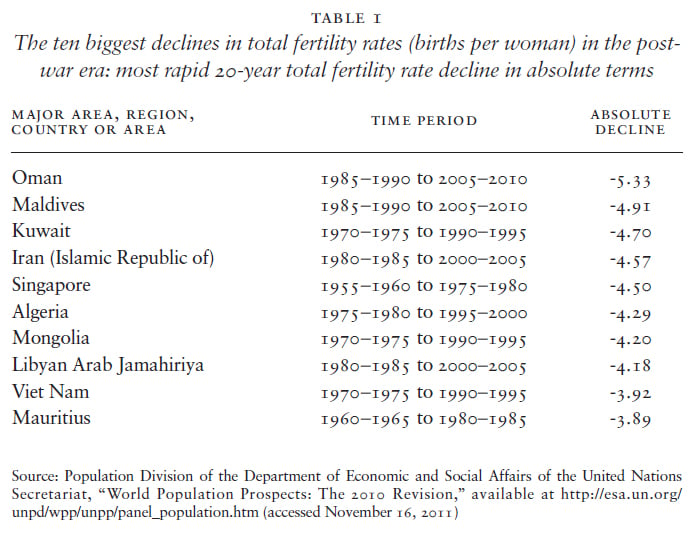
Predominantly Islamic countries like Oman, Kuwait, Iran, Singapore, Algeria have all recorded five out of the ten largest declines in fertility rates in the past a few decades.
Now, Seoul in Korea has a distinction for having one of the lowest fertility rates in the world, just naught point five five. And if you ask young women why they are not having children, their main reasons include things like the high cost of housing, the crazy pressure for paying for extracurricular education in the evening, and that just the high cost and time involved in bringing up children in a super competitive society. It’s very hard to find the time, one young woman rather sadly reported. She just didn’t feel Korea was a place where a child can live happily. Korea’s economy has grown at a breakneck pace, but it has come at a cost of a falling fertility rates, but is so large it threatens the future of that society.
Now, economists generally have great faith that you can solve any problem through changing incentives. Cash for kids. But policies to increase fertility suggest that economics might have met its match. Nearly two thirds of all countries have some policies to increase birth rates, but very largely they’ve achieved very little.
In 2019, Hungary offered a thirty thousand dollars loan to newlyweds forgiven when he had three children. And thirty thousand dollars is a really substantial amount. Yet since 2019, the birth rate has remained unmoved at 1.59. Seoul is providing Filipino nannies at just seven dollars an hour to help working mothers. Taiwan, with one of the lowest birth rates in Asia, has spent three billion dollars encouraging people to have children. Subsidies for IVF tax credits, cash benefits, paid parental leave of eighty percent. The government even hosted a singles event, hoping it would break the trend to people not getting married. But as the LA times reported, young women leaving the singles event early, saying having kids and getting married is just not their first choice anymore. Taiwan retains the fertility rate of one point one. Some say even lower.
Policies to offer tax breaks and subsidies for having children may well be worth trying. Trying to reduce housing costs is a good policy, whether or not it increases fertility rates. These policies may well help at the margin, but it’s not going to fundamentally change the much larger trends that it seems to be going across the entire world.

This is the UK’s predicted fertility rate, with fertility policies causing only a very minor bump in birth rates, but still well below the replacement ratio. The government can do many things, but it seems that getting people to have more children is much more complicated than paying higher benefits. But where does this ageing population leave young people today? Do they have any hope for the future of a young generation doomed to paying ever higher rates of tax to fund the retirement of the older generation?
Let me know, what you think.
Video Version
Related
About The Author
