
2025 has been a tough year for the housing market. A weak economy, higher taxes and budget uncertainty have all led to stagnation.
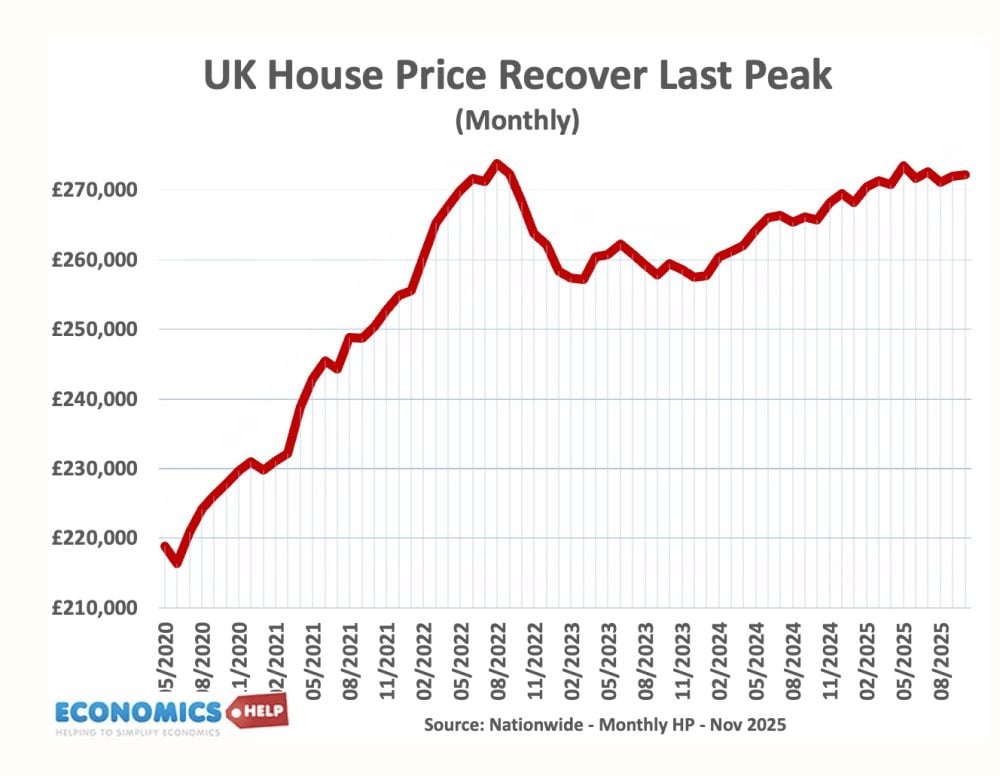
Transactions have been low, and house prices barely increasing. In fact, with inflation over 3%, real house prices have continued to fall. And This is actually a big underlying story of the UK housing market, real house prices have come down since 2022 and are even lower than 2007.
s
But, with the budget less impactful than many feared and the prospect of lower interest rates, what does 2026 hold for the housing market?
Pessimistic Case
Pessimists will point to continued economic weakness, rising unemployment, the expectation that average earnings will barely increase. The OBR forecast just 0.2% growth in 2026. Not only that but despite some falls in prices, UK house prices still look unaffordable. House price to incomes have definitely come down since their 2022 peaks, but for many buyers, buying a house is still out of reach.
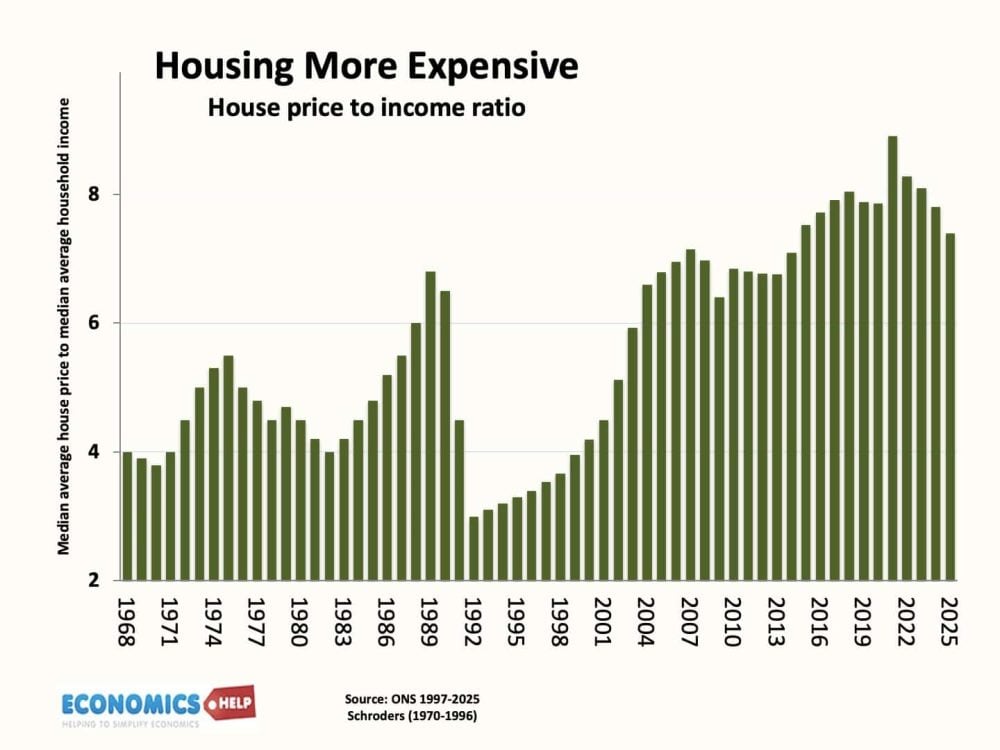
Whilst some hope for interest rate cuts, pessimists will point to the persistence of UK inflation as a warning that interest rates may not actually be able to fall much at all.
The Bank of England are still forecasting inflation will remain elevated and therefore, homeowners face the prospect of continued high mortgage costs. Despite a decline in interest rates in recent months, homeowners still pay a relatively high share of income in mortgage payments. Interest rates may be lower than the 1980s, but because house prices are so high, it is still a big cost.

However, for those predicting a crash in 2026, unless there is really an unexpected event, it is very hard to see. But, first a very quick look at how past forecasts went. At the end of last year, house price forecasts for 2025 ranged from 1.1% to 6.3%. It is looking like house price inflation will be around 2-3% for 2025, so they were not too far off. However, the national figures masks a big regional divide cheaper areas in the north saw strong house price growth Liverpool 10%, Sunderland 9.4%. But, expensive areas in south east hit by stamp duty and higher interest rates saw big drops Westminster -11.5%, City of London -9%

A very important factor is the reduction in mortgage rates since 2024, it means that people remortgaging are no longer seeing the kind of big shock in mortgage rates of recent times. Furthemore, we are likely to see another rate cut this month. Capital Economics suggest that in 2026, UK rates could fall more than previously expected. Wage inflation is slowing, service sector disinflation continues. Furthermore, budget measures will reduce inflation by 0.4% and although higher minimum wage may counteract some of this, it is worth bearing in mind that the UK remains an outlier in terms of interest rates, if rates were to get closer to ECB levels, it would be almost a return to the rates of the 2010s – a period of booming house prices.
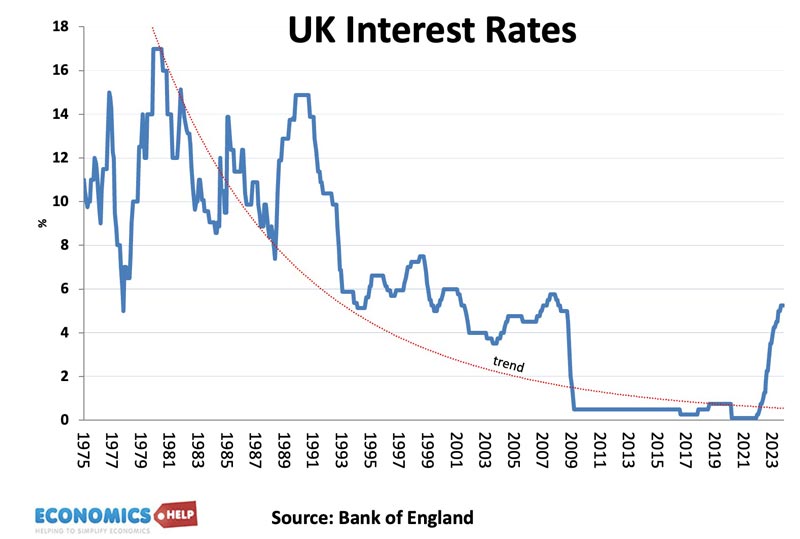
And here is an interesting speculation. For 12 years, the UK had virtually zero interest rates because of economic stagnation. Covid, Ukraine and Liz Truss temporarily blew that apart, but the forces that led to low interest rates for a decade have not entirely gone away. The prospect for economic growth in the rest of the decade is not great. Higher taxes towards the end of the parliament will slow down growth. In fact, the OBR’s growth forecasts rest on the assumption of significantly lower interest rates counteracting the effect of higher taxes.
Mortgage falls (75% LTV)
In 2023, with 2 year fixed rates at 6%. A £250,000 mortgage would cost £1,610 a month. But, today with rates at 3.8%, that falls to £1,292 that is significantly more affordable. Also bear in mind that nominal wages have risen 11% since 2023. Yes, the housing market is still very expensive, but there have been a relative improvement in affordability in recent years.

And whilst mortgage payments have come down, the cost of renting has gone up, average rents in Great Britain have risen 30% within four years. Which would you rather pay the average rent for England of £1,399 a month or £1,292 a month for mortgage payments on a mortgage for £250,000? To me, it would be a no-brainer. And don’t forget, inflation will erode the real value of your mortgage, but inflation will push up rents.
House Price Crash?
Back in 2022, I started youtube, and it was an exciting time for the housing market, interest rates tripled, inflation 10%, all on top of record unaffordability. I made many videos about how house prices were going to fall, and they did a little bit, but the nominal fall was less than you might have expected. Why. Well, one reason is that it’s not just income that is used to buy houses. Wealth, inherited wealth and gifts from parents play an increasingly important role in the UK housing market. It is why some people can afford an average deposit of £144,000 in London. There are a lot of wealth transfers to come, as the boomer generation pass away and pass on the value of their houses to the children, you can expect a large share of this wealth to be recycled back into the housing market. For those outside the loop, those who can’t rely on parental wealth, it is deeply frustrating, but this recycling of wealth explains, at least some of this higher house price to income ratio. Also, as well as inherited wealth, British households have been quitely increasing their level of savings. It means many households are in a position of affording bigger deposits than in the past.
Budgets Effects
What about the budget will the mansion tax have any affect? Not really It affects less than 1% of houses and 80% of these are in the south east. However, high values of stamp duty and new council tax bands will continue to be a drag on the price of the top end of the market. And more are getting dragged into paying stamp duty. The mansion tax could lead to greate price compression with more demand for houses just below the £ 2 million threshold, but it is not the kind of thing to move national prices.
What about supply and its affect on price? A big factor behind the surge in rents, was very high levels of migration, but so far this year, we have seen a big drop in migration as government policies to restrict migration come into effect. A slower population growth will moderate house prices, but it will have more effect on the rental sector and minimal effect on house prices. The government made a target of building 350,000 homes a year, they will not meet this target, but it would take a very long time of very extensive house building to materially lower house price inflation. As a rough rule of thumb a 1% increase in supply might mean house prices 1% lower than otherwise.
Forecasts
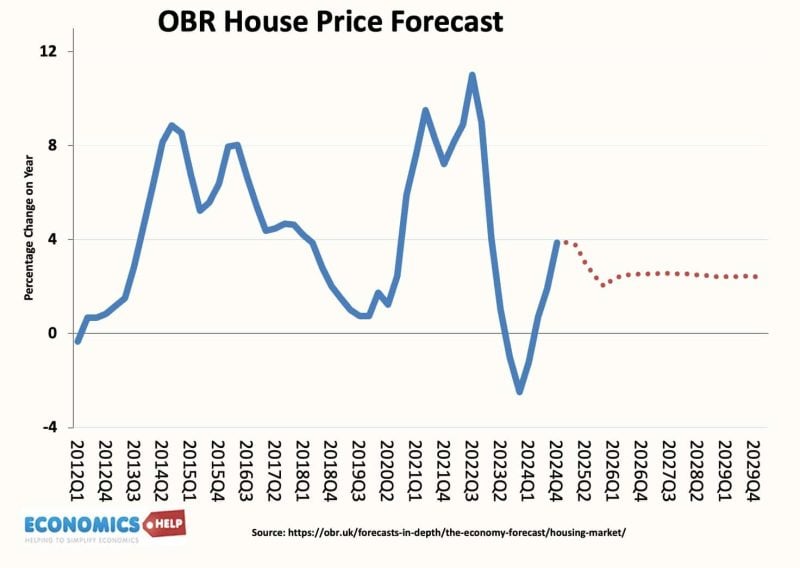
So what do forecasters say? The OBR is rather conservative, house price growth of 2.5% for the next four years, basically zero real price growth. Others say anything between 2% and 6%, I would forecast towards the top end of the forecasts around 5%, which would mean for the first time in a few years, we could actually have positive real increases in house prices. The main reason is the decline in mortgage payments, rise in savings and wealth, combined with the fact that rents have gone up so much. I see nothing to change the old British habit of wanting to buy a house, whatever the cost. And when plans to increase housing supply don’t materialise, usually what happens is that the government try another track such as reducing mortgage criteria or encouraging bigger mortgages. Already there has been talk of a return to 100% mortgages and mortgages six times income.
To actually get a housing crash, we would need one of two things A very deep recession, with unemployment rising to 10%. Now, there is a possibility this happens. US stock markets are arguably over-valued and a stock markets crash would have knock on effects to the financial system. The second thing is a return to high inflation and big rise in interest rates like 2022. But, with growth weak, this would require a major geo-political crisis, surge in oil prices and the end of a Pandemic causing supply side problems like 2022. At the moment, there is nothing to cause a mass selloff of house prices like in 1991, when interest rates rose to 15% or a credit crunch of 2007
Yet, if a crash is not on the horizon, there is limited room for house price growth. Real income growth is is forecast to rise only slowly, and prices remain unaffordable. Landlords also face higher property taxes from April 2027, on top of new regulations and taxes. The era of a buy to let boom does seem over, even if bigger corporate landlords are getting into the market.
Related
About The Author
