
The decline of trade unions in the UK has been a long-term trend since the late 1970s. Union membership peaked in 1979 at over 13 million workers, but has since fallen to around half that level.

As a share of the workforce, union density has dropped from more than 50% in the late 1970s to roughly 22% today. This decline reflects deep structural changes in the UK economy, alongside political and legal reforms that reduced the power of organised labour.
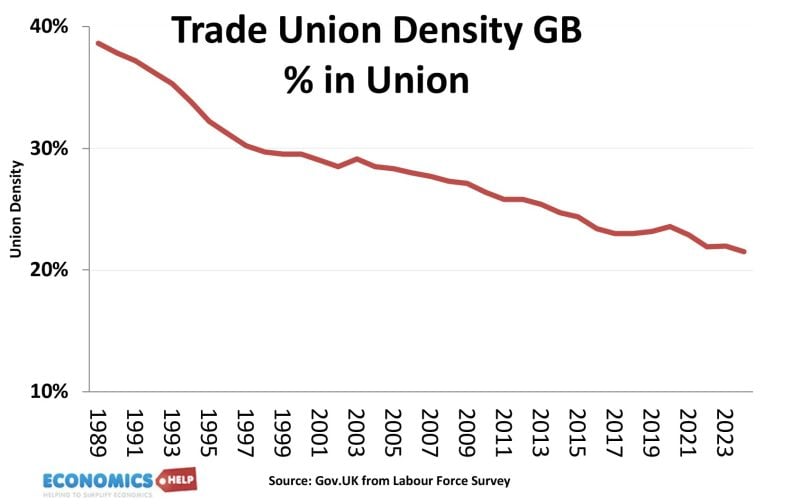
In recent years, the wage premium for union jobs has also declined. This reflects reduced power of trade unions, but also the increasing role of the national minium wage in boosting wages for low-paid workers.

What Caused Decline in Trade Unions?
1. Deindustrialisation One major factor was deindustrialisation. Traditional union strongholds such as coal mining, steel, shipbuilding and manufacturing shrank rapidly from the 1980s onwards. The decline of heavy industry was due to decline in competitiveness, with cheaper imports replacing UK production.
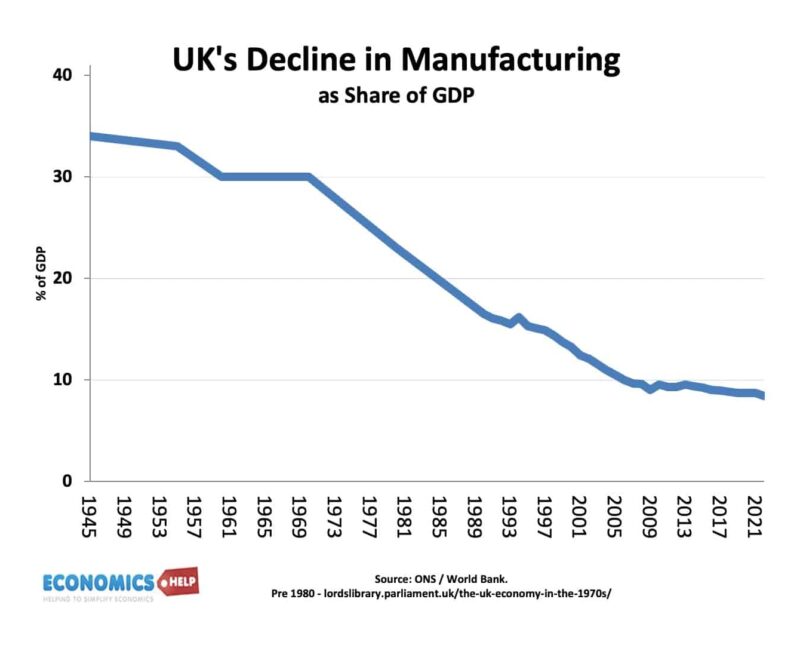
This shows manufacturing declining as a share of UK GDP, thus traditional union sectors were much reduced.
The growth in employment came in new service sector services like, retail and hospitality—sectors that are more fragmented, have a higher labour turnover, more likely to be temporary and are therefore harder for unions to organise. Smaller workplaces, part-time jobs and the rise of self-employment also reduced the effectiveness of collective bargaining.

Modern day union membership is dominated by the public sector, with female employment more likely to be represented by unions. The largest union in the UK is now Unison – representing public sector workers.
2. Government policy During the 1980s, reforms under Margaret Thatcher introduced stricter rules on strike ballots, limited secondary (sympathy) action, and increased employer rights during industrial disputes. These legal changes raised the costs and risks of union action, weakening unions’ bargaining position and reducing their appeal to workers.
3. Cultural shifts. Cultural and economic changes reinforced this trend. Greater emphasis on individual pay bargaining, performance-related pay, and flexible labour markets reduced reliance on collective representation. Some workers perceived unions as less relevant in a more competitive, individualistic labour market. For example, former manufacturing jobs have been replaced by jobs such as working in warehouse, supermarkets, and as delivery drivers.
4. Rise in Minimum Wage. Since its introduction in 1997, the minimum wage has increased faster than inflation and plays an increasingly important role in setting wages for the low-paid.

With minimum wage, many workers may feel a union will not be able to gain significantly more wages.
5. Decline in wage premium
The trade union wage premium (% increase in wages for union members over non-union members has fallen, even in the past 30 years. This suggests unions are less influential in increasing wages, reducing the incentive to join.
6. Growth in self-employment
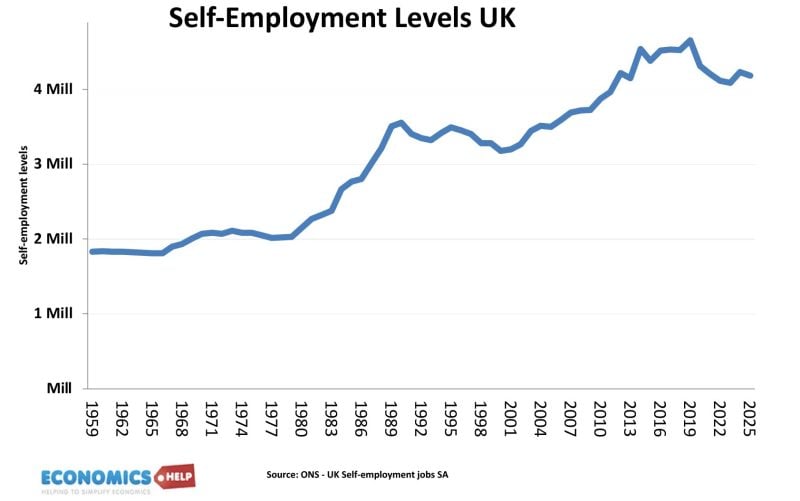
Levels of self-employment rose from 2 million in 1980 to four million today. This is a significant growth in employment which will not be covered by union activity. This reflects the greater fragmentation of the labour market, with more opportunities for self-employed and the decline in jobs for life from big companies.
Life in unions
The decline has not been uniform. Union membership remains relatively high in the public sector, especially in education, health and local government. In recent years, concerns over job insecurity, real-terms pay cuts and working conditions—particularly in the gig economy—have led to renewed debate about the future role of unions in representing workers’ interests.
Problems of the decline of trade unions
- Lower wages: Weaker collective bargaining reduces workers’ ability to secure pay rises, contributing to wage stagnation and higher inequality.

It would be a mistake to blame the stagnation in average wages on the union decline because many other factors are responsible (low productivity growth, economic stagnation). But, the union decline hasn’t helped.

It is worth point out, the labour share of UK GDP fell from mid 1970s to 1997. But, has actually increased since 1997 and remained fairly steady in past two decades.
US experience

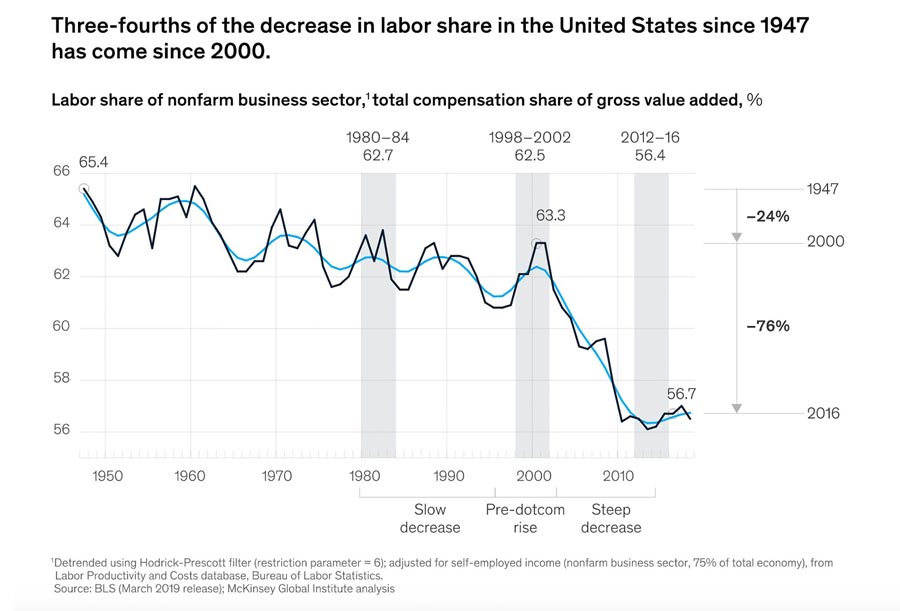
By the way, the decline in trade unions is not just a UK issue, we can see a similar trend in the US. The decline in US unions has led to rising inequality and a fall in labour share of GDP.
- Worse working conditions: Less union oversight can lead to longer hours, weaker health and safety, and more insecure contracts.

- Reduced worker voice: Employees have less influence over workplace decisions, increasing dissatisfaction and staff turnover. The UK sees more under-employment with workers wanting more hours
Benefits of Falling Union Influence

Critics of unions will say that the union heyday led to problems of days lost to strikes, falling productivity and high inflation. It would be a mistake to put all the blame on unions as management had its own issues.
1970s – The Union Heyday
Sources:
Trade union stats at gov.uk
Related
About The Author
