
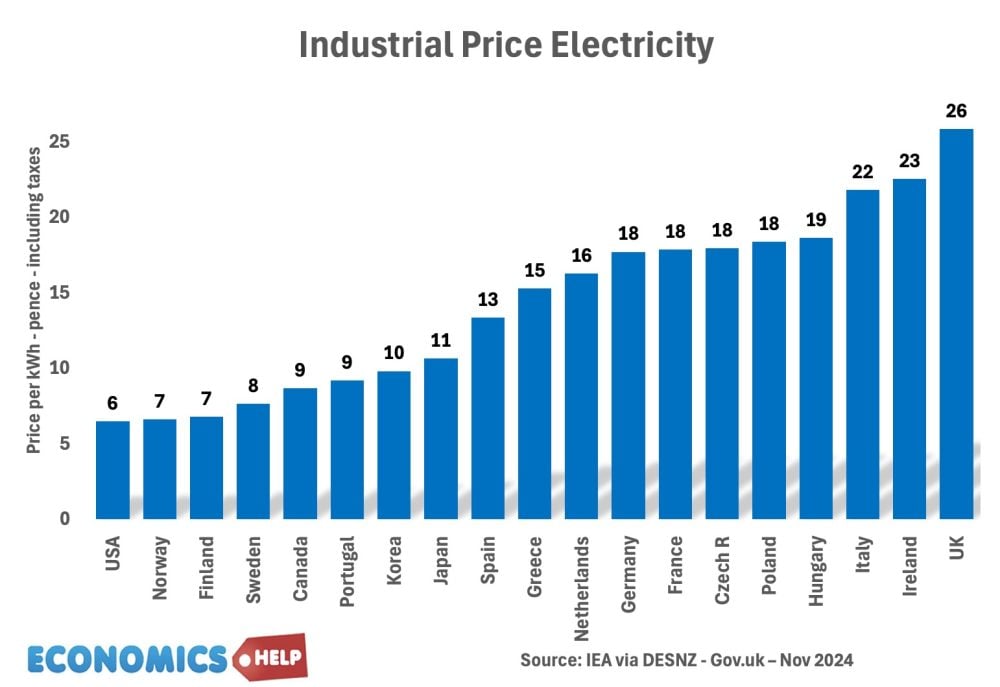
It is well known that the UK has some of the highest household electricity prices in the world. Critics of Net Zero argue that despite a rise in the share of renewables to a record breaking 50%, we have also seen a sharp rise in electricity prices, – much faster than the rate of inflation.
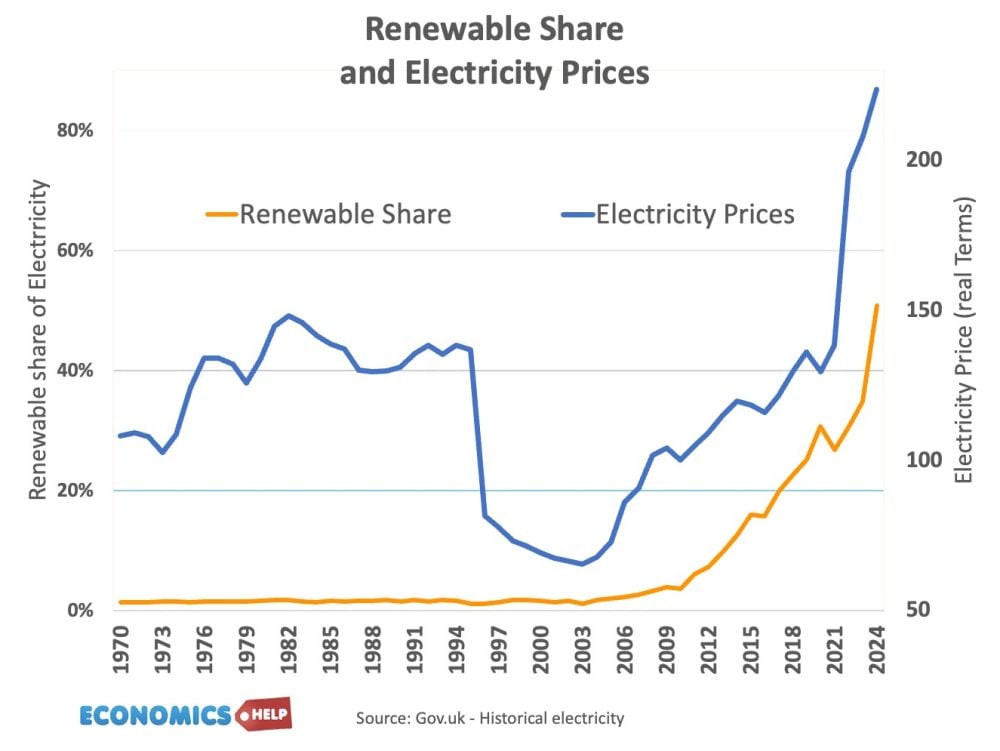
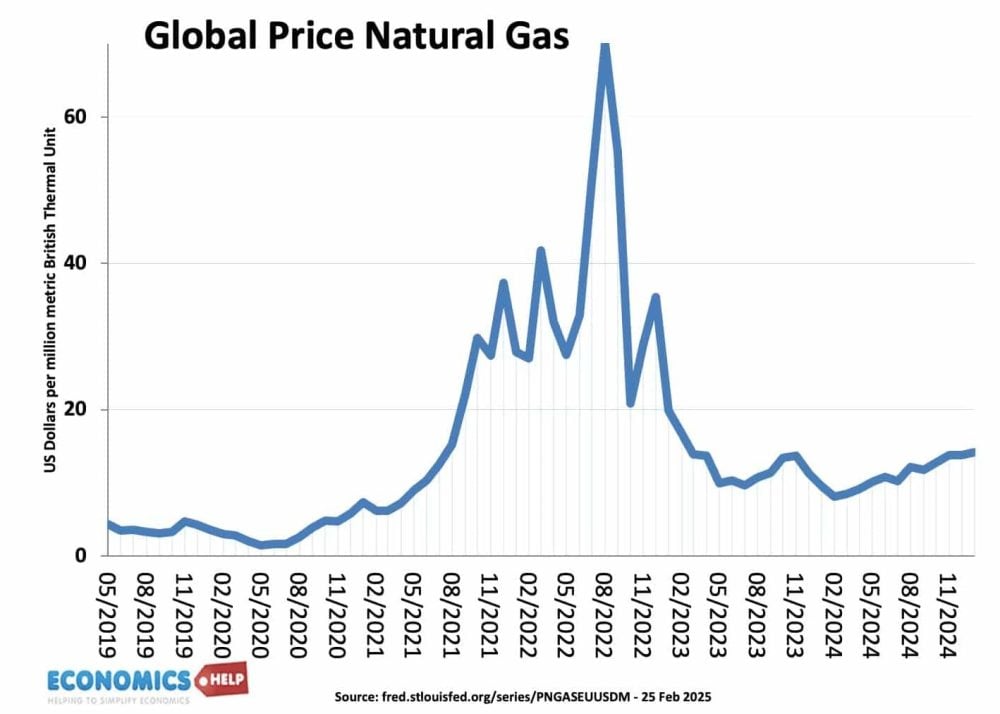
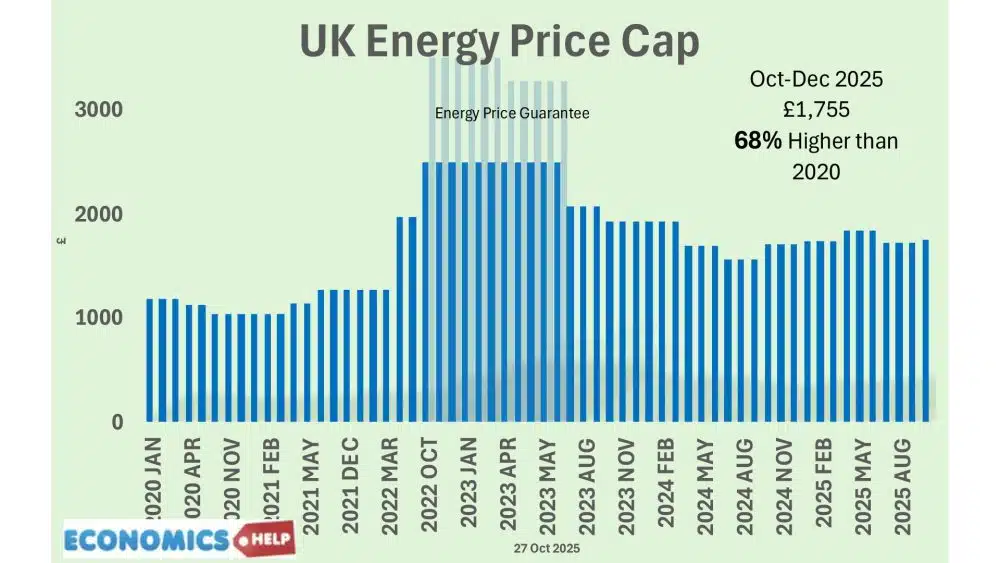
Yet, the marginal cost of solar and wind keeps getting lower, it is one of the great technological stories of recent years. So how come adding more renewables to the grid is coinciding with higher prices? The answer is that the price of electricity is in 98% of days determined by the marginal cost of gas. And since 2021, there has been a big rise in the cost of importing gas. This is the biggest factor in leading to higher energy bills in the past few years.However, since gas prices have fallen, household bills have remained elevated
Household bills
But, if the rise in electric prices is due to a rise in price of gas, it begs the question why is gas determining 98% the price of electricity – despite only being 14% of the total electricity generation?
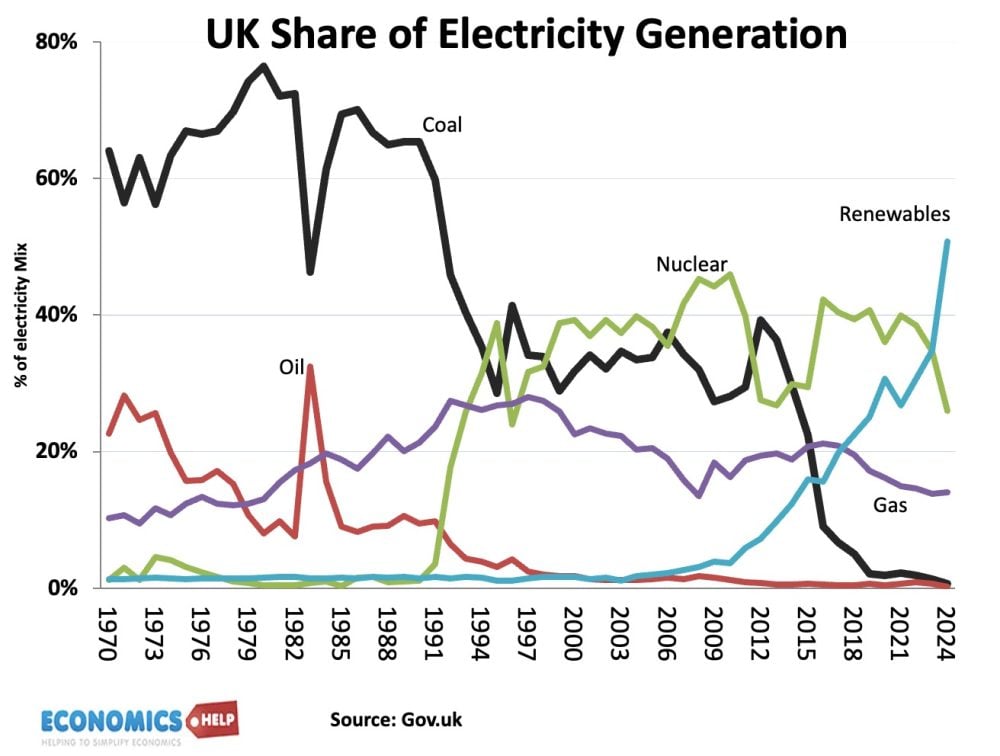
This graph shows the change in the UK electricity mix. In the early 1980s, it was dominated by oil and coal. Nuclear power increased in the 1990s, but has tailed off in past 5 years. Renewables are now the largest source. But, there is a limitation of solar and wind, output depends on the weather. If its cloudy and still day, renewables produce very little, and the UK has to fire up gas powered stations to keep the grid going – more likely in winter. A limitation of renewables is that they have higher storage and transmission costs and supply is not guaranteed. There has been a sharp rise in the costs of balancing the electricity system, and since April 2023, this falls on consumers – not both producers. Therefore, even though marginal cost of wind can be very low, it hasn’t helped reduce electricity prices.
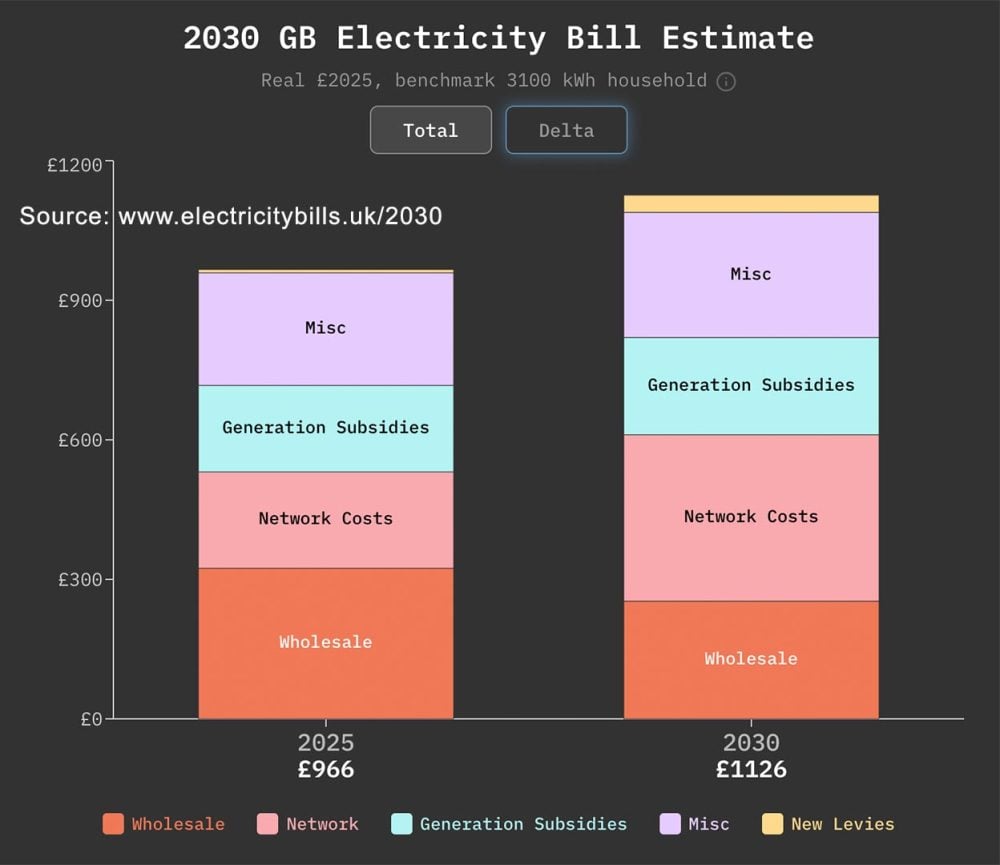
In the future, network costs will become a bigger part of the bill.
Also, a problem with wind power is that often we can’t make use of wind, so producers are paid a minimum price, but we can’t physically move the power (off coast of Scotland) to where it is needed – London, South East
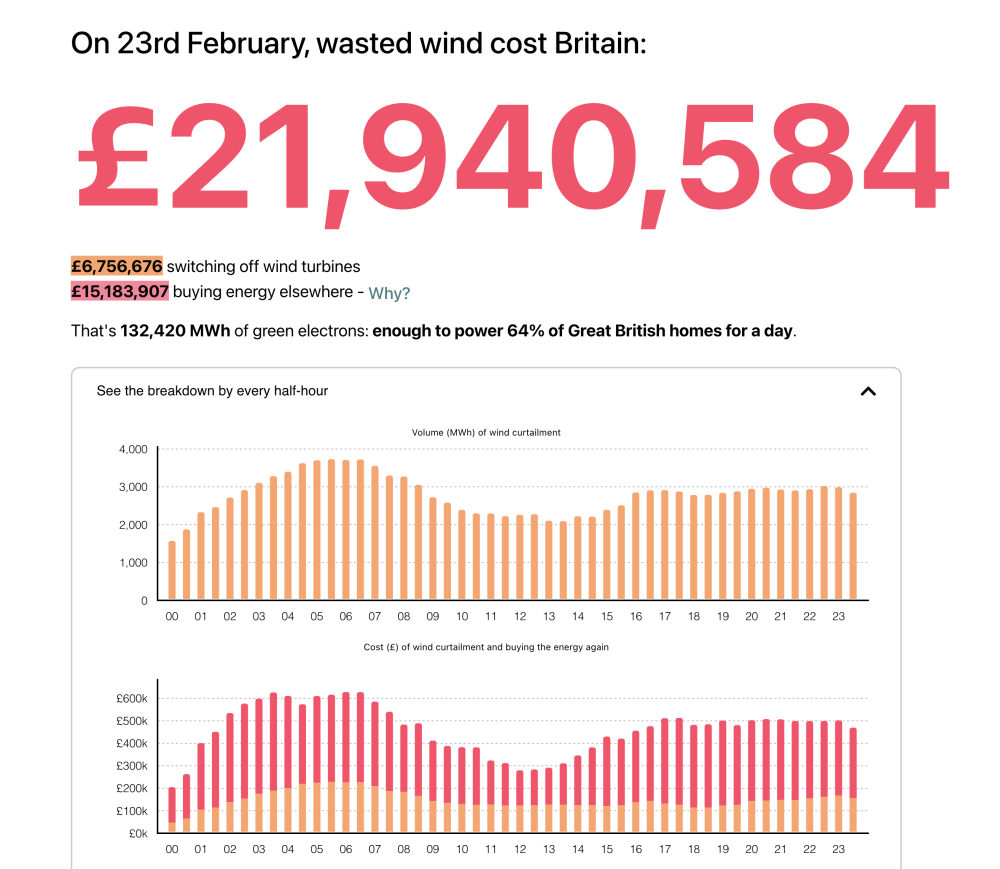
Wasted wind tracker tracks the cost of unused wind
UK Wind is also more expensive
Despite being very windy, UK wind is more expensive than say onshore wind in Germany. In the UK, big energy giants have successfully gained large subsidies and guaranteed minimum prices in return for investment.
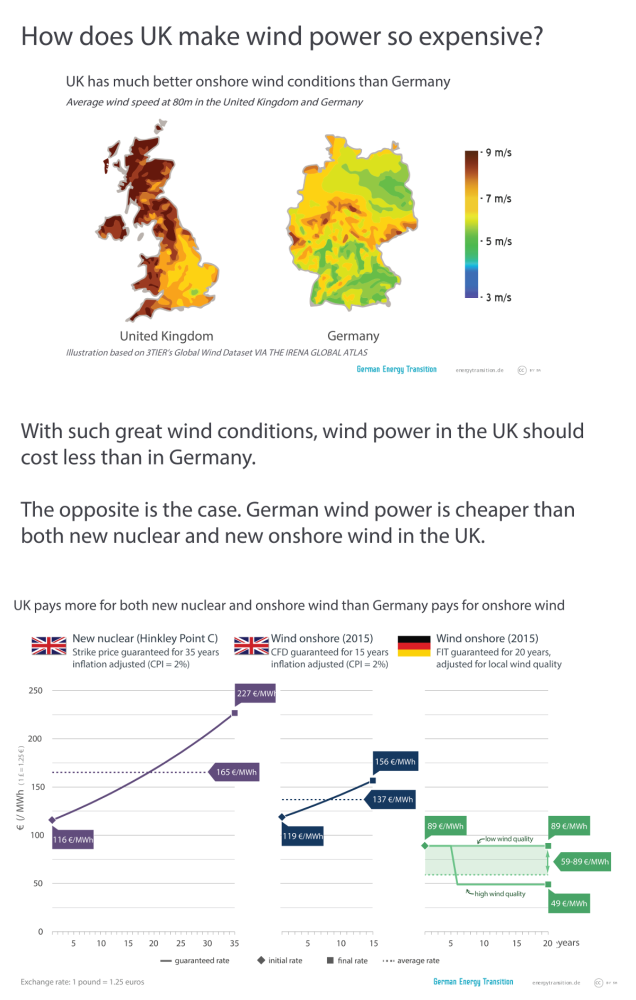
British energy expert Dave Toke put it well in December: “in Germany the independent renewables sector runs the RE industry. There the political interest group pressure is almost 180 per cent different to the UK. In this country it is the Big Six, give or take a couple of other multinational energy corporations, who will influence contractual terms.” Why is Wind so expensive in the UK?
Monopoly power of Gas stations
The dependence on gas to fill shortages can give gas producers a lot of monopoly power in charging excessive prices. It is a shame this critical energy infrastructure wasn’t kept in public ownership. It is also a great shame that many off-shore gas storage facilities were decommissioned and not replaced. It is easier to store gas, than store electricity. Though although privatisation has problems in some areas, if we look at UK electric prices since since 1970, it was privatisation and in particular deregulation of the electric industry in the early 1990s, which played a key role in reducing prices.
Renewables can work..
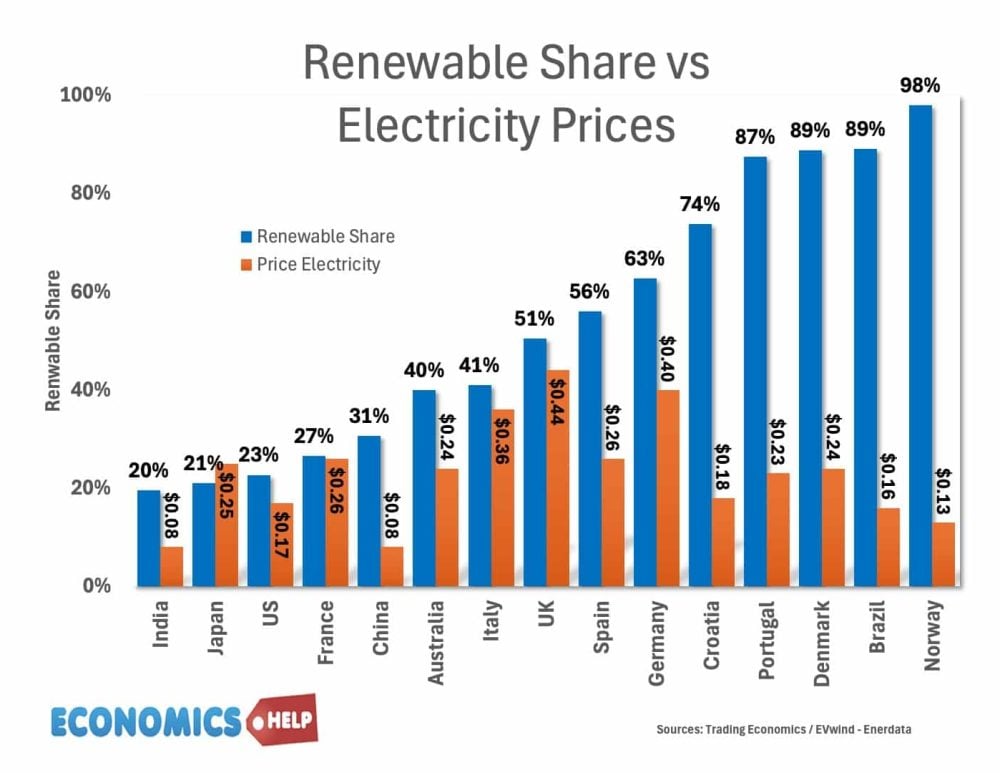
However, are renewables really to blame for the UK’s high prices? If we look at an international comparison. Many countries, Denmark, Brazil and Norway have much higher share of renewables, but much cheaper electricity prices. Part of the reason is that European countries have a few advantages. Firstly, Norway can make use of hydropower. A renewable source of electricity, that is much more stable than say solar. Also, European countries have better interconnectedness of importing electricity from each neighbouring countries. The UK hs certainly more reliance on gas.
Also, solar power + batteries is becoming very successful in places like California and Texas. But, the UK is too far north to benefit from solar in the winter. We have banked on wind, but wind technology has actually increased in recent years.
Cost of building
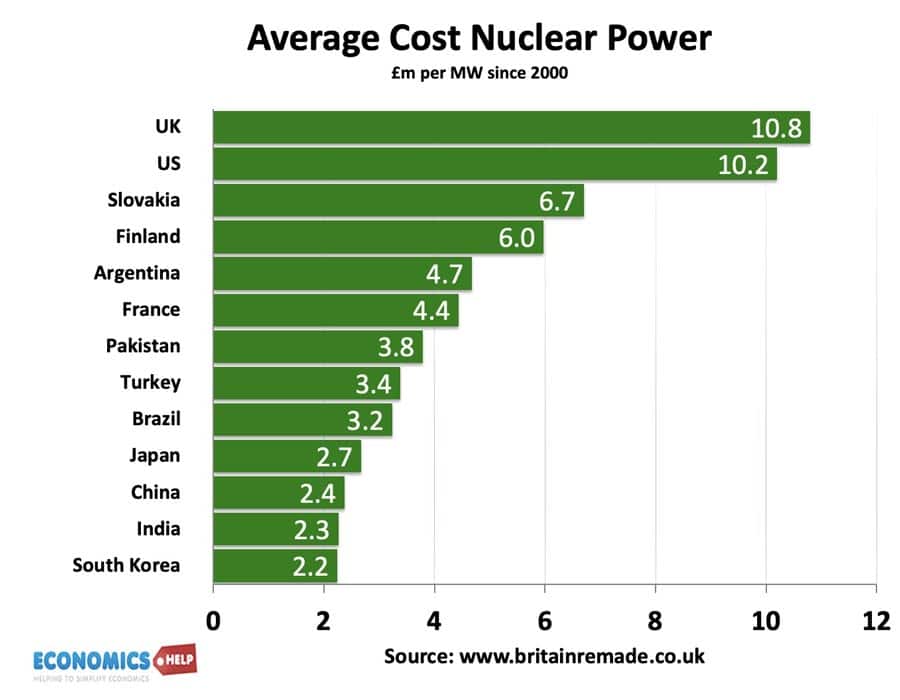
One reason for high electricity prices in the UK is the difficulty in building power plants and upgrading the national grid. A good example, is the difficult and cost of building nuclear power in the UK. High costs due to planning, consultations, over-regulation and lack of economies of scale mean that the UK is to set a record for the most expensive nuclear power station in the world, with the current cost estimated at £41 to £48bn, though when finished in around 2029, it will produce 7% of the UK’s total electricity, enough to power six million homes for 60 years.
Limited reserves in North Sea
After 2004, the UK was no longer able to be self-sufficient in gas, and currently imports more than 50%. One argument about Net Zero, is that the UK should be drilling for more oil and gas in the north sea. Banning new licenses for investment in north sea oil and gas doesn’t alter the overally amount of fossil fuels used in the world, it just alters where it comes from. The problem is that the UK’s north sea reserves have been dwindling for decades. The UK has definitely reached peak oil and gas. There are some fields that could be explored. By 2050. Production is expected to fall by 97%, but even with new licenses issued it would still fall 95%. It’s a similar story with North Sea oil. New fields and future discoveries can only marginally slow down the demand. Even if UK did issue new licenses, it would do nothing to alter the international price of gas, determined by global demand and supply.
Tax
Another issue with net zero policies, is that it involves environmental taxes and VAT. VAT is 5% on domestic bills and 20% for most business. Industry is also charged a climate change levy. For an average household, 16% of the final electric bill is taxes. For Gas, it is 6%. Bills could be modestley reduced by removing levies on energy use. But, it would require higher taxes elsewhere. VAT on fuel is not entirely regressive because higher income households have strong correlation of using much more energy due to bigger homes, more appliances, more likely to have electric cars.
Is Coal the Future?
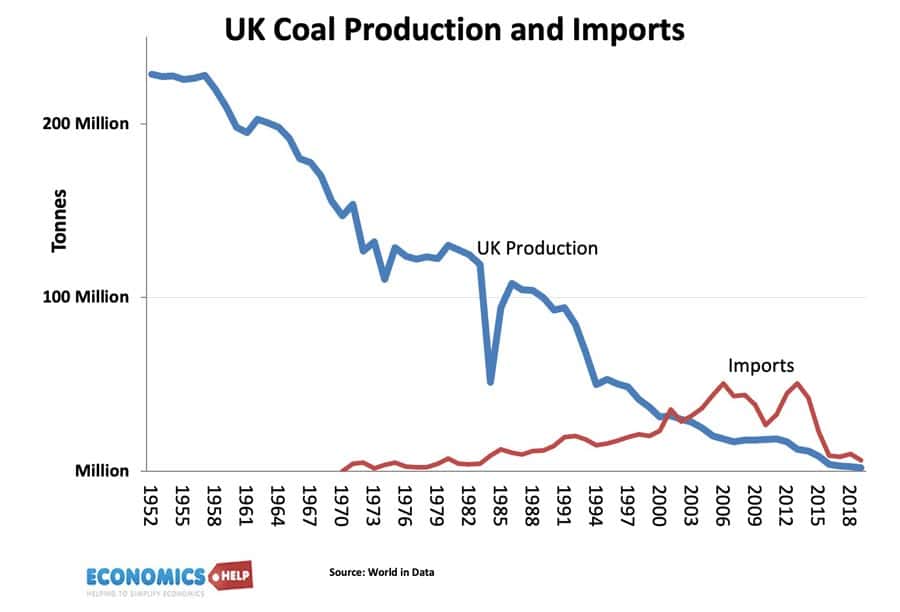
Another way to answer this question is would the UK have been better off if we had not built any renewables but just kept coal burning power stations. Firstly, burning coal had many negative externalities, pollution led to acid rain, climate change, mercury poisoining, higher risk of cancer and respiratory disease. In the US, an estimated 13,000 – 20,000 premature deaths due to coal pollution. Cleaner air, less pollution and less health problems is an economic and health benefit. Secondly, retaining coal power stations, would have helped reduced the surge in prices in 2022. But, it is worth bearing in mind, the cost was relatively high £100-£160 per MWh, compared to £70-120 for gas and £40 to £60 for wind. Given the carbon intensity of coal, nuclear power would have been better backup option.
Zonal Pricing – rejected
There are many other factors that are causing high price. Due to contracts given out in past decades, we pay firms to turn off wind power when there is surplus energy. Zonal pricing would encourage energy intensive industry to move to where energy is cheaper, making better use of existing energy and not losing money. It is a real scandal we are paying so much subsidies to wind farms to turn off energy. Though, the UK isn’t just subsidising renewables but fossil fueles and consumers and biomass. It’s a real mess. High prices, despite massive subsidies.
Grid Stability
Does relying on renewables make the grid less stable. It depends how it is managed, certainly, even with 90% coal, the UK did have blackouts in the past. In 2021, Texas had a massive energy blackout, but it ran an independent power grid cut off from other US regions, limiting ability to import energy. And, the incentives it gave were only for producing electricity just in time, with no rewards for capacity or backup readiness. In 2025, Spain, had a major power blackout. At the time 59% of the energy provided was from solar, 12% wind and combined gas plants just 5%. One theory is that solar energy has a lower inertia which can make grid more vulnerable to this kind of switch off. But, it is worth pointing out that it was a warm sunny day, and it’s not clear why power would suddenly drop off so drastically. It’s also a bit of irony, that if you are worried by potential power blackouts, the best thing to do is get solar panels and battery storage. You could find yourself suddenly very popular by neighbours and friends desparet to recharge their mobiles.
Renewables conclusion
Renewable energy does have potential advantages – lower pollution, lower prices, reduces the amount of imports that we need, reduce dependence on volatile fossil fuels. But, the energy mix is not right. But, the technological improvements which will be really valuable is improvements in battery storage and grid connnectivity. The UK did make mistakes in past few decades. Notably, lack of investment in national grid, decline in production of nuclear power. The UK is also hampered by this lack of hydropower that many European countries have. Nevertheless, despite these past mistakes there are solutions. Reducing end use demand, though greater efficiency, zonal pricing to help market rebalance geographical use. Continued investment in nuclear, perhaps taking help from other countries who are more successful in building.
Nevertheless a problem for UK in making a transition to non-fossil fuels, is to have a lack of hydro power and/or significant nuclear power.
Related posts
Sources:
- https://www.theb1m.com/video/hinkley-point-c
- https://oeuk.org.uk/uk-gas-production-will-fall-75-by-2030-without-new-investment-warns-industry-body/
- https://www.nesta.org.uk/project/finding-ways-to-deliver-cheaper-electricity-by-rebalancing-levies/household-energy-bills-green-levies/
About The Author
