
Back in January 2021, you could lend the UK government £100 for thirty years — the safest investment there is. Today that £100 is worth £35. Government bonds have lost 60% of their value, and many fear the sell-off isn’t over.
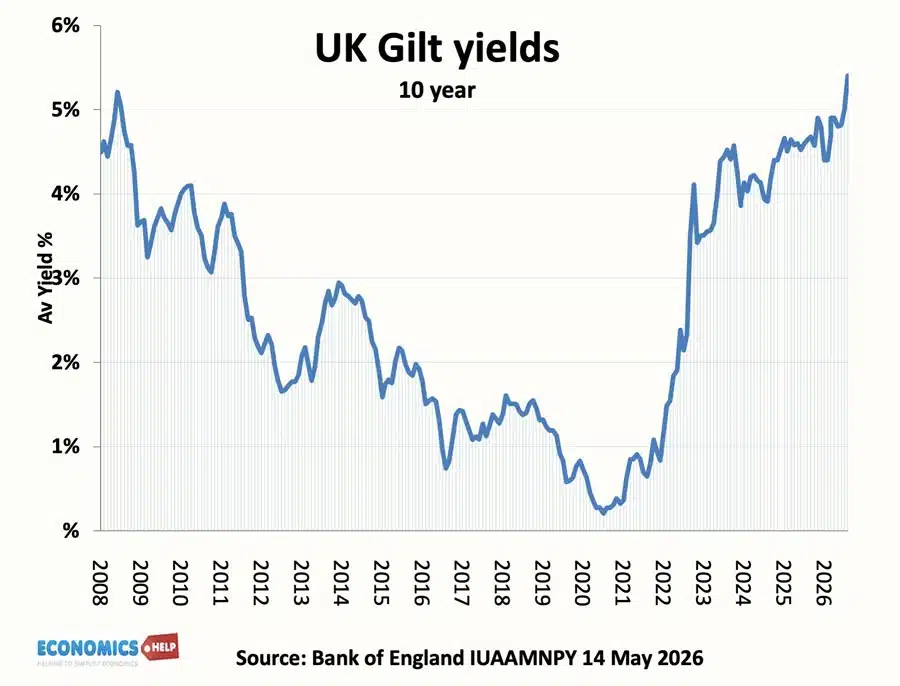
US yields have just hit 5.2% and UK yields 5.4%, the highest since before the financial crisis. So why are borrowing costs back at 2007 levels when the economy looks nothing like 2007? And why is your mortgage going up when the Bank of England hasn’t moved rates?
A global sell-off, not a British one

This is not a UK problem. Yields are rising across every major economy, and fastest in heavily indebted France and Italy. And when bond yields rise, bond prices fall — which matters even if you have never bought a bond in your life, because your pension fund almost certainly holds them. The thirty-year gilt is an extreme example; shorter-dated bonds have lost far less.
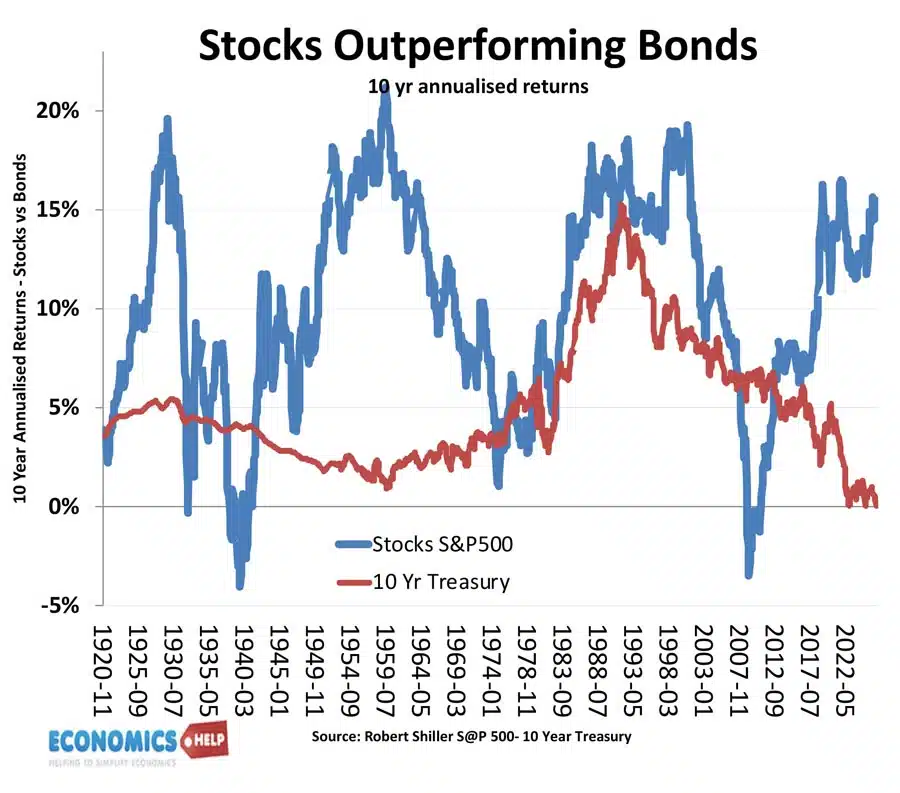
The scale of the underperformance is striking. Over the past ten years, US shares have beaten government bonds by the widest margin since 1960. The problem is that government debt is rising everywhere at once, just as the appetite for buying it is falling.
The AI borrowing boom
The first explanation for the sell-off is that AI firms are creating the biggest investment boom in history — and are increasingly funding the data centre build-out by borrowing, issuing corporate bonds. That extra supply competes directly with government bonds.
Alphabet, Google’s parent company, raised £5.5bn in sterling in February, including a 100-year bond. Some investors may feel they will get a better return lending to Google than to the UK government. At least Google doesn’t have a demographic timebomb and a pension triple lock to fund.
Not everyone buys this. Economists at HSBC and Morgan Stanley doubt the link between corporate issuance and sovereign yields is that strong.
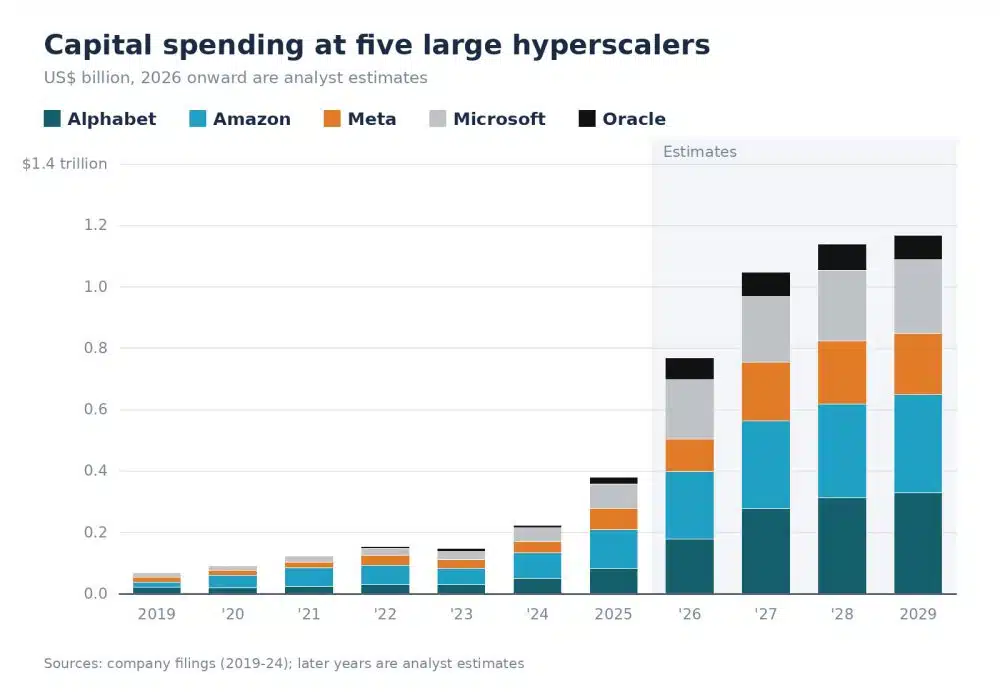
What is not in doubt is that higher interest rates are not slowing the build-out down. Capital spending at the large hyperscalers is forecast to run at over $1 trillion a year. Mike Riddell, a fund manager at Fidelity, says markets are not even close to cooling a red-hot economy. Interest rates of 5% are causing real pain for households, but they are not slowing the AI boom.
Oil, diesel and the inflation channel
While stock market investors talk about a red-hot economy, ordinary households will feel they are living in a parallel universe. The only red-hot thing about the real economy is the price of petrol and diesel.
There is a strong link between oil prices and inflation, but as regular readers will know, the real issue is how far diesel prices have risen. That feeds through to inflationary pressure, especially as the crisis and elevated prices drag on. An important point is that this rise in oil prices is now more sustained than the spike after Russia’s invasion of Ukraine in 2022.
On a more positive note, oil flows through the Strait of Hormuz have increased, with the US navy escorting tankers at great cost. But investors doubt a lasting solution. Iran’s real threat is not the Strait itself but its ability to hit refineries across the region — and it is diesel, not crude, driving inflation and therefore interest rates.
What is actually driving yields
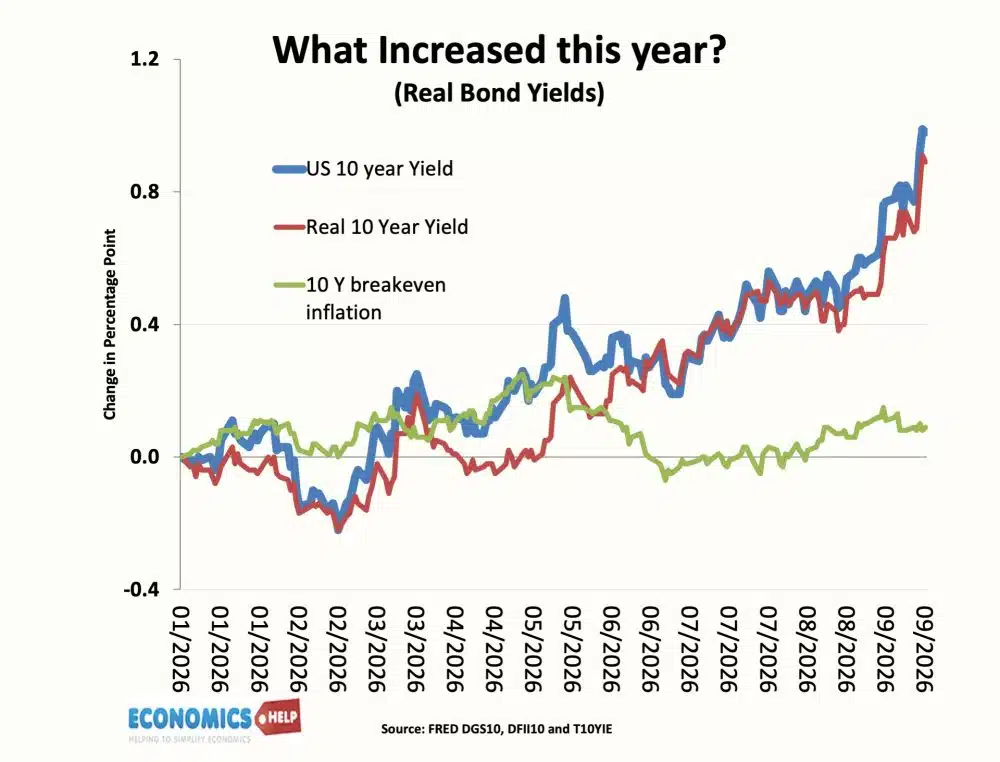
Here is the strange thing. If you break down this year’s rise in US bond yields, almost none of it is due to higher expected inflation — markets still expect long-term inflation of around 2.3%. Even this month, with Brent crude up 15%, expected inflation barely moved.
Nearly the entire rise is the real yield: investors demanding a genuinely higher return to lend. And that points somewhere else entirely.
Deficits and the debt spiral
If the AI boom is focused in the US, why are yields rising everywhere, even in European countries facing a slowdown? Global bond yields have always followed US yields to some extent — if US yields are higher, competition pushes UK rates higher whether we like it or not.

Beyond AI and inflation there is the longer-term pressure of fiscal deterioration. Deficits are rising and debt as a share of GDP is forecast to keep climbing. The US may have a red-hot economy, but it is not translating into government tax revenues. The Congressional Budget Office warns that if rates run one percentage point above the baseline, US debt will reach 222% of GDP by 2056 — 47 points above the baseline projection. In other words, a rise in bond yields compounds into a rise in debt.

The US Treasury is already worried enough to be buying back debt. Some traders see this as QE by the back door, and it points to the real long-term threat to bondholders: a government inflating away its debt. It has happened before, at lower debt levels than today.
Why your mortgage is rising anyway
Governments face a double hit. Higher bond yields raise debt interest costs, higher borrowing costs hit homeowners, and rising diesel prices feed inflation.
In the UK, the Bank of England has held base rates at 3.75% because growth is still weak. But the Bank is almost helpless to stop mortgage rates rising, because fixed mortgage rates are priced off swap rates, which follow bond yields rather than Bank Rate.
To be fair, mortgage rates are not rising as fast as in the US, where thirty-year rates are at 7%. But that is little comfort to a UK homeowner coming off a five-year fix at 2.63% and remortgaging at 5.96% today. On a £150,000 mortgage over thirty years, that is a rise from roughly £603 a month to £895 — an extra £292 a month, or around £3,500 a year.
The structural problem
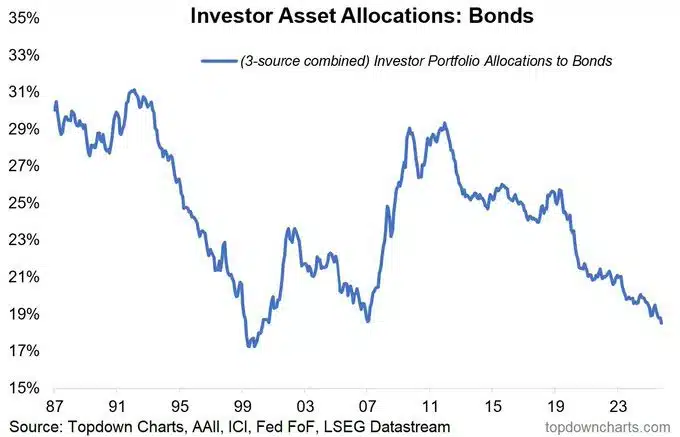
Allocation to bonds as share of investor assets falling. Topdown Charts / Chart Storm – stocks versus bonds long-run returns
Some argue that fiscal risk is a long-term issue and doesn’t explain a short-term surge. That is true — but underneath the five-year rise is a bond market with structural problems. Pension funds have shifted from seeking guaranteed income to seeking capital growth. Global bond supply keeps rising as every country borrows more. And overseas buyers are retreating: China in particular has gone from major buyer to seller, with several central banks diversifying away from US bonds and into gold.
The case against
Past performance is no guarantee of future returns, and the bond market moves in cycles. If the AI boom unwound and stocks fell, the relative returns of bonds and shares could reverse. It is also worth remembering that the dividend yield on shares has fallen below 2% — for an investor who needs income alone, bonds now offer the better return.
An end to the Iran war would allow oil prices to fall and inflation to come back down. And the fiscal story is clearly not the only driver, even if heavily indebted countries like France and Italy are seeing the largest rises in yields.
There is also a warning sign with short-term yields have been rising faster than long-term yields, and last week the gap between two-year and ten-year Treasuries nearly closed. The two-year yield is essentially the market’s bet on where the Fed goes next, so a narrowing gap means investors expect rates to rise sharply and then come back down — which is what happens when an economy stalls. An inverted curve has preceded every US recession since the 1960s, though it gave a false signal in 2022. Either way, it is a reminder that today’s high yields may not last.
A two-speed economy
The real problem is that interest rates are rising despite large parts of the economy being very weak. Strip away AI investment and the economy is not hot at all. Households are struggling with rising living costs, and those costs are being made worse by higher interest rates.
Usually when rates rise it is because of strong growth and demand-pull inflation. Today they are rising because of higher living costs, an AI investment boom and higher government debt — and none of those three is helping ordinary people.
A rise in bond yields isn’t necessarily a bad thing; yields have been far higher in the past. The issue is that the reasons behind this rise are not helping the economy. There is a growing imbalance between the AI boom and everything else. AI is absorbing resources and pushing up interest rates, which is perhaps why it is the real yield rising rather than inflation expectations. Households face higher living costs and higher interest rates without benefiting from the boom in US investment. It looks like a very distorted allocation of capital.
Sources
- Financial Times – bond market coverage, September 2026
- Financial Times – AI borrowing and corporate bond issuance
- Financial Times – global yields and the Fed outlook
- Topdown Charts / Chart Storm – stocks versus bonds long-run returns
- Congressional Budget Office – long-term budget projections
- FRED, Federal Reserve Bank of St Louis – DGS10, DFII10, T10YIE
- Bank of England – Bank Rate decision, 17 September 2026
- Moneyfacts – average UK mortgage rates
About The Author
