
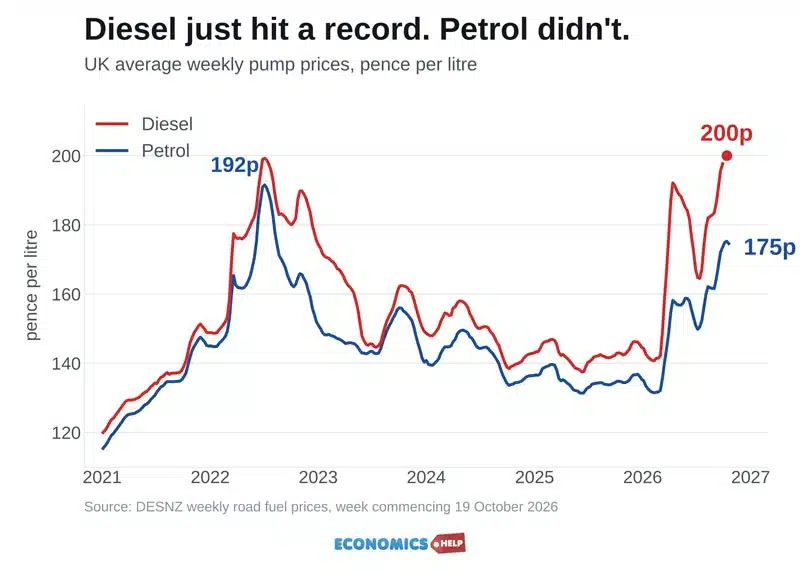
If like me you filled up with diesel this week, you paid a record price. Over 200p a litre. That has never happened before. That is 56p a litre more than this time last year.
Now the obvious answer is the war, and the disruption to oil coming through the Strait of Hormuz. But there is a complication. There isn’t one oil price any more. There are two, and right now they are telling opposite stories.
Two prices, opposite stories
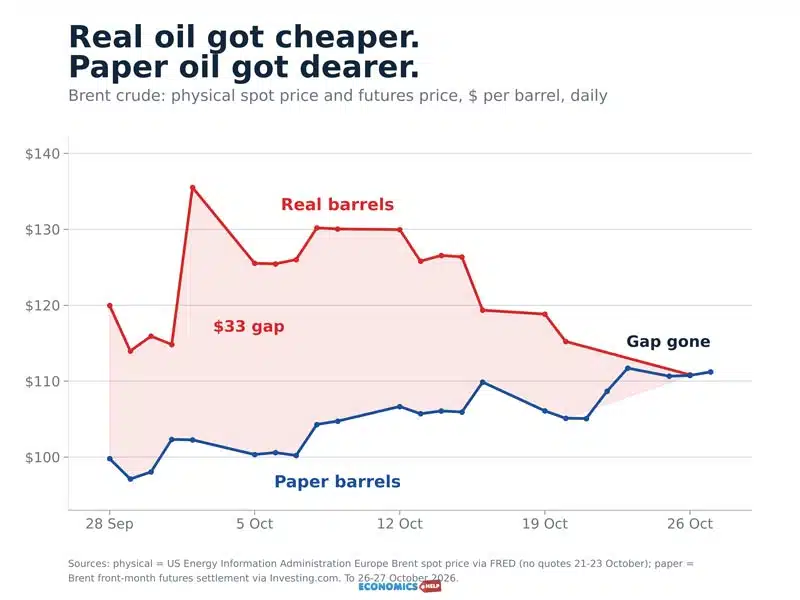
For a real barrel of physical oil, loaded onto a ship, the price is falling. It is $25 lower than at the start of this month, and well below its April peak. But if you buy a futures contract, the price has been rising.
On the second of October a real barrel cost $33 more than a paper one. By last Monday they had converged. The gap vanished in under four weeks.
So why is physical oil getting cheaper, paper oil getting more expensive, and diesel still trading at an all-time record?
Spot and futures
First it is worth explaining the difference. The spot price is what a refinery pays for the crude it needs now. The futures price is a contract for delivery months ahead. Normally the two are within a dollar or two of each other. The crisis broke that link. When physical oil is genuinely short, a refinery will pay whatever it takes to get a cargo landed this week, because you can’t make diesel out of a paper contract. That is what a $33 premium was telling you.
But in recent weeks more oil has been moving through Hormuz — estimates suggest around 84% of pre-war levels. However, oil is flowing at a high cost. Shipping a barrel from the Gulf to China cost about $2 in January. It now costs around $36, because of the war risk.
So why has the paper price gone up over exactly the same weeks? Because traders are pricing what happens after the American midterms on the third of November. They fear escalation, and strikes on Gulf oil facilities. That is a political calculation rather than shortage.
Why diesel is still at a record
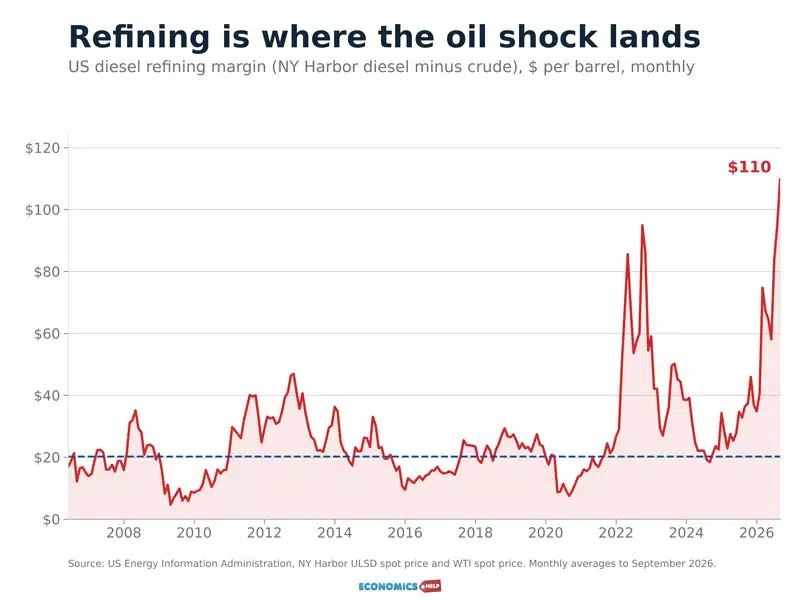
Which leaves the real question. If physical crude is falling, why is diesel still at a record? And why is that the price that matters most to your finances?
Crude spot prices have been volatile all year. January, $67. April, $117. June, back down to $86. September, $115.
The refining margin has done nothing of the sort. That is the gap between what a refinery pays for crude and what it sells the diesel for — the cost of the processing, not the cost of the oil. Between 2015 and 2019 it averaged $20 a barrel. It is now over $100.
You can see it at the pump. Diesel used to cost about 4p a litre more than petrol. Today that gap is 25p. And 21p of that gap is the shortage and nothing else. That is £11.42 every time you fill the tank, purely because the world cannot turn crude into diesel fast enough.
Three pieces of evidence
There are three pieces of evidence that this is a refining crisis rather than an oil crisis.
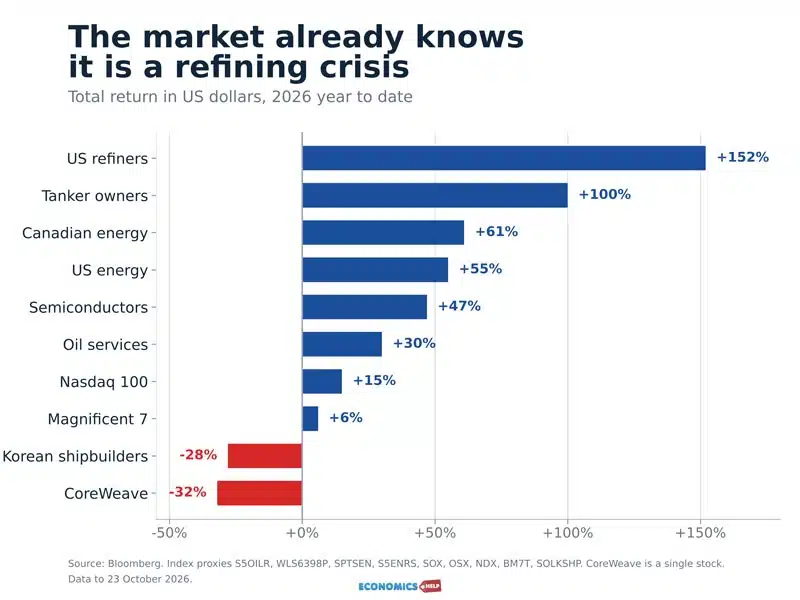
First, look at who makes profits. US oil refiners are up 152% this year. Crude oil producers are up 55%. Tanker owners up 100%, oil services only 30%. If this were a crude shortage the producers would be winning.
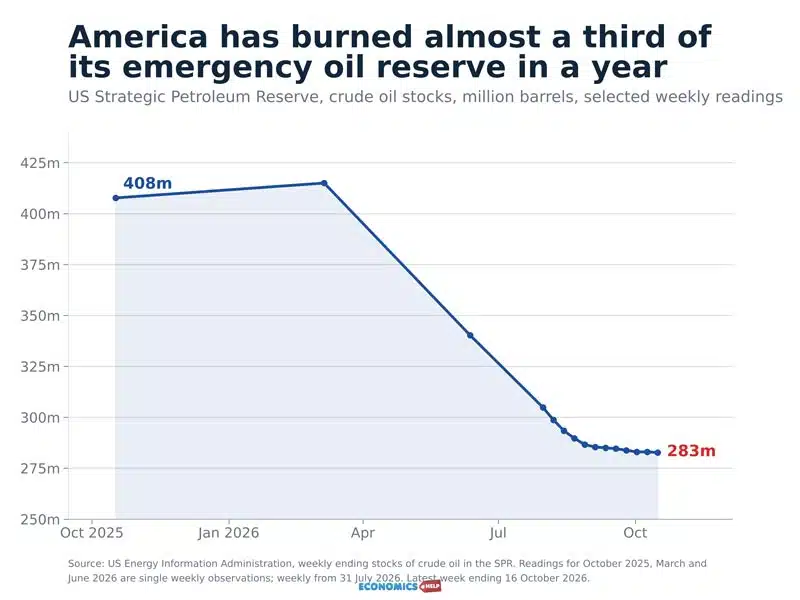
Second, governments have tried to fix this and couldn’t. The G7 released 100 million barrels from strategic reserves, and Trump cut a deal for more Russian diesel. It did cause the UK diesel-petrol gap to fall from 34p in April to 14p over the summer. But then it went straight back up to 25p. You can talk the paper price down for about six weeks, but you can’t talk a refinery into existence.
Third, and this is the real mechanism. The conflict hit major Gulf refineries, knocking them out of production — and even the ones still running couldn’t get the diesel out. Then Ukrainian drones hit Russian refineries, taking out another slice of global diesel supply. And Europe has been closing refineries for years, so there was no slack to begin with. Crude can be re-routed around a blockage. Refining capacity cannot.
The cushion is gone
On top of that, the cushion is gone. America has drained its Strategic Petroleum Reserve from 408 million barrels to 283 — the lowest since 1982 and the scheduled repayments don’t start until 2027. Commercial diesel stocks are around 10% below last year.
Which means there is nothing left to absorb the next problem. One more refinery outage now moves the price in a way it simply wouldn’t have in 2024.
How long, not how high
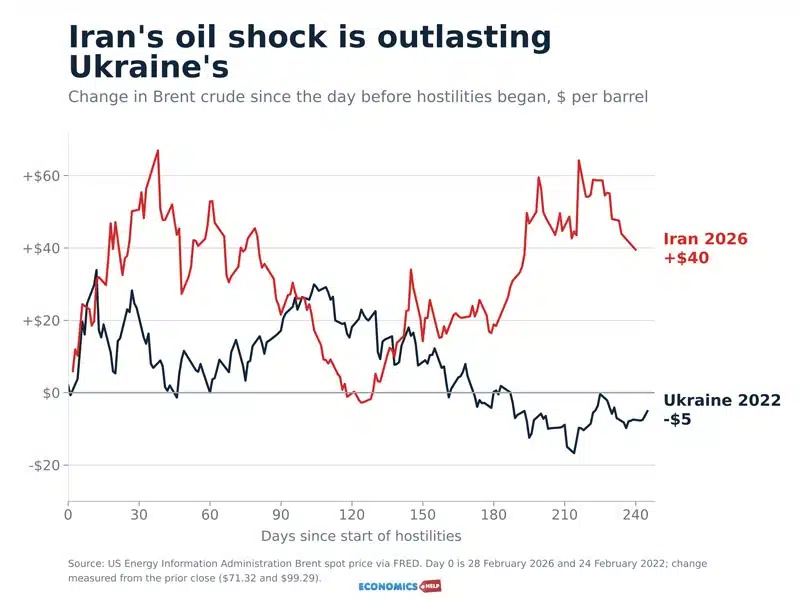
When oil prices rise the temptation is to ask how high they will go. I would argue that is partly the wrong question. What determines the damage is how long prices stay elevated. And this shock is already outlasting the last one. Two hundred and forty days after the invasion of Ukraine, Brent was $5 below where it started. Two hundred and forty days into this one, it is $40 above.
Here is why that matters for your money.
First, base effects. A temporary spike removes itself from inflation automatically. In 2023 energy went from being the biggest contributor to inflation to a large negative, which is most of why the UK rate fell from 11% to 3%. A plateau never does that.
Second, lags. An energy shock takes six to eighteen months to work through into core inflation. UK inflation only really jumped last month – a sign of what is to come, if diesel remains expensive.
Third, hedging. Firms hedge fuel six to twelve months ahead, so part of the early shock was absorbed by contracts bought in 2025 when oil was $69. As those expire, firms are re-hedging at today’s higher prices.
Fourth, and most important, expectations. One bad year gets absorbed. Two bad years get into pay settlements and knock-on effects.
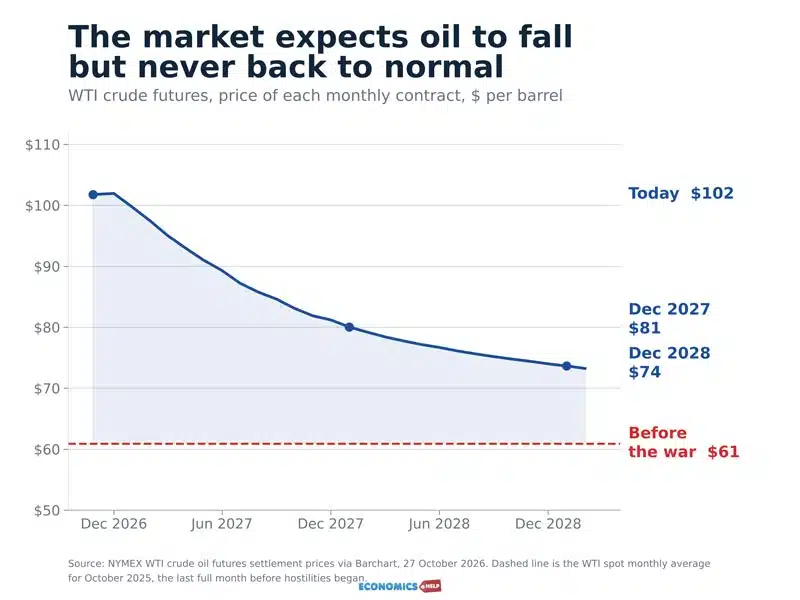
The market seems to agree this is likely to last. December 2027 WTI is trading at $81 a barrel. Before the war, oil was $61. That is $20 a barrel the market still expects to be there in fourteen months’ time. Futures prices are not reliable forecasts — but this conflict has already run far longer than almost anyone expected back in March.
The objections
Now, you could object to all of this. The most important price, the actual physical one, is coming down, because crude is flowing again. Hormuz was the crisis. If that is 85% solved then in theory we are heading back towards normal, and the rise in paper prices is just political speculation. If those fears don’t materialise, crude falls sharply after the midterms.
Unless there is a flare up in the political situation this is probably right — about crude. But diesel is a separate market. If refining capacity stays constrained, diesel stays high whatever crude does. So the question becomes: when does refining capacity come back? The IEA’s answer is the second half of 2027, even if the conflict ended tomorrow. That is at least another nine months of elevated diesel prices, and that is more than enough to keep inflationary pressure going.
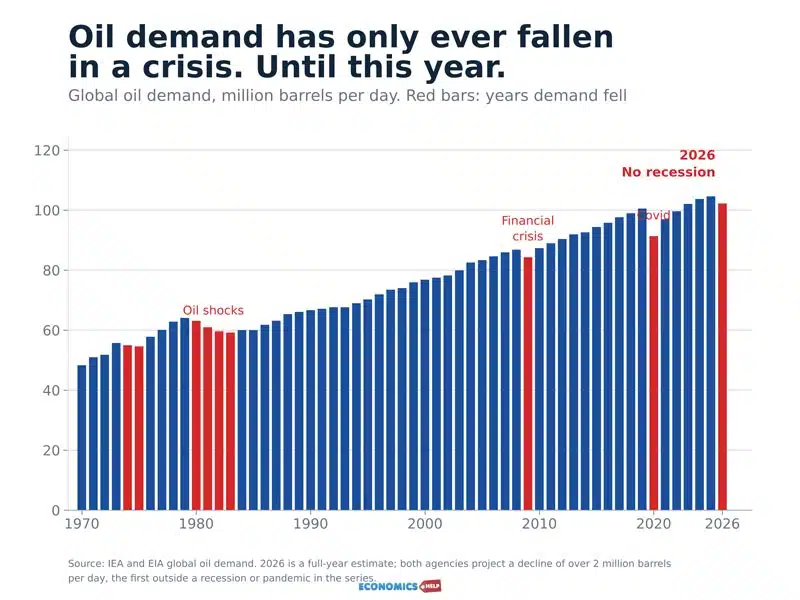
A bigger objection is more interesting — global oil demand has fallen this year. It is the first time we have seen a big fall in oil demand without a recession. Part of the reason is simply supply was physically rationed. With 2 million fewer barrels, consumption fell 2 million. And the diesel crisis has been great for electric car sales! But diesel demand is still pretty inelastic. Rising prices could be deflationary and cause lower growth.
Why this reaches your mortgage
Here is what makes this different from an ordinary cost-of-living squeeze. Diesel isn’t just pushing up prices. It is pushing up interest rates.
Central banks respond to persistent inflation, and a one percentage point rise in rates cuts housing investment by around 6%, takes 0.2% off consumer spending, and adds to government debt interest at a time of record borrowing. For a household coming off a five-year fix, that doesn’t arrive as a statistic. It arrives as a monthly mortgage payment.
And it is a diesel car costing £514 a year more to run. It is a 44-tonne lorry burning 57,000 litres a year, whose fuel bill is up £32,000 — and that lorry delivered your supermarket shop. Petrol moves people. Diesel moves goods, which is why it leaks into the price of everything.
This is the backdrop to the upcoming UK budget, everything is getting squeezed by the external pressures of rising oil and diesel prices. It is why the upcoming budget will be so difficult, this explains the pressure the UK government is facing.
About The Author
