
Last week Alphabet had its worst day since it went public in 2004. The shares fell more than 12% and roughly $500 billion came off the company’s value in a single session. The simple story is that AI stocks are expensive, investors are nervous, the bubble is popping. But, share prices are only one part of the equation, rising bond yields are actually a bigger stress signal. Google will probably be fine, but other players may not survive.
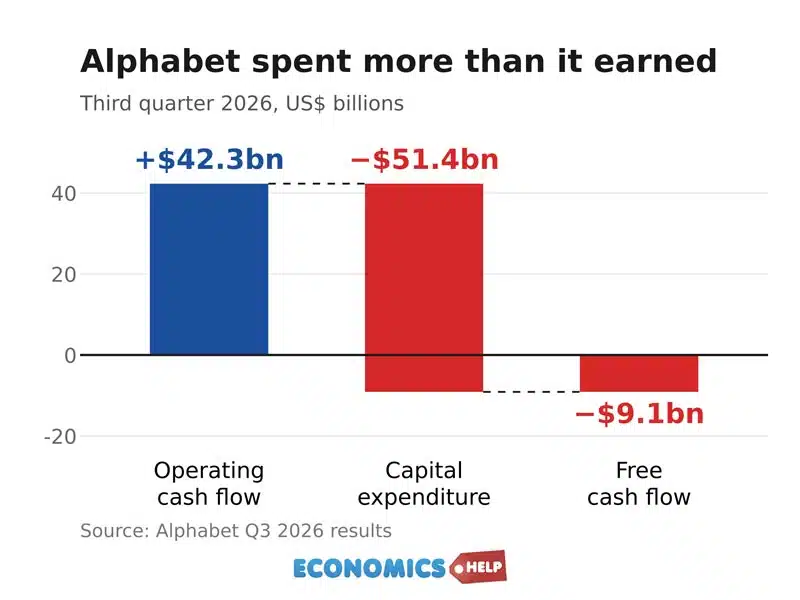
But this is about much more than stock prices. If you look into Alphabet’s accounts you will see that in the third quarter it spent $51.4 billion on capital expenditure — data centres, chips, power. And the company once known as a cash printing machine reported negative free cash flow of $9.1 billion. It is spending more than it earns.
The Financing crossover
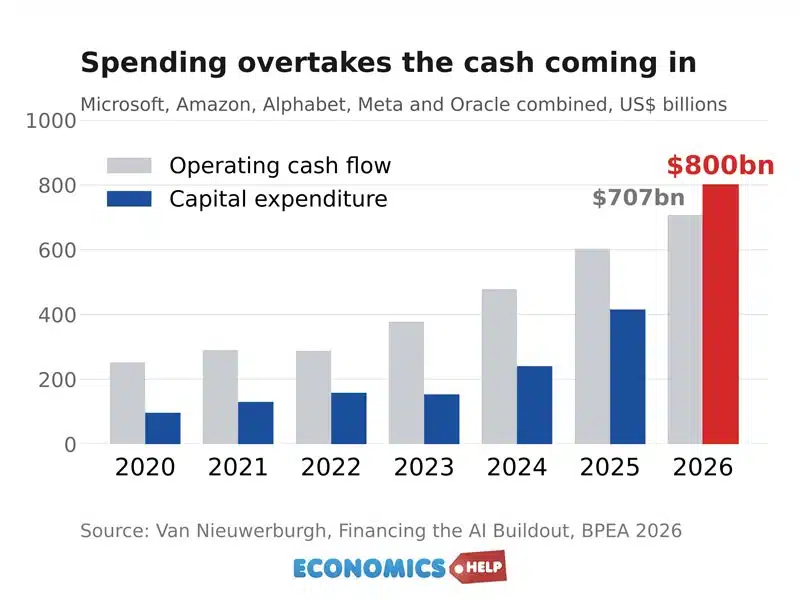
In 2020, the big five — Microsoft, Amazon, Alphabet, Meta and Oracle — generated enormous profits from search, advertising and cloud. They spent $97 billion on capital expenditure against $252 billion of operating cash flow, a ratio of 38%. By 2025 that investment had reached $416 billion, or 69% of cash flow.
This year investment is running at around $800 billion, or 113% of cash flow. For the first time in more than a decade, these companies are spending more on building AI than their businesses produce in cash. And future commitments suggest this will rise above $1 trillion a year for the next four years.
How is build out Financed?
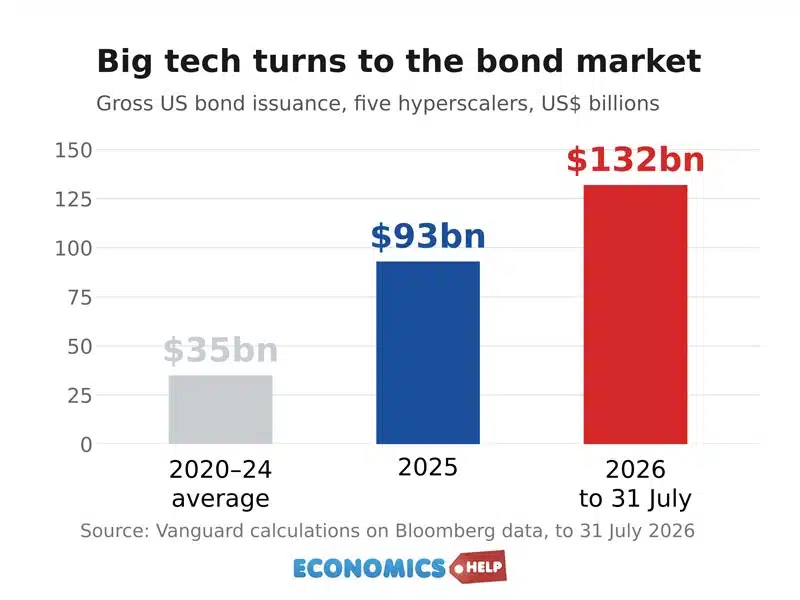
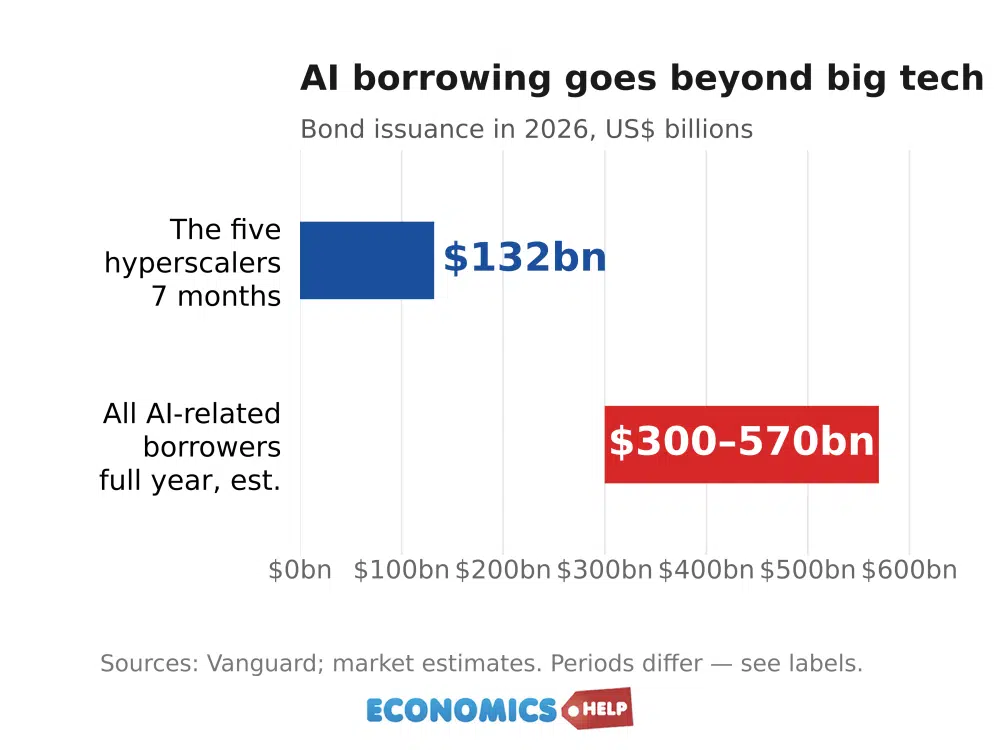
Between 2020 and 2024, those five companies issued about $35 billion of bonds a year between them. In 2025 it jumped to $93 billion. In the first seven months of 2026 alone, it was $132 billion. Their combined debt now stands at around $700 billion, and it is set to increase.
And that is just the big five. Once you include the chipmakers, the data-centre developers and the utilities, estimates of total AI-related bond issuance for 2026 run from $300 billion to $570 billion. Alphabet issued $75 billion in the first nine months of this year.
But the wave of optimism around AI is being challenged. There is a backlash against building data centres — it is unpopular across the political spectrum — and markets are worried that fantastical revenue forecasts may fail to materialise.
Rising Interest Costs
The cost of insuring Oracle’s debt against default is at a multi-year high, and traders now use it as a general proxy for nervousness about AI. CoreWeave, which rents out Nvidia chips, has been paying around 15% on some of its borrowing. If rates rise from 5% to 15%, you need far more revenue to justify the borrowing binge.
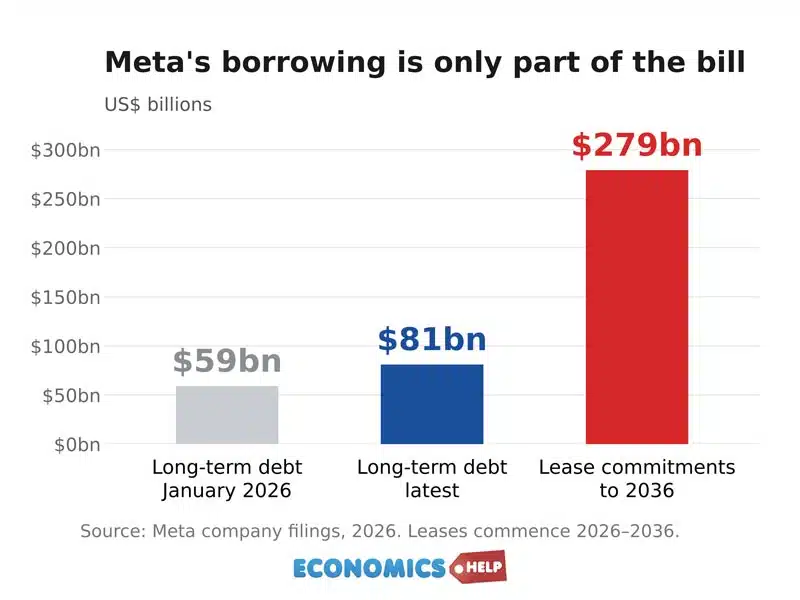
Meta’s long-term debt has gone from $59 billion in January to $81 billion. Alongside that it has disclosed around $279 billion of lease commitments running to 2036 — three times the borrowing, and rarely counted, because leases do not get called debt.
Why it matters in Britain
To see why this matters beyond Silicon Valley, you need the scale of what is being built.
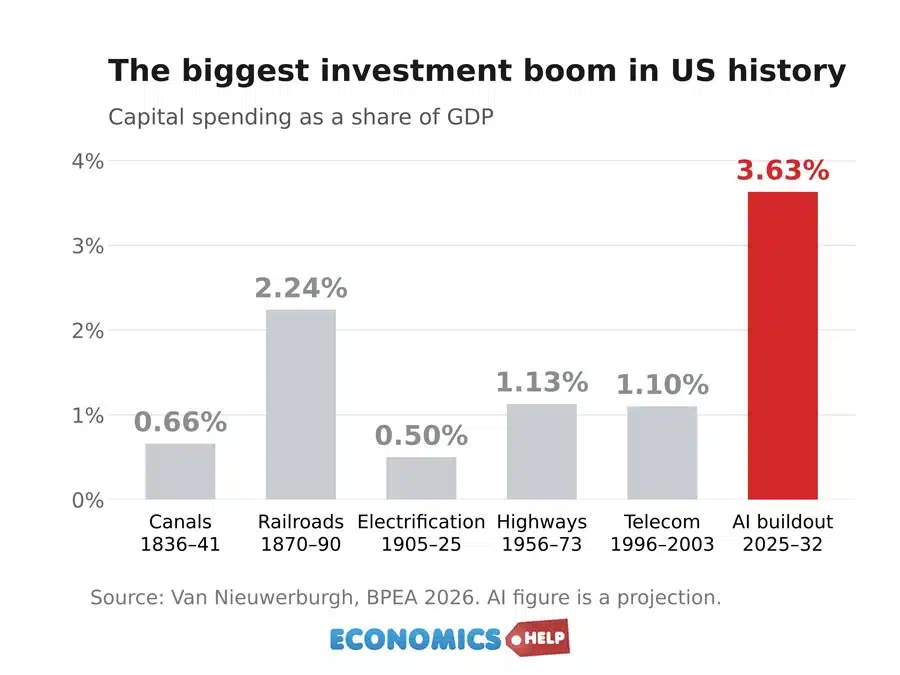
There is a paper by Stijn Van Nieuwerburgh of Columbia which sets the AI buildout against every major capital spending boom in American history. His estimate for the AI buildout, running to 2032, is 3.63%, around $10 trillion. That would make it the largest capital spending boom in American history.
All that AI borrowing competes for the same pool of global savings that governments are borrowing from — and governments are borrowing a lot. Debt is rising across the OECD. The US deficit approaches $2 trillion. France is facing real distress, and bond issuance continues to grow in the UK and Europe.
More borrowing by AI firms means they and governments are chasing the same buyers. That means interest rates rising, and higher gilt yields feed into higher mortgage rates. You do not need to own a single tech share for this to reach you.
In Britain there are around 140 proposed data centre projects, and together they have applied for 50 gigawatts of power. Our entire peak demand is about 45 gigawatts. Most will never be built, but Ofgem is now consulting on charging data centres for grid access, because the applications are clogging the connection queue.
What makes the AI bubble a big issue is the disconnect with the rest of the economy. US growth was running over 2.5% this year, but it is being driven by capital investment. Households are just seeing higher electricity bills, unwanted data centres and higher interest rates. How sustainable is the AI boom if it does not benefit households? Last night election results in the US, will be a blowback against building data centres.
The case on the other side
These are not dot-com companies. Microsoft, Alphabet and Amazon have real revenue, real profits and investment-grade credit ratings. Microsoft is still generating positive free cash flow. If borrowing gets expensive, they can simply slow down — that is very different from a telecoms company in 2001 with debt and no business underneath it.
Nor is this always the circular financing people claim. Microsoft put around $13 billion into OpenAI over six years, and booked $24.1 billion in revenue from it in the 2026 financial year alone. The money came back.
And the infrastructure does not disappear. The railways went bust and the rails kept carrying freight for a century and a half. Even if the current owners lose money, the data centres will get used.
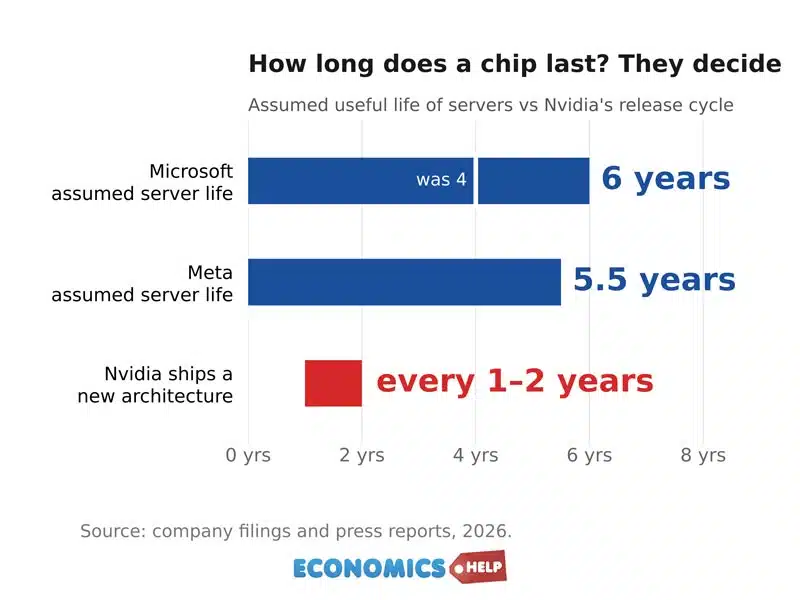
Though one caveat on those profits. How long does a GPU last? The companies decide, and they have been extending the answer — Microsoft from four years to six, Meta to five and a half — while Nvidia ships a new architecture every year or two. Stretch the assumed life and reported profit goes up. Michael Burry reckons the industry is overstating profits by well over $100 billion across the next few years.
The sums that do not add up
Goldman Sachs ran the numbers in September. On the average annual capex across 2026 and 2027, they estimate the hyperscalers need around $308 billion a year of AI revenue just to break even. For a normal return on that capital, 10% to 20%, you would need somewhere between $417 billion and $526 billion a year.
So what are they actually earning? Goldman’s measure is that cloud revenue was running about $70 billion a year above the old pre-AI trend. But, that is well below the $300-570bn target.
In fairness, the same analysis notes that announced revenue backlogs — contracts signed for future years — are over $1.5 trillion. That is real, and it is the strongest thing the bulls have. But a backlog is a promise to pay later, often by companies that are themselves raising money to be able to pay it. It is not revenue until it gets paid.
That gap might close. AI is genuinely useful and getting cheaper, and cheaper usually means more demand, not less. Though it is quite possible that improving technology means you can bypass the likes of OpenAI and Anthropic completely and run your own model. You can do that already, and open-source models will soon catch up to the best frontier models.
But whatever happens, the bond market is already starting to price in increased risk, and that means higher interest rates. You can see it in Oracle’s credit default swaps and CoreWeave’s 15% borrowing costs. This is the kind of interest that makes the whole thing less profitable.
So the question for the next year is not whether AI works. It is whether the financing holds while we find out. Watch the bond market, not the share price.
Sources
- Stijn Van Nieuwerburgh, Financing the AI Buildout, Brookings Papers on Economic Activity, 2026 — capital spending booms as a share of GDP, and hyperscaler capex against operating cash flow. Conference draft (PDF); NBER working paper.
- Vanguard, The AI buildout comes to the bond market — hyperscaler bond issuance by year, as of 31 July 2026.
- FactSet, Hyperscalers Tap External Financing as AI Capex Outruns Cash Flow — incremental debt as a share of capex, and aggregate debt.
- Goldman Sachs via Investing.com and Edward Conard — break-even revenue and the return threshold.
- CNBC on bond market anxiety over AI capex, and Oracle’s CDS as a proxy for AI debt fears.
- Oracle’s CDS spread at a record 288 basis points, 15 October 2026.
- Hyperscaler quarterly capex and cash flow: AI Capex Tracker, November 2026.
- Bank of America via Parameter — aggregate hyperscaler free cash flow turning negative in 2026.
- Meta’s non-voting share class and capital raising: Reuters explainer, 23 October 2026.
- Depreciation and useful-life assumptions: AI Capex Depreciation Accounting and Yardeni on the quality of AI earnings.
- UK data centre grid applications: Resultsense on the Ofgem consultation and Computing on grid access charges.
Figures are as reported at the start of November 2026. Forecasts for 2026 onward are consensus estimates and the Van Nieuwerburgh projection runs to 2032.
About The Author
