
Baumol’s Cost Disease explains why the cost of services tends to rise faster than goods, even when productivity in those sectors doesn’t improve much. It explains why wages in service sector can rise despite stagnant productivity. Baumol explained it as a disease because the less productive industries take up a bigger share of the economy.

This shows how the the price of manufactured goods like TVs and toys have fallen, but hospital services have increased the most. It is much easier to increase productivity for TVs than it is for health care (labour intensive).
Why does Baumol Cost Disease Occur?

Classic example of services increasing faster than goods
Some industries (manufacturing, tech) can increase productivity rapidly—producing more output per worker. They can afford to pay higher wages from those efficiency gains.
Other industries (healthcare, education, social care, live performance, policing) have limited scope for productivity improvement. A teacher still teaches a class, a nurse cares for patients, a string quartet still needs four musicians to play a symphony. Yet, to keep workers in these jobs, wages must rise at a similar pace to the high-productivity sectors, otherwise workers would leave for better-paid industries.
Result: Costs in low-productivity-growth sectors rise faster than output, pushing up prices.
Classic example
A string quartet took ~30 minutes to perform a piece in 1800, and it still takes ~30 minutes today. Productivity hasn’t changed—yet musicians’ wages have risen in line with the rest of the economy, so ticket prices rise over time.
Baumol effect as a positive
We tend to think of the Baumol cost effect as a negative thing. But, another way of thinking about it is – is that the most successful productive industries are able to pull up all the wages in the economy, even those where it is hard to increase productivity. The result is that we can devote a higher share of the economy to valuable industries like health care and education.
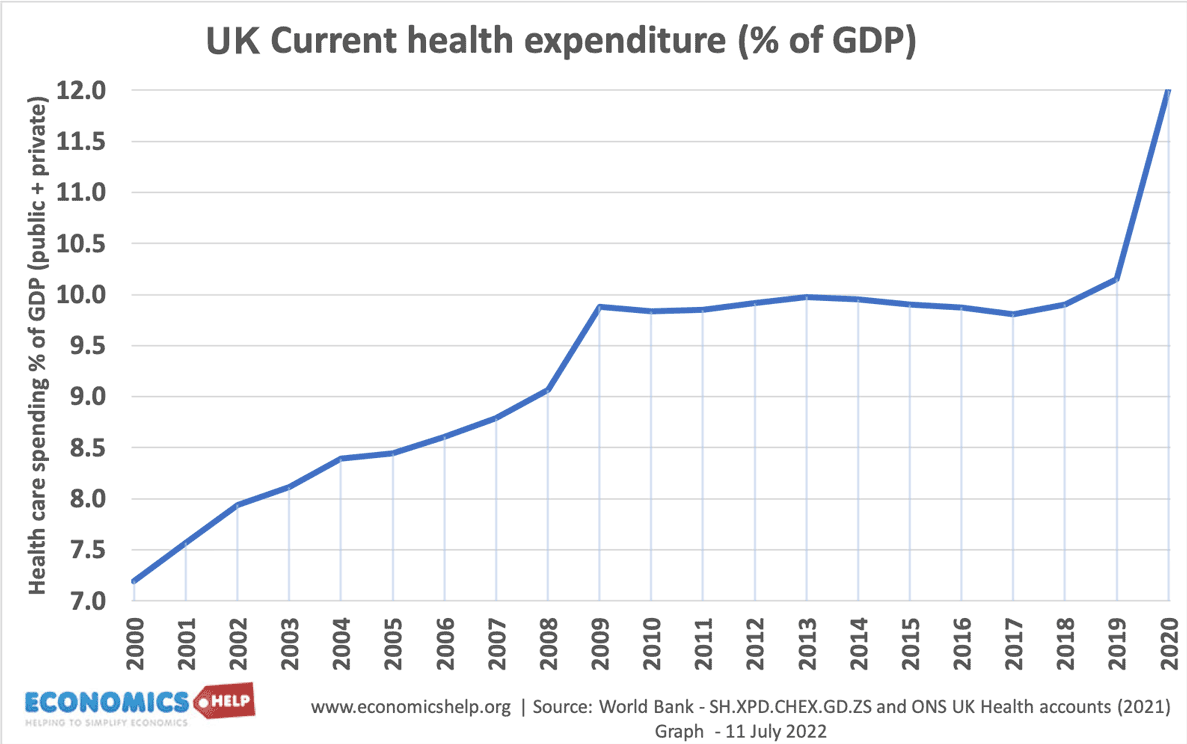 Source: World Bank and ONS
Common sectors affected by Baumol Cost Disease
- Football
- Same number of footballers needed
- Healthcare
- Human care and monitoring can’t be easily sped up
- Education
- Classroom teaching time is still required
- Social care
- Personal, time-intensive assistance
- Police, courts
- Human judgement and procedure
- Performing arts
- Same number of performers/time needed per show
Could AI Change the Whole Baumol Cost Disease Issue?
Traditionally, technology has led to productivity gains in agriculture and manufacturing. It is easier to automate manufacturing than labour intensive service sector.
However, some claim that AI and robots could actually start to replace human labour in many areas, for example, even health care diagnosis, counselling people turn to chat GPT. Therefore, it raises the prospect of productivity gains in areas which previously were limited.
In theory, we could even have four robots play a string quartet. Though I doubt that it will ever catch on. I wouldn’t go to see robots play a violin concerto, would you?
About The Author
