
Compensating Variation measures the amount of money needed after a change (such as a price rise or fall) to restore the consumer to their original utility level.
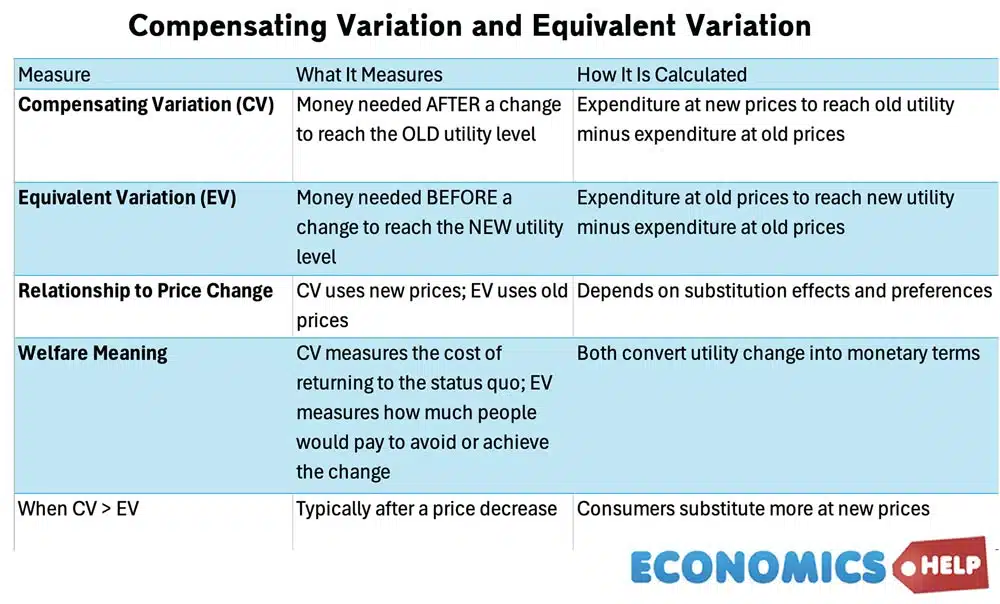
Compensation variation answers the question:
“How much compensation is required so that the consumer is just as well off as before the policy or price change?”
After a price rise, CV is positive because the consumer needs extra income to offset the loss.
After a price fall, CV is negative because the consumer would be willing to give up some income and still be as well off as before.
CV uses the new prices and the old utility level, comparing expenditure functions:

CV is often interpreted as the actual income compensation necessary to neutralise the welfare impact of the change, hence its name.
Equivalent Variation (EV)
Equivalent Variation measures the amount of money that would need to be given or taken before the change to make the consumer as well off as they would be after the policy or price change. It answers:
“How much money would make the consumer indifferent between the status quo and the new situation?”
After a price rise, EV is positive because the consumer would need extra income in advance to feel as well off as they will be after the increase.
After a price fall, EV is negative, indicating how much income could be taken away beforehand while leaving the consumer as well off as after the improvement.
EV uses old prices and the new utility level, comparing expenditure functions:

EV captures the hypothetical change in income needed before the event occurs to match the new utility.
Key Difference
The central distinction is that CV keeps consumers at old utility, while EV keeps consumers at new utility. CV works with new prices, EV with old prices.
- Compensating Variation is the “after-the-fact compensation” needed to undo the welfare loss.
- Equivalent Variation is the “before-the-fact equivalent payment” needed to replicate the welfare gain or loss.
Both measures rely on the expenditure function and provide theoretically precise welfare measures, unlike consumer surplus which is an approximation.
Examples
Congestion Charge
Suppose a city introduces a £10 daily congestion charge.
Effect on a commuter
Before the charge, the commuter spends £0 and has utility U₀.
After the charge, they pay £10 per day, reducing their utility to U₁.
Compensating Variation (CV)
CV asks: “How much money would this commuter need after the congestion charge is introduced to be as well off as before?”
If the commuter would need £12 per day to feel as well off as before, then:
CV = £12
This is the exact welfare cost of the policy to this commuter.
Equivalent Variation (EV)
EV asks: “How much would we need to give them before the congestion charge so that they don’t mind the new policy?”
If giving them £11 before the charge makes them indifferent between old and new situations, then:
EV = £11
Why CV and EV differ
The commuter changes behaviour after the charge (substitution to train, carpooling).
Substitution effects mean the welfare loss depends on which set of prices you evaluate at.
Why CV is not just £10
The congestion charge is £10, but the welfare loss to the commuter is not necessarily £10, because:
1. The commuter changes behaviour after the charge (substitution effect)
The CV is based on keeping the commuter at their original utility.
But after the charge:
- they might switch from car → bus, car → train, car → cycling or reduce trips entirely
This behavioural change means the actual cost in utility can be more or less than £10.
If switching to alternatives is inconvenient, time-consuming, or unpleasant, the true welfare loss can be greater than £10 (e.g., £12).
If switching is easy, the welfare loss can be less than £10 (e.g., £6).
So CV captures loss in utility, not money paid.
Why is EV not £10?
Price changes affect choices, and choices affect utility
The congestion charge doesn’t just take £10—it changes the relative price of travel options.
That causes:
- substitution effects
- different travel choices
- different time costs
- changes in comfort or convenience
EV captures the welfare impact of those effects, not the fee itself.
This is why EV ≠ £10.
Smoking Tax Increase
A pack of cigarettes rises from £12 to £15 after a tax increase.
Consumer behaviour
Smokers cut consumption from 5 packs/week to 4 packs/week.
CV
“How much money do smokers need after the tax increase to be as well off as before?”
If the welfare loss is equivalent to £10 per week, then:
CV = £10
EV
“How much money would we give them before the tax increase* to leave them as well off as the new situation?”
If they would accept £8 prior to the tax to be indifferent:
EV = £8
The difference reflects the substitution response (smoking less when prices rise).
Related
About The Author
