
Maximum rents, also known as rent controls, are a form of price ceiling imposed by the government to prevent rents rising above a legally set maximum level. They are usually introduced in areas where housing demand is high and market rents are considered unaffordable, particularly for low-income households.
For a maximum rent to have an effect, it must be set below the market equilibrium rent. If the maximum rent is set above the equilibrium, it will have no impact on the market. When binding, rent controls reduce the price landlords can charge but increase the quantity of housing demanded, leading to excess demand or a shortage of rental accommodation.
Economic Diagrams to show impact of Maximum Rent/ Rent Controls

With a maximum rent price (P2) below the equilibrium price (P1) it causes a shortage of rental properties. (Q3-Q2)
One advantage of rent controls is that they improve affordability for existing tenants. By limiting rent increases, households gain greater financial stability and are less likely to be forced out of their homes due to rising rents. Rent controls can also increase security of tenure, particularly in cities experiencing rapid population growth or housing shortages.
Problems of rent controls
- Rent controls, which limit rents and profit will often reduce the incentive for landlords to supply rental housing. Lower returns may discourage new investment in housing, leading to a fall in new construction. Over time, this can worsen housing shortages and push up rents in the unregulated or newly built sector. This will be worse in a time of inflation or booming demand.
- Rent controls can also reduce the quality of housing. Since landlords are unable to raise rents to cover rising costs, they may cut spending on maintenance and repairs. This can result in a deterioration of the existing housing stock, especially in older buildings.
- Another problem is the misallocation of housing. Long-term tenants may remain in rent-controlled properties even when their housing needs change, such as when household size falls. This reduces mobility in the housing market and prevents accommodation being allocated to those who value it most. It may also discourage people moving to the city because outsiders face a tougher rented market.
- In some cases, rent controls lead to black markets and non-price rationing. Landlords may demand side payments, higher deposits, or favour tenants who are willing to pay informally. As a result, access to housing may depend on connections rather than willingness to pay.
- Two speed renting. If you have rental controls on a portion of properties, it creates a two speed rental market. For example, in Sweden, those rental properties outside the controlled sector are roughly double the controlled sector.
- Swedish controlled rent sector – Monthly rent: SEK 6,000–8,000. Access: 15–20+ year waiting list.
Second hand rent sector Monthly rent: SEK 13,000–18,000 Access: Immediate
In evaluation, rent controls may provide short-term relief for tenants but are likely to worsen housing affordability in the long run if they significantly reduce housing supply. Many economists argue that policies to increase housing supply, such as planning reform or subsidies for construction, are more effective in addressing high rents.
Evaluation
- Supply may be more inelastic than the diagram suggests. Therefore a maximum price may cause a smaller shortage.
- To some extent landlords have monopoly power and so can abuse monopoly position to set higher prices. Rent controls can be seen as a way to counterbalance this monopoly power.
- Demand may also be rising because of population growth, so the max price may have to rise to accommodate this.
Rent Controls over time

- This is a more involved diagram, we start of with rent controls, at the equilibrium where demand and supply meet at Q1 – rent control price. Here there is no shortage of rental properties
- But, supposing demand shifts to the right to demand 2. Normally, this would lead to an increase in the price (to market price without control) and a movement along the supply curve, increasing quantity of housing to Q2, The new price would be “Market price without control”.
- However, because of rent controls, we don’t see a rise in supply or rise in price. Landlords have no incentive to buy or build houses for rent with rents are capped. Therefore, the rise in demand is not accommodated. This creates a shortage of Q3-Q1.
- Without rent control, more people would be able to rent, the new quantity would have been Q2.
- Therefore in this model rent controls benefit those existing tenants with lower prices, but some lose out and may struggle to live anywhere. It could lead to homelessness or people moving to other cheaper cities, constraining growth in that particular city.
Rent Controls in the First World War
- Rent controls were first introduced in the UK during the First World War in response to acute housing shortages and rising rents. With large numbers of men conscripted into the army and wartime controls limiting new housebuilding, the supply of housing became highly inelastic. At the same time, demand for housing increased in industrial cities due to war-related employment.
- Landlords responded to the shortage by raising rents, which caused significant hardship for working-class families, particularly the wives of soldiers fighting overseas. Rising rents led to growing public anger and rent strikes, most notably in Glasgow in 1915, where thousands of tenants refused to pay rent increases.
- In response, the government introduced the Increase of Rent and Mortgage Interest (War Restrictions) Act 1915. This legislation effectively froze rents at their pre-war level for many working-class properties and restricted landlords’ ability to evict tenants. The policy aimed to maintain social stability and prevent unrest on the home front during wartime.
- This policy was successful in the short-term, but in long-term influenced the development of rental properties.
Rent Controls and Consumer Surplus
- A maximum price changes consumer surplus – some consumers gain an increase in surplus (lower prices)
- Some renters lose out less properties for rent. For these people consumer surplus decreases because there is no opportunity to rent.
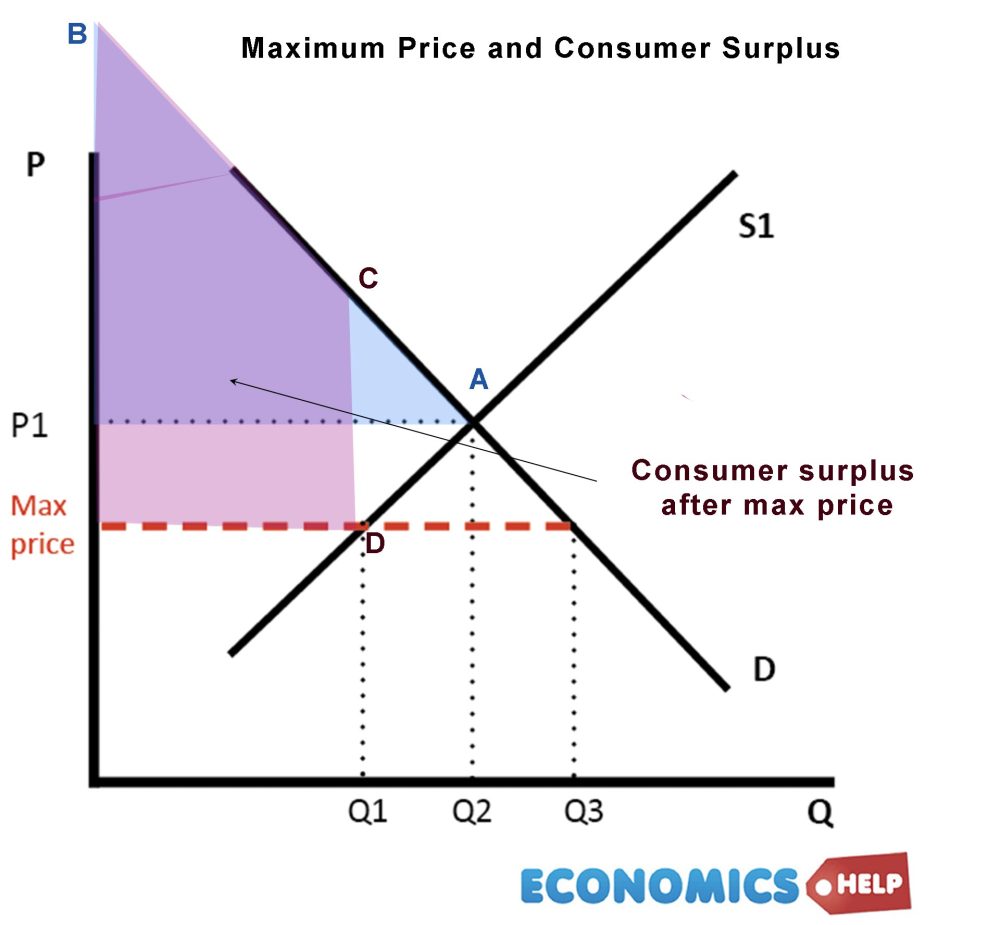
- Initially consumer surplus was A, B, P1 (blue triangle)
- But, after Max Price, price falls to Max Price, and quantity falls to Q1.
- The new consumer surplus is the pink shaded area (Max Price, D, C, B)
- Some consumers gain more consumer surplus because price is lower.
- Some consumers lose consumer surplus because they no longer get to buy good at all.
Alternatives to Rent Control
1. Increase supply

This reduces price to the maximum price without the shortage. The big question is how to increase supply
- Make it easier for property developers to build, e.g. reduce planning restrictions
- Government build social housing.
Related
About The Author
