
A Trading Possibility Frontier (TPF) shows the maximum combinations of goods a country can consume after trade, given its production possibility frontier (PPF) and the terms of trade.
It demonstrates the gains from international trade.
A Production Possibility Frontier (PPF) → shows what a country can produce on its own
Trade → allows a country to specialise and exchange
Trade Possibility Frontier (TPF) → shows that consumption can occur outside the PPF
Example of TPF
Without trade, the UK and France have their own production possibility frontiers.
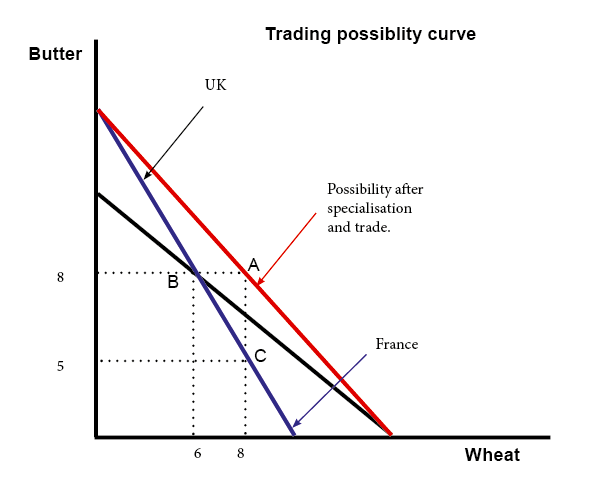
- The UK has a PPF of which offers choice of 16 wheat – 13 butter. It could choose a point on its PPF such as B (8B, 6W)
- France has a PPF which offers choice of 11 wheat – 16 butter. It could choose a point on its PPF such as C 5B and 8 W
Benefit of Trade
- If both countries specialise – UK in wheat. France in Butter. Then the new total PPF is the red line (16W to 16 B)
- Now both countries can consume a point A. UK produces 16 million wheat and exports 8 million to France.
- France produces 16 million Butter and exports 8 million to UK
- The trade has led to higher consumption in both France and UK
Shifts in the TPF
The TPF can shift due to:
- Improvement in terms of trade. Export prices rise relative to import prices The country can obtain more imports for the same level of exports
- Changes in world prices
- Trade agreements or reduced tariffs, enables more to be produced.
An outward shift means:
- Greater gains from trade
- Higher potential consumption
What happens with a Fall in Export Prices
- World price of exports falls
- More exports needed to buy the same imports
Effect on TPF
- TPF pivots inwards
- Reduced consumption possibilities
- Lower gains from trade
Distinction between TPF and PPF
- World price change → TPF shifts
- Productivity/resource change → PPF shifts
World prices affect consumption possibilities, not productive capacity.
Related concept
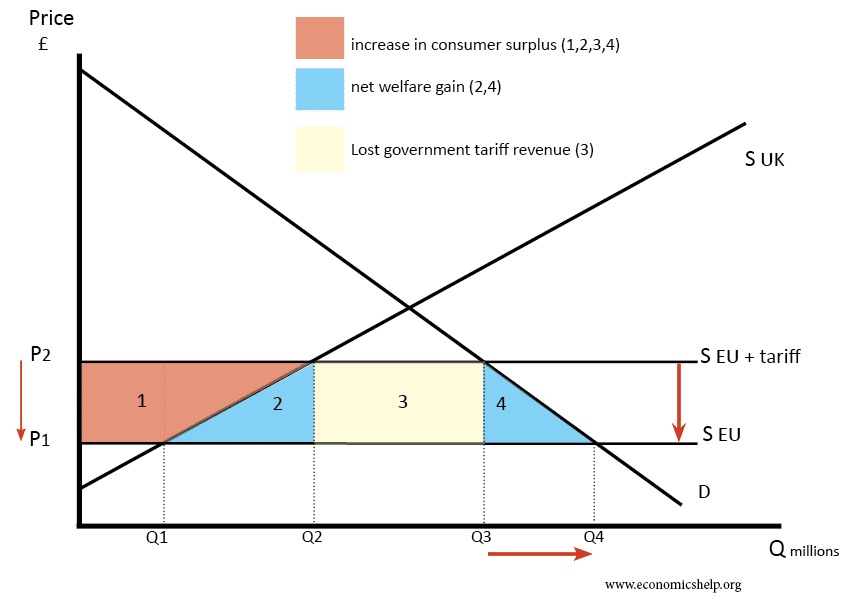
Trade Creation
About The Author
