
OCR GCSE Economics – Topic 1.1 The Basic Economic Problem

Introduction to Economics

Interactive OCR GCSE revision questions.

Progress: 0%

1.1 Scarcity, choice and opportunity cost

Q1. Scarcity occurs because:
Q2. Opportunity cost is:

1.2 Factors of production

Q1. Machinery used in factories is an example of:
Q2. Scarcity means that:
Q3. If a government spends more on defence, the opportunity cost may be:
Q4. In economics, the factor of production 'enterprise' refers to:

1.3 Resource allocation

Q1. Resource allocation refers to:
Q2. In a market economy resource allocation is mainly decided by:
Q3. Why does scarcity lead to opportunity cost?
Q4. In a market economy, scarce resources are mainly allocated by:
Q5. In a market economy, prices mainly act as:
Q6. Which of the following is one of the basic economic questions?

1.4 Production Possibility Curve (PPC)

Use the diagram to help answer the questions.
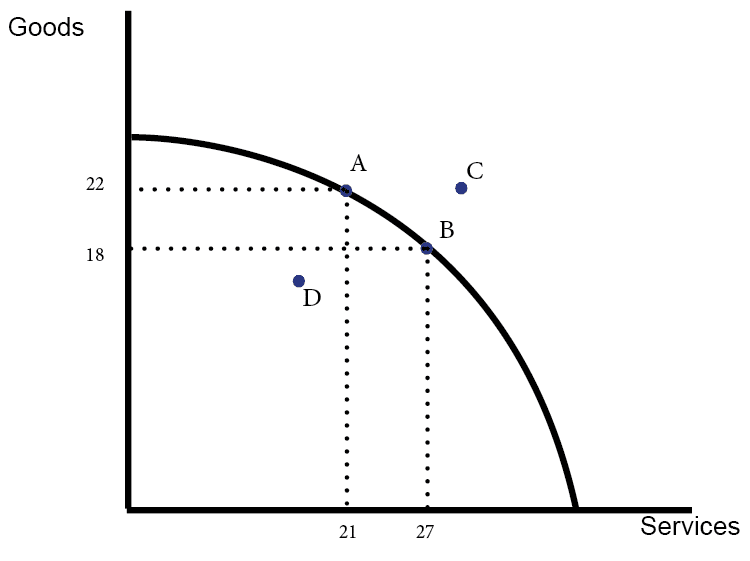
PPC showing opportunity cost

Diagram: PPC showing trade-offs and opportunity cost.

Q1. Productive efficiency occurs when output is:
Q2. A point inside the PPC represents:
Q3. A point outside the PPC is:
PPC showing economic growth and outward shift

Diagram: PPC showing outward shift from growth.

Q4. Which factor would cause the PPC to shift outward as shown in the diagram?
PPC showing increasing opportunity cost

Diagram: PPC with increasing opportunity cost.

Q5. Why is the PPC curved in this diagram?
PPC showing movement along curve

Diagram: Movement from A to B along the PPC.

Q6. Moving from point A to point B on the PPC shows:
Q7. If unemployment rises, the economy will move:
Q8. Producing more capital goods today is likely to:

1.5 Specialisation

Q1. Division of labour refers to:
Q2. One advantage of specialisation is:
Q3. Which is an example of specialisation?
Q4. Why does specialisation often increase productivity?
Q5. Countries often specialise in producing goods where they:
Q6. Adam Smith argued that division of labour leads to: