
Definition of Black Market – A ‘black market’ is a sector of the economy where transactions occur without the knowledge of the government and usually involve the breaking of certain laws, such as filing proper tax returns or paying in cash to avoid VAT. Other terms for a black market may include
- Underground market
- Hidden economy
- Grey market
- Unreported markets
A black market can also refer to the selling of a particular good. For example, if price controls or quotas exist for a good, then usually a black market develops. An example is a ticket tout selling tickets far above face value.
The black market often involves cash transactions or digital currencies like Bitcoin. It makes it harder for the authorities to track what is going on.
Reasons for Black Market
- Government bans or restrictions: When goods like drugs, alcohol, or foreign currency are made illegal, people still buy and sell them illicitly
- High taxes or tariffs: People and businesses try to avoid paying heavy taxes by trading outside the official system. Though ironically, high-tax economies like northern Europe have smaller shadow economies.
- Price controls: When governments keep prices artificially low, shortages occur, and illegal sellers charge higher prices. This was big issue during the rationing of the Second World War.
- Shortage: If essential items are hard to find in legal shops, people turn to illegal markets to get them.
- Recession/Poverty. In times of high unemployment or low wages, people may use black market jobs to earn extra income.
- Lack of enforcement Poor policing, and bribery allow illegal markets to grow. This is a big issue in developed economy
- Social attitudes. In some countries, there is widespread acceptance of shadow economy practises.
- Complex regulations: Too much red tape or licensing costs can push small traders to operate unofficially.
Problems of the Black Market
- Loss of government revenue: Taxes are not paid on illegal sales, reducing money available for public services. It can lead to higher tax rates for those who do buy legally or it might lead to lower government spending on public infrastructure.
- Poor quality and safety: Goods sold illegally are often unregulated, unsafe, or counterfeit. For example, prescription drugs bought on dark web.
- Encourages crime and corruption: Black markets often involve bribery, smuggling, and organised crime. Prohibition of alcohol was a boom to the mafia in the US during the 1920s and 30s.
- Exploitation of workers: Jobs in the shadow economy may have low pay, no protection, and unsafe conditions.
- Economic distortion: Official data on production and employment become unreliable, making it harder to plan economic policy.
- Weakens trust in government: When people trade illegally, confidence in laws and institutions declines. It may discourage investment and lead to lower economic growth in the first place.
How Big is the Black Market?
The size of the black market varies from country to country. Estimates for developed economies suggest anything from 7-15% of the total economy. An IMF working paper found that the average size of the shadow economy of the 158 countries from 1991 to 2015 is 31.9%
- The largest ones were Zimbabwe with 60.6 percent, and Bolivia with 62.3 percent of GDP.
- The lowest ones are Austria with 8.9 percent, and Switzerland with 7.2 percent.
It depends on various factors such as:
- Economic development. Developing economies often have a bigger black market, and part of this is due to the existence of a barter economy which falls outside the remit of the government.
- A degree of police control and mafia organisation
Many former Soviet countries experienced a huge growth in the black market after the fall of Communism. Communist economies tended to be highly regulated, and so when the regulation fell away, it created a gap for new ‘entrepreneurs’ to meet basic supply and demand.
Estimating the Size of the Shadow Economy in European Countries
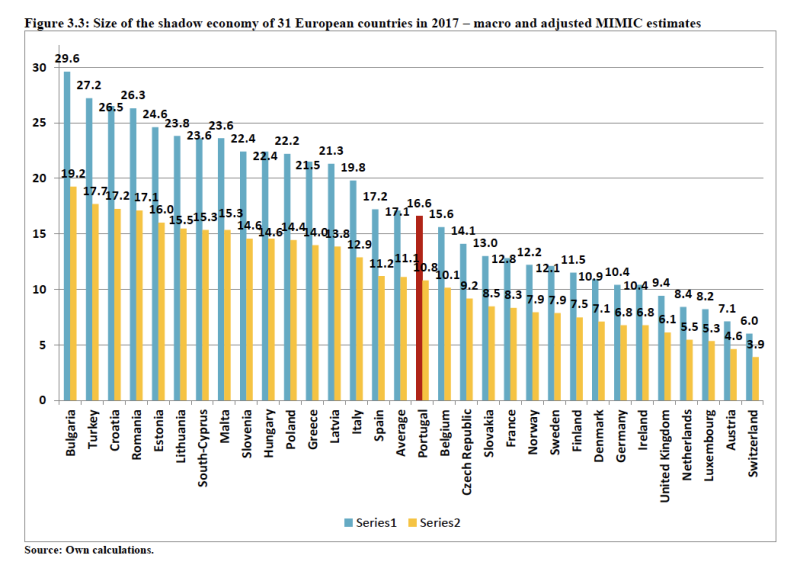 Source: IMF “Shadow Economies Around the World: What Did We Learn Over the Last 20 Years”
Difference between Macro and Adjusted MIMIC Estimates
Macro estimates use broad national data to infer the size of the shadow economy, based on indicators such as cash use, labour participation, or gaps between income and expenditure. They are simple to apply but often imprecise because they do not fully separate other economic effects.
The adjusted MIMIC model (Multiple Indicators Multiple Causes) uses a statistical approach that links several causes of informality (like taxes and regulation) with multiple indicators (such as electricity use or cash demand). The “adjusted” version converts these relative estimates into percentages of GDP, making results more comparable across countries and time.
In short, macro models are simpler and less accurate, while adjusted MIMIC estimates are more refined and comparable.
Related posts
About The Author
