
A Capitalist is defined as a person who makes the majority of their income from the ownership of assets and capital. For example, a capitalist may receive dividends from shares or rent from property that he owns.
In a sense, a person with a private pension can be said to be gaining income from assets they have built up. But, most people use the term capitalist to refer to someone who makes a good living from the ownership of assets.
The term capitalist is sometimes used pejoratively, implying that the person makes income without having to work or earn it. The Marxist theory stated that a Communist revolution would occur as the proletariat would be disgusted with the Capitalist class who make a living from their work.
Others argue that capitalists are essential for the development of a modern economy. A capitalist will invest in new businesses because of the reward of gaining more money.
In everyday economics, a capitalist can mean:
- An individual investor or business owner who employs capital to earn returns (profits, dividends, interest).
- Someone who supports capitalism — an economic system based on private ownership, markets, and profit incentives.
Marxist vs Neoclassical definition
A Marxist perspective will say a capitalist is someone who owns the means of production, such as factories, land and machinery, and earns income by employing labour rather than primarily working themselves. Following the ideas of Karl Marx, profit arises because workers are paid less than the value they create in production. This difference is known as surplus value and is viewed as a form of exploitation.
- Marxists argue that capitalists and workers have fundamentally opposing class interests, making inequality and economic instability an inherent feature of capitalism rather than a temporary problem.
A neoclassical perspective, a capitalist is an investor or entrepreneur who supplies capital to the production process and helps organise resources efficiently. Profits are seen as a legitimate reward for risk-taking, innovation and delaying consumption. Income earned by capitalists reflects the marginal productivity of capital, just as wages reflect the marginal productivity of labour.
- In this view, capitalism is largely efficient and welfare-enhancing, although government intervention may be justified where markets fail.
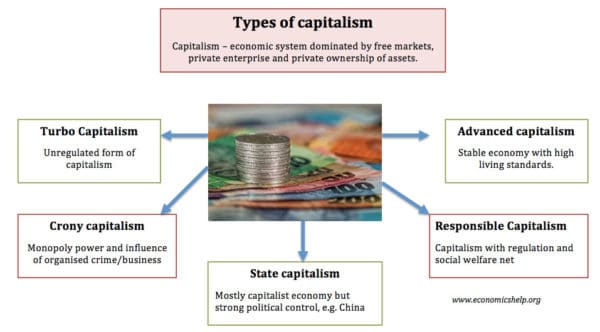
Different Types of Capitalism
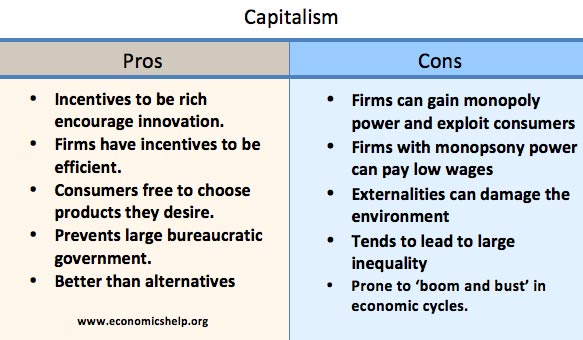
Pros and Cons of Capitalism
See also:
About The Author
