
A trade weighted index is used to measure the effective value of an exchange rate against a basket of currencies. The importance of other currencies depends on the percentage of trade done with that country.
It gives the best guide to the overall performance of a currency
For example, in calculating the trade weighted index of the Pound Sterling, the most important exchange rate would be with the Euro. If the UK exports 45% of total exports to the EU, the value of £ to Euro would account for 45% of the trade weighted index.
A trade weighted index is useful for measuring the overall performance of a currency.
For example, if the Pound appreciates against the dollar, that might be due to the dollar’s weakness. But, if the trade weighted Sterling index increases, this shows the Pound is getting stronger against its main trading partners.
Example of UK trade weighted index
| Trading partner | Currency | Trade weight |
|---|---|---|
| EU | Euro | 45% |
| USA | Dollar | 20% |
| China | Yuan | 15% |
| Others | Various | 20% |
Note: These are rough approximations
Example of Sterling Trade Weighted Index
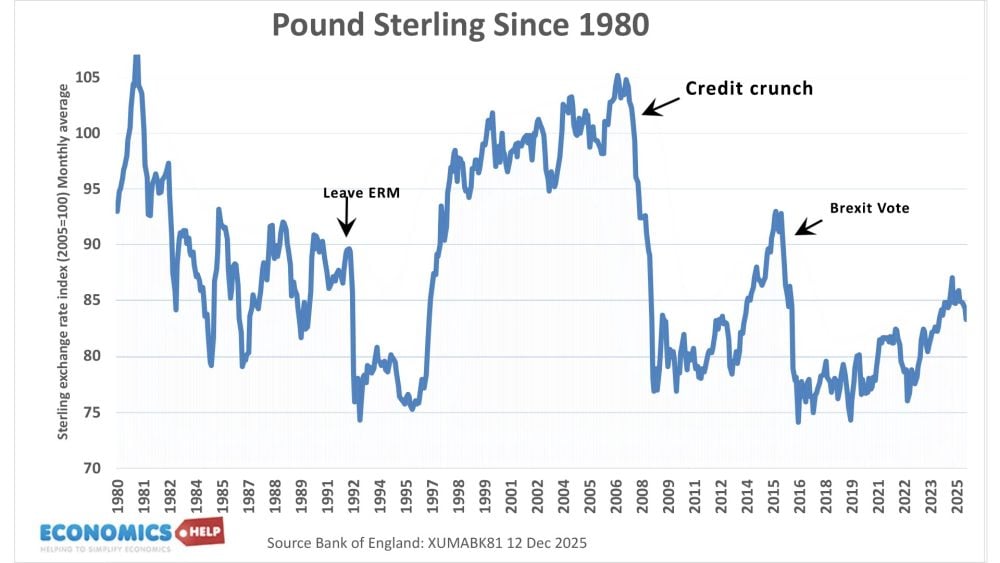
This shows that Sterling fell in 2008/09 due to credit crunch. It also fell after the Brexit vote of 2016
Exchange-rate changes
| Trading partner | Currency | Trade weight | Change in £ exchange rate |
|---|---|---|---|
| EU | Euro | 45% | £ falls 10% vs euro |
| USA | Dollar | 20% | £ rises 5% vs dollar |
| China | Yuan | 15% | £ falls 5% vs yuan |
| Others | Various | 20% | No change (0%) |
Step-by-step calculation
Multiply each exchange-rate change by its trade weight:
- EU: −10% × 0.45 = −4.5
- USA: +5% × 0.20 = +1.0
- China: −5% × 0.15 = −0.75
- Others: 0% × 0.20 = 0
Overall change in trade weighted index −4.5+1.0−0.75+0= −4.25%
Therefore despite appreciating against the dollar, the overall Sterling index has depreciated in value.
The trade weighted index gives a better guide to the state of Pound Sterling. The rise against the dollar reflects the dollar weakness rather than Sterling strength.
Related
About The Author
