
Monopoly power occurs when a firm has market dominance in an industry. (for example, more than 40% market share). Abuse of monopoly power could involve setting higher prices or limiting output. Abuse of monopoly power can lead to deadweight welfare loss, less choice, and problems for suppliers.
A monopoly diagram
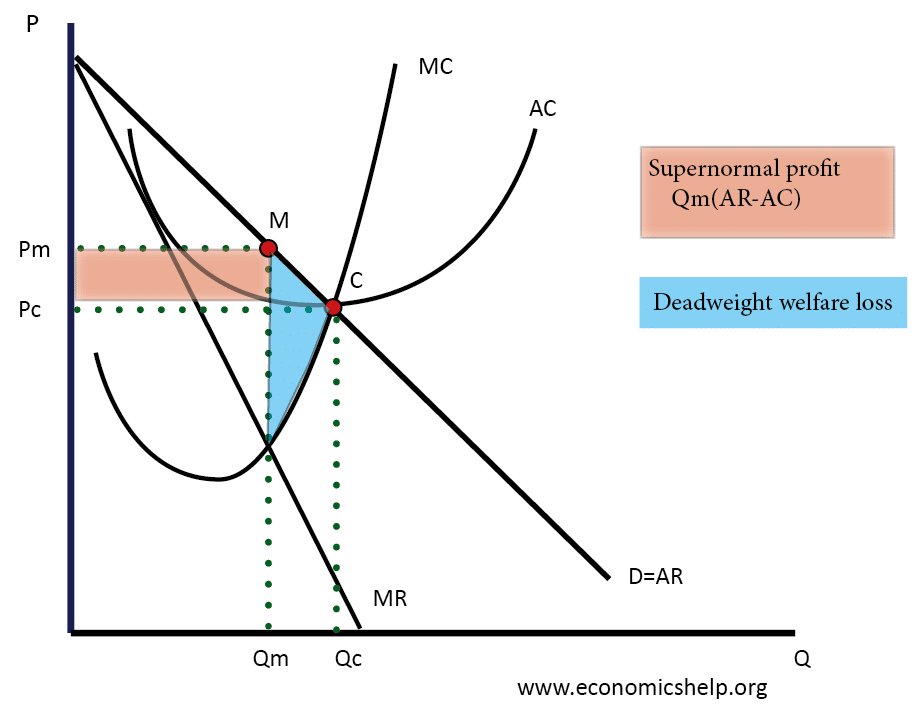
In this diagram, the monopoly raises price from Pc to Pm – leading to a fall in output from Qc to Qm.
Competition Act
In the UK, the Competition and Markets Authority can investigate abuse of monopoly power and act against firms who are found guilty of abusing monopoly power
The prohibition under both Article 82 and the Chapter II prohibition is on the abuse of the dominant position, not the holding of the position. (article)
- Firstly the Competition and Markets Authority must investigate whether firms have a dominant position.
- They will look at: National or regional market share. Usually, a firm would have to have at least 40% of the market to be considered to be a dominant firm.
- The contestability of the market. If barriers to entry are low, then the incumbent firm is unlikely to be dominant even with a high market share because new firms can enter if profits are high.
- If the firm is considered to be dominant then the OFT will look at abuses of Monopoly power these include:
Evidence of Abusing Monopoly Power
- Charging excessively high prices. This might be difficult to judge, but if they are making high profits then this is an indication that prices are higher than in a competitive situation
- Predatory Pricing. This involves cutting prices and selling below average cost to force rivals out of business.
- Limiting production and access to technical developments. Artificial barriers to fair access.
- Unfair treatment of competitors – e.g. giving preferential treatment to certain parties, placing others at a disadvantage.
- Contracts which add supplementary obligations unrelated to the subject of a contract.
- Vertical restraints. This involves the monopoly firm imposing prices or restrictions on its suppliers or retailers. For example, this could involve
- Selective distribution e.g. Levis’ doesn’t want to supply Tesco supermarkets. Also, this is a significant problem in the UK car industry with car firms entering into selective and exclusive distribution networks to keep prices high. The competition commission report of 2000 found UK cars were at least 10% higher than European cars
- Exclusive distribution. Some retailers will only buy from some particular manufacturers
- Tie in sales. E.g. if you buy a printer the company will try and make you buy their own brand ink
Examples
- Excessive prices for liothyronine tablets The CMA is investigating alleged excessive and unfair pricing with respect to liothyronine tablets under Chapter II CA98/Article 102 TFEU. (link)
Consequences of abusing monopoly power
- OFT can fine firms 10% of annual turnover if they are abusing market power.
- In 2003 OFT stated toy manufacturers were guilty of fixing prices and were fined a significant amount.
- The OFT can make recommendations such as:
- No brewery should be allowed to have more than 2000 public houses
- In 1995 It investigated Sega and Nintendo and stated that they should reduce its licensing charges on firms supplying software
See also: