
Europe may be a great place to live, free health care, ga enerous welfare state, great cities, but in the past 20 years, Europe has fallen behind the United States. Growth is sluggish, productivity is low, debt rising. And when it comes to new engines of growth – big tech, AI, electric cars, Europe is slipping behind both the US and China. In 1980, Europe accounted for nearly a third of world GDP, but today, it has been overtaken by China.
Europe is being squeezed by cheaper imports in China, better tech in America and Russia’s foreign policy in the east.
Robot Taxi
In California, one in three taxi rides is already in a robot taxi. The growth has been exponential and they are set to overtake ordinary taxis. The market opportunity is huge; they will be cheaper than paying a driver. In Texas, Tesla is already charging just a dollar a mile. They are safer too – 90% fewer accidents. And that means cheaper car insurance. They will save income, reduce emissions and reduce the need to buy an expensive car. It’s not just America; in China ,2,000 driverless cars are already transporting millions across the big cities. But, for Europeans, the idea of a driverless car, is still the stuff of science fiction. Or more accurately, something blocked by the European love of regulation, risk-aversion, and a powerful car lobby still stuck in the combustion engine era.
Car Industry
Europe’s car industry used to be a great source of pride. BMW, Volkswagen, and Fiat — all global brands which still gain respect today. But China is now producing electric cars for under €10,000. Europe are nowhere near an industry slow to adopt the latest trends. Right now, tariffs are the only thing protecting European carmakers. But tariffs can’t protect global market share forever.
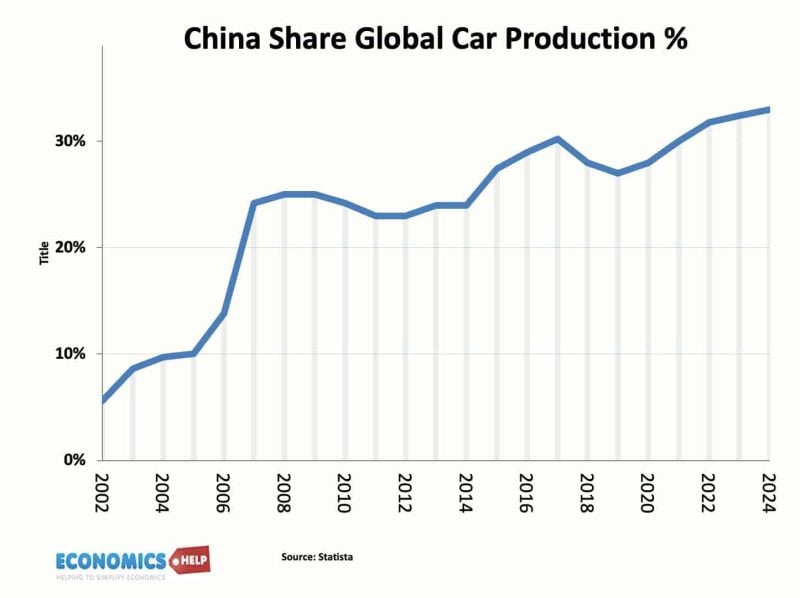
In the past 22 years China’s market share has risen from 5 to 33%. Europe’s great strength was in mechanical engineering, but the future of cars is electric, and here Europe will lose its comparative advantage.
US
One of the great strengths of the US is geography – a large integrated country with deep capital markets and low barriers to trade. For all the talk of a European single market, there is actually a long way to go, the IMF suggest internal tariffs on services of 110%. In terms of finance, bond markets and venture capital are all fragmented, and it is harder to raise finance. As a share of GDP, research and development in the US is 3.5%, in the Eurozone 2.2%. Venture capital funding is almost five times greater in the US, and this has been particularly effective in promoting the new wave of tech innovation, with America dominating social media and artificial intelligence. The problem is that these new industries lend themselves to a monopoly power of the first company to dominate; once you fall behind, it’s very hard to catch up.
Tech Succes
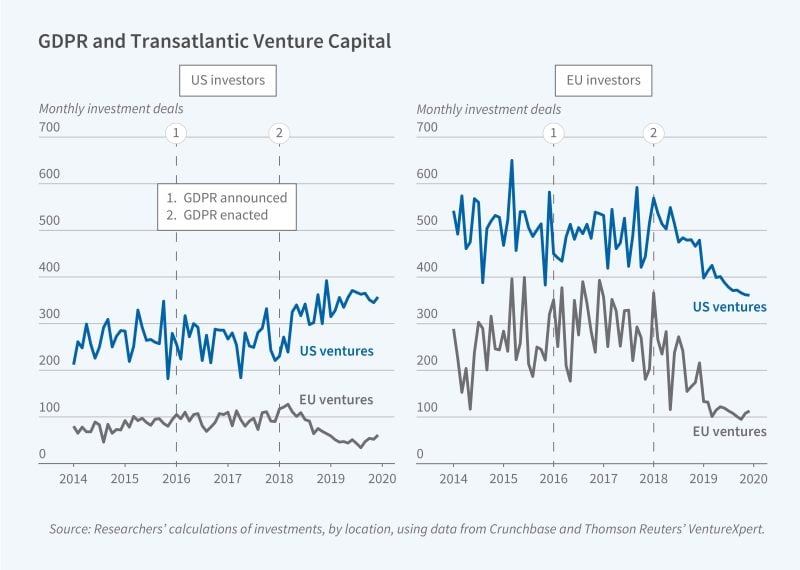
True, Europe does have some successes such as Revolut, Klarna and Spotify, but these are dwarfed by the US giants of Meta, Google, Apple and Microsoft. The EU’s response has been to seek to regulate the murky world of big tech surveillance, but in a way, the sledgehammer of GDPR regulation has done more to increase costs for local European business and tech startups. This graph shows the stark divergence from 2018, when GDPR was enacted. Monthly investment deals in EU startups slumped from both the US and EU. One study suggested GDPR cost 8% of business profit. It is a self-inflicted cost that has hampered investment and growth. There is an old saying, America invents, China imitates, and Europe regulates. Harsh, but an element of truth. Though the big change is that China is no longer imitating, but producing goods far cheaper than in Europe. But Europe is still stuck in a regulatory mindset.
Regulation
It would be unfair to only blame the EU for regulation. There are actually very real benefits of banning harmful chemicals in food that can’t be measured by GDP statistics. Life expectancy in Europe is higher than the US, which counts for a lot in my book. There is a logic in trying to regulate the use of AI, so we don’t end up with AI, infused with a particular extreme ideology that has sometimes surfaced on Grok. But, there is a problem in striking a balance, Germany’s manufacturing decline is at least partly blamed on cumbersome regulation, legal costs and growing levels of bureaucracy.
Some wounds though are self-inflicted. Europe bet its industry on cheap Russian gas, Germany closed down its nuclear power. Then came 2022. Prices soared, and industry was hit with a huge rise in costs. Ironically — Europe now imports LNG from the US as America profits from its shale gas boom.
Demographics
In terms of demographics, Europe is ageing faster than the US. But with an extensive welfare state and pensions this threatens the viability of public finances. Whilst the US spends 7% of GDP on public provision of pensions, in Italy it is 16%, in France it is 13%. And both these countries have rising debt burdens as a share of GDP, and a lack of political will to address these concerns. France seems in perpetual crisis, and other countries not far off. Though we should point out, China is ageing even faster than Europe.
Euro
The Euro has been a mixed blessing for Europe, lower transaction costs, but it highlights an unbalanced EU economy. Germany runs a large current account surplus, fringe economies like Greece and Portugal running deficits. But, there is no scope for Germany to appreciate, weaker countries to devalue. One size fits all. But, this can have disastrous effects. The Euro Debt crisis of 2012, led to high bond yields and a response of austerity, which contributed to weak growth in the last decade. Mario Draghi’s intervention did reduce bond yields, but the ECB has been criticised for a deflationary bias, it has certainly struggled since the covid era, with growth in Europe much less.
Strengths of Europe
Now, to be fair, Europe still has many strengths, which often get overlooked. Firstly, Eastern European economies like Poland and the Czech have made big gains in living standards testiment to the European project European-based Airbus has outperformed American Boeing for several years. Europe supplies much of the world’s specialised industrial equipment. European firms are producing the new weight-loss wonder drug, which it is exporting to the US. And even in new technology, it has strong battery production through Northvolt and world leaders in renewable energy like wind power.
Independence
If the lack of demand has held back the European economy, the new push for greater defence independence from the United States could provide a boost to EU manufacturing. The threat of Russia on the east and the fading of America as an ally has also sharpened the realisation that Europe needs to up its game. And after all the talk of self-inflicted costs, it seems that the US is seeking to outdo Europe with its new found love of tariffs and unorthodox economic policy. With the dollar weaker, the Euro area could start to look more attractive. But America’s retreat from the post-war world is hardly something that is going to help Europe in the short term, Europe runs a trade surplus with the US, and US tariffs will hurt European exporters.
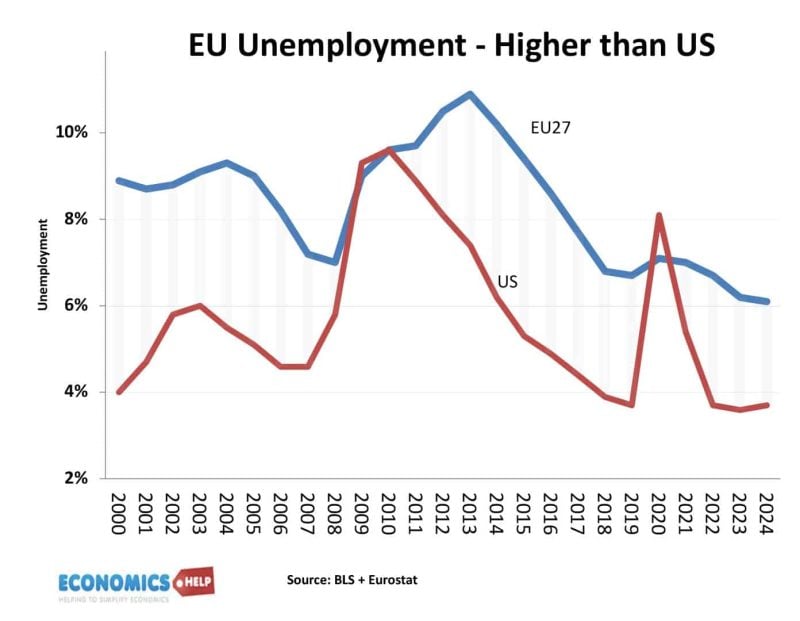
Also, a criticism of Europe has been high rates of unemployment, some argue driven by greater labour market regulation. Though in recent years, Europe has made progress in this area with lower unemployment then the early 2010s.
So here’s the paradox. Europe has some of the best living standards in the world. But those living standards depend on a strong economy.
If growth, productivity, and competitiveness keep slipping, pensions, welfare, and high quality of life Europeans take for granted will be harder to sustain.
But the decline isn’t inevitable. It’s partly self-inflicted. And that means — with the right choices — Europe could still change course.
Sources
eu-internal-tariffs
About The Author
