
A production possibility frontier shows how much an economy can produce given existing resources. A production possibility can show the different choices that an economy faces.
Think of the PPF as a simple way of showing the fundamental economic problem of scarcity: we can’t have everything, because resources are limited. So the curve shows all the different combinations of two goods an economy can make if it uses everything efficiently. If an economy devotes more resources to the army, it will need to take resources from health and education.
Key concepts for Production possibility Frontiers
- Scarcity, The PPF illustrates scarcity because resources are limited — the economy cannot produce unlimited amounts of both goods.
- Opportunity Cost If you increase production of one good it requires producing less of another.
Opportunity cost = value of the next best alternative foregone. - Efficiency. At a point on the curve = productive efficiency (all resources used). Inside the curve = inefficiency (unemployment, underused resources).
- Law of Increasing Opportunity Cost (diminishing returns) A PPF is usually concave because resources are not perfectly adaptable. As production of one good increases, the opportunity cost of producing it rises.
Diagram of Production Possibility Frontier
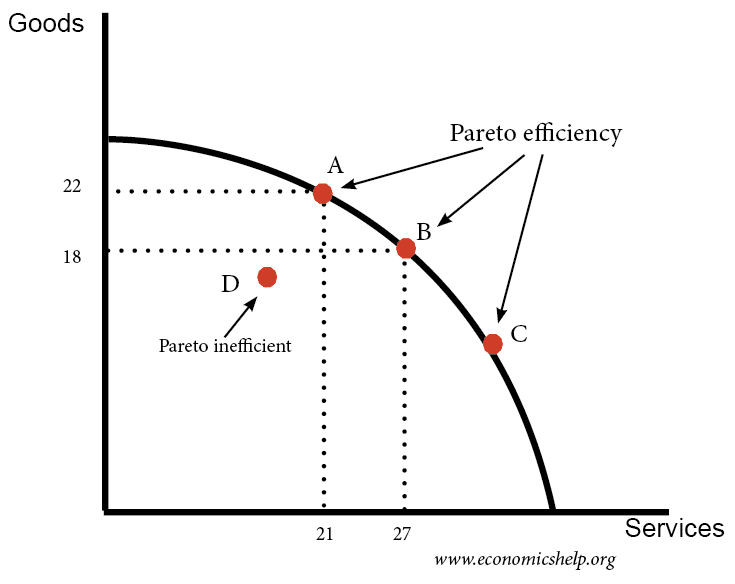
- Moving from Point A to B will lead to an increase in services (21-27). But, the opportunity cost is that output of goods falls from 22 to 18.
- At point D, the economy is inefficient. At point D, we can increase both goods and services without any opportunity cost.
- Pareto efficiency is any point on the PPF curve. On the PPF curve, it is impossible to increase one choice, without causing less production of the other.
Simple Choice showing PPF

Economic Growth
If there is an increase in land, labour or capital or an increase in the productivity of these factors, then the PPF curve can shift outwards enabling a better trade-off.
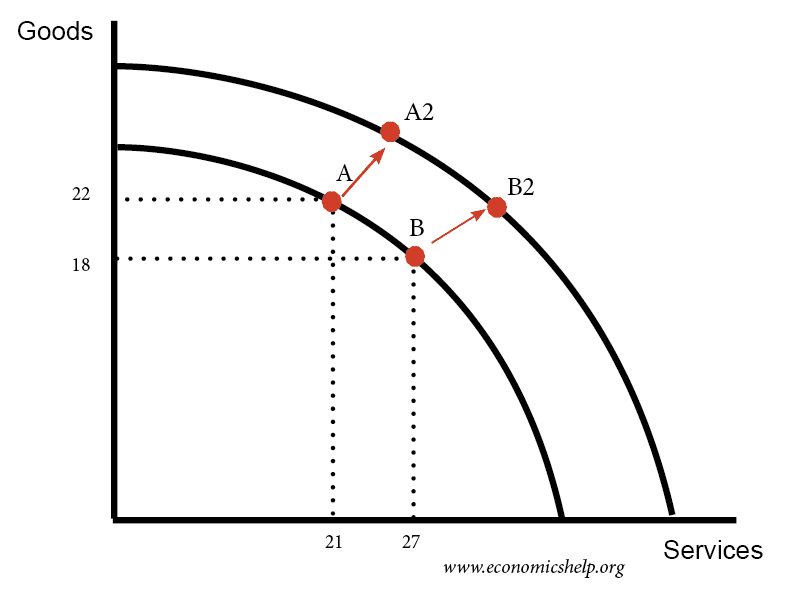 Graph showing increase in PPF.
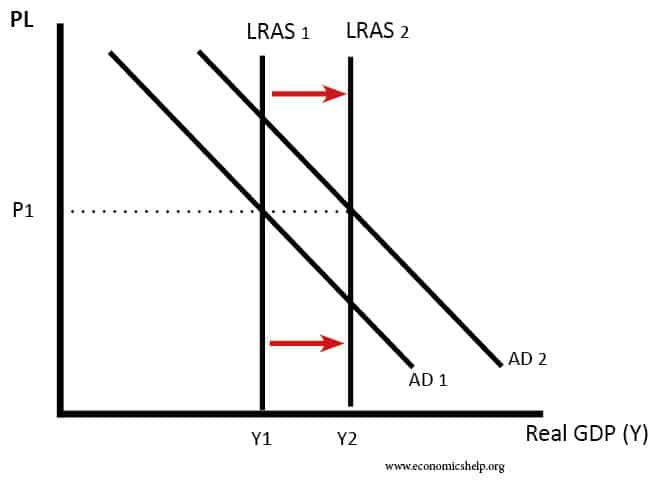
Note: there is a link between macroeconomics and the long-run aggregate supply curve. If the PPF curve shifts to the right, then it is similar effect to the LRAS shifting to the right
Production possibility frontier and investment
One choice an economy faces is between capital goods (investment) and consumer goods.
- If more resources are devoted to capital goods (e.g. building new factories) then in the short-term, consumption will go down.
- However, if the investment is successful, then in the long-run, productive capacity will increase and the PPF curve will shift to the right
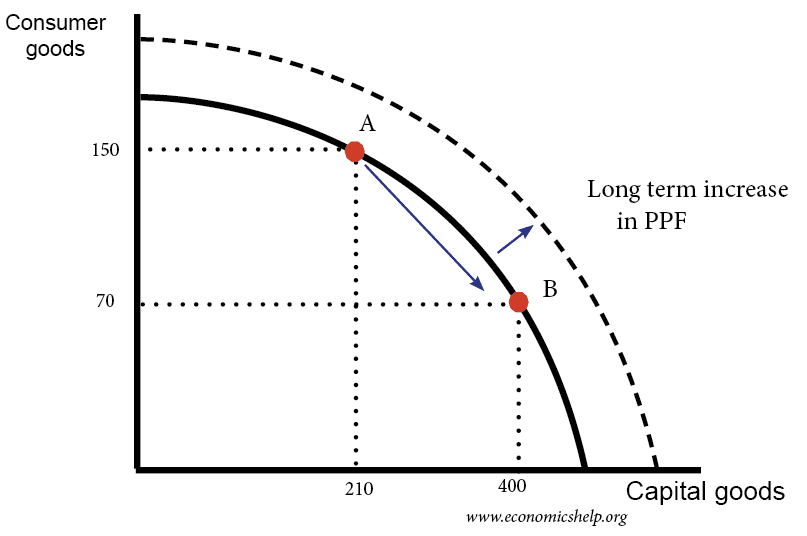
Increase in capital goods has an opportunity cost of fewer consumer goods, but in long-term can enable economic growth.
Similarly, a decline in investment can enable more consumer goods in the short-term but can lead to lower rates of economic growth.
PPF and recession
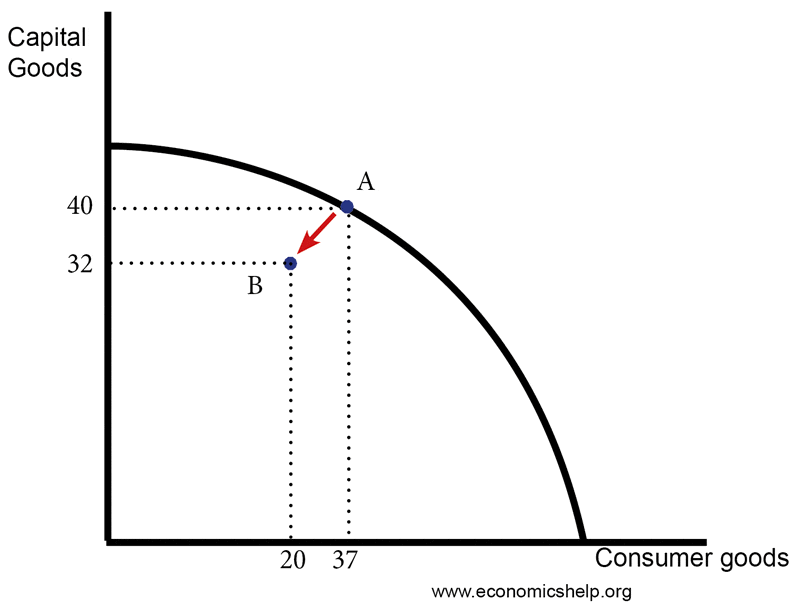
A recession can be shown by output falling below the production possibility frontier (from A to B).
- A = full employment
- B = unemployed resources
A short-lived recession doesn’t usually shift the PPF. However, in a long depression with resources idle for many years and factories closing down, then the PPF curve can start to shift inwards.
PPF and choices for government
Any government faces a trade-off in how to use scarce resources and tax revenue. If the government increases spending on the military, then the opportunity cost will be less spending on another public service, such as health care.
Different PPF Curves
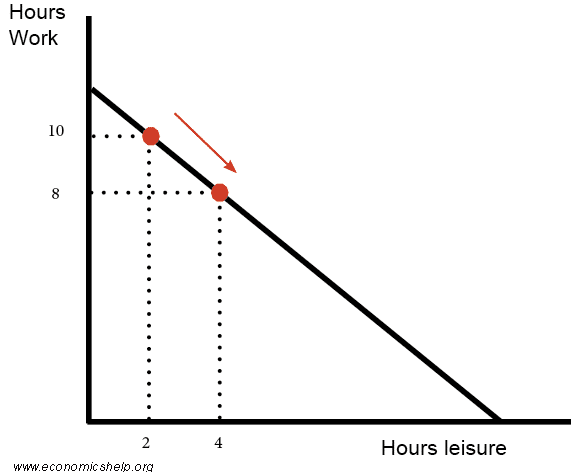
This shows a trade-off between working and hours spent in leisure.
Other Diagrams
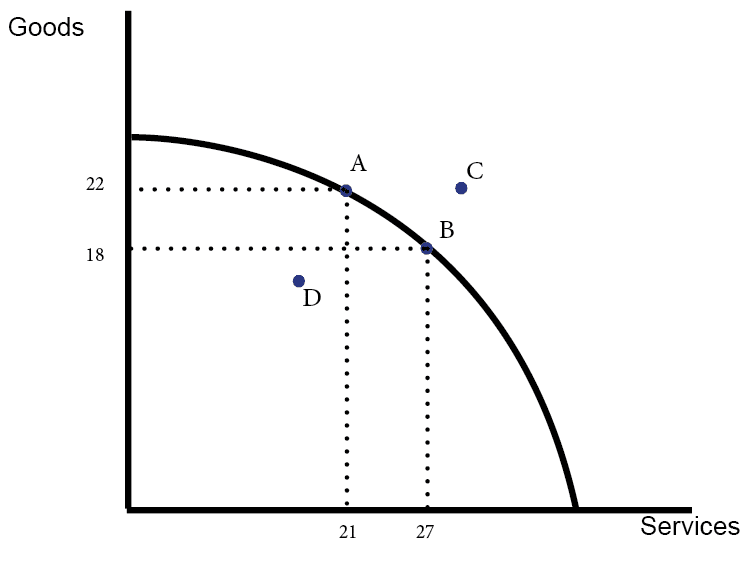
- Which is inefficient?
- Which is impossible?
Economic Growth and PPF

PPF curve and Trade
If countries specialise where they have a comparative advantage, they can consume beyond their PPF through trade.
Without trade: A country can only consume what it produces — a point on or inside its PPF.
With specialisation + trade: Countries specialise, exchange goods, and end up consuming a mix outside their original PPF, reflecting higher total world output.

Related