
The Coase Theorem states that if property rights are clearly defined and transaction costs are zero, private bargaining between the parties involved can lead to an efficient outcome, regardless of who holds the initial rights. The key insight is that externalities do not necessarily require government intervention; instead, affected parties can negotiate a mutually beneficial solution.
For example, if a factory pollutes a river used by a fisherman, the efficient level of pollution can be reached whether the factory has the right to pollute or the fisherman has the right to clean water. As long as negotiation is costless, both parties can agree on compensation that reflects the true costs and benefits of pollution or abatement. The final allocation will be efficient, though the distribution of income will depend on who initially holds the rights.
Practical difficulties of Coase Theorem
- Transaction costs are usually significant. Especially when many people are affected by an externality. This limits the ability of private bargaining to achieve efficient outcomes in real-world settings. Large-scale externalities such as climate change particularly suffer from high transaction costs and free-rider problems.
- Incomplete information. Often with regard to externalities, there is incomplete information. How do you measure the costs of global warming and pollution?
- Negotiations with lawyers will often be more costly than the benefit
- Intergenerational issues. How to deal with global warming when those most affected will be in the future.
- In practise the person with existing property ownership will get more income from the settlement of the property dispute, even if they are the main polluter. Why should victims have to pay the polluter to reduce level of pollution..
Theoretical example
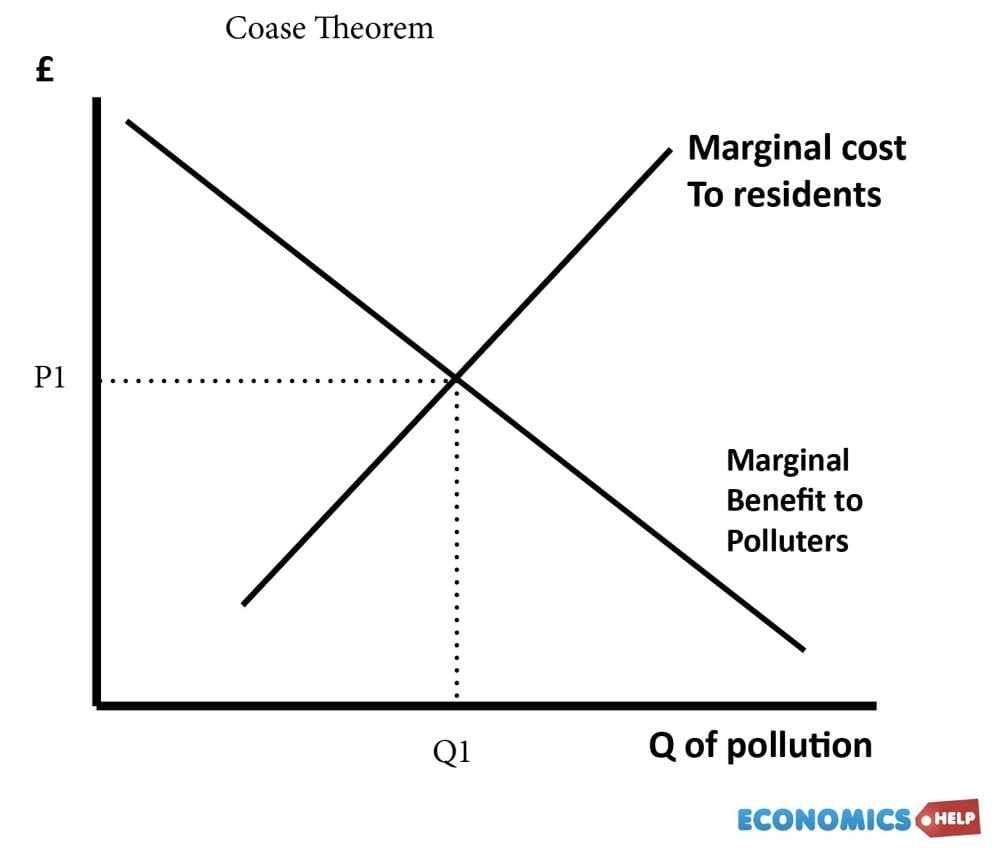
This shows that the more pollution occurs, the smaller the marginal benefit to polluters and the greater the marginal cost to residents nearby.
The optimal outcome would be a level of Q1 pollution
The Coase Theorem still provides important policy implications. It highlights the value of assigning clear property rights and reducing transaction costs where possible. It also helps justify market-based environmental policies such as tradable pollution permits, which create a framework for negotiation and efficiency even when perfect bargaining conditions do not exist.
In legal decisions judges have sometimes appealed to Coase theorem in justifying rulings which offer compensation to one party adversely affected.
Real World Examples of Coase Theorem
Airport noise and homeowners – Chicago Midway Airport
Homeowners living near Chicago’s Midway Airport faced aircraft noise. In several cases, residents and the airport authority negotiated compensation or sound-proofing payments without needing regulation. Because the number of homeowners involved was relatively small and both sides had clear property rights, bargaining was feasible. The airport paid for insulation rather than being forced to reduce flights, achieving an efficient outcome.
Ranchers and farmers – Cattle trespass disputes (US West)
Coase’s original examples came from US ranching communities. When cattle wandered onto neighbouring farmland, ranchers and farmers often agreed privately on fencing costs or compensation for crop damage. If a fence was cheaper than repeated crop losses, they shared the cost; if not, they tolerated some damage. These negotiations worked because there were few parties and property rights were clear.
Private land access rights – UK landowners and telecommunications
Telecom companies like BT/Openreach often pay landowners for permission to lay fibre-optic cables or install masts on private land. Rather than compulsory regulation, firms negotiate payments that reflect the costs and benefits to both sides. Where bargaining is simple, efficient infrastructure placement emerges through voluntary agreement.
Related
Policies to overcome market failure
About The Author
