

This year the stock market has reached several record highs. Yes, as the assets of the wealthy continue to soar, there is another economy. It is one of rising living costs, poor job prospects and a disconnect from the wealth of Wall Street. In the second quarter of 2025 the top 10% of wealthiest Americans were responsible for 49% of consumer spending. It is an economy where the demand for Gucci soars, but households cut back from essentials.
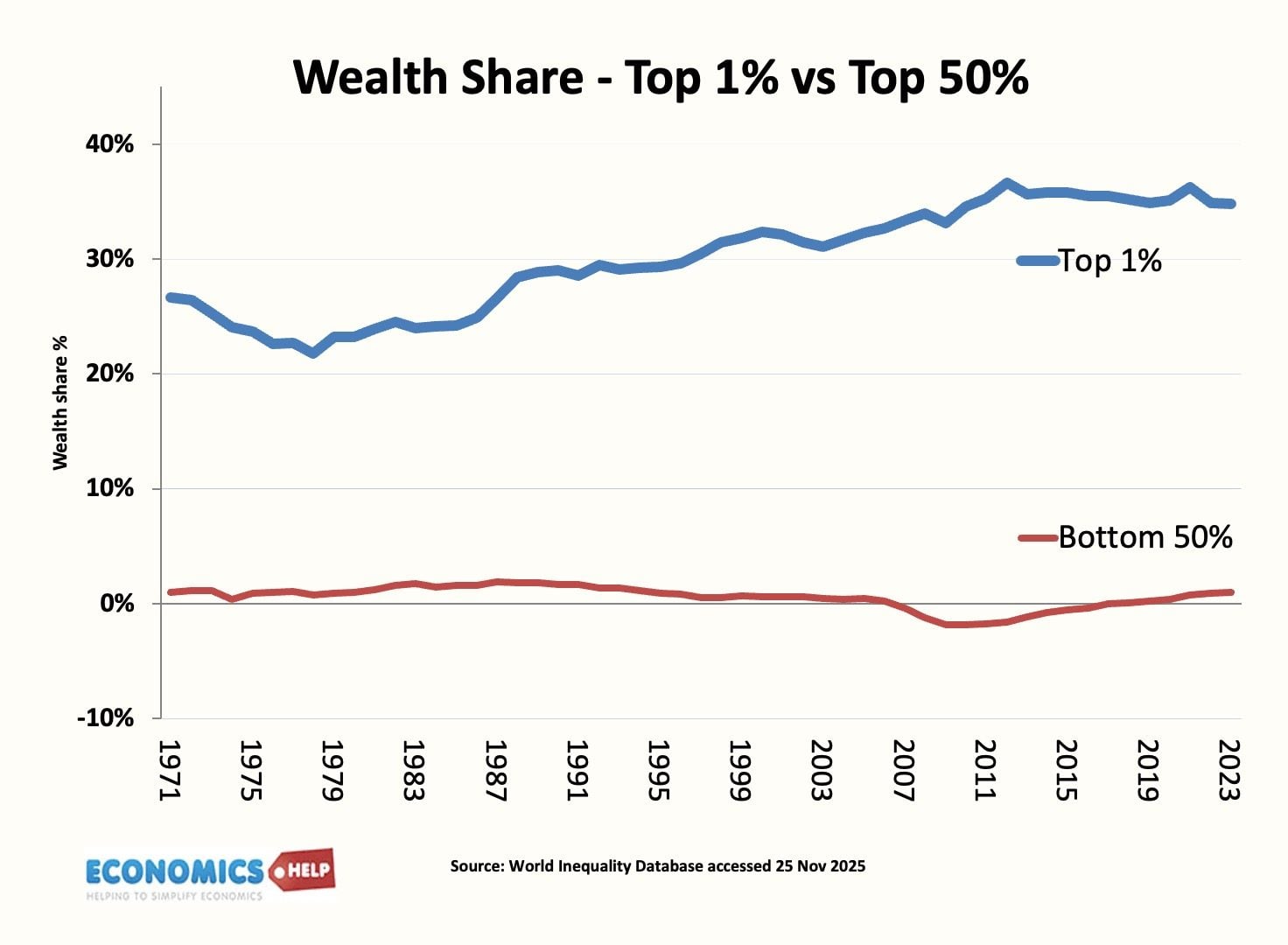
The top 1% own 35% of nations wealth. The poorest 50% own less than 1%. It’s a new gilded age.

If you look at raw economic stats, the economy doesn’t seem to be doing too badly. The misery index which includes both inflation and unemployment, is not particularly high by historical standards.
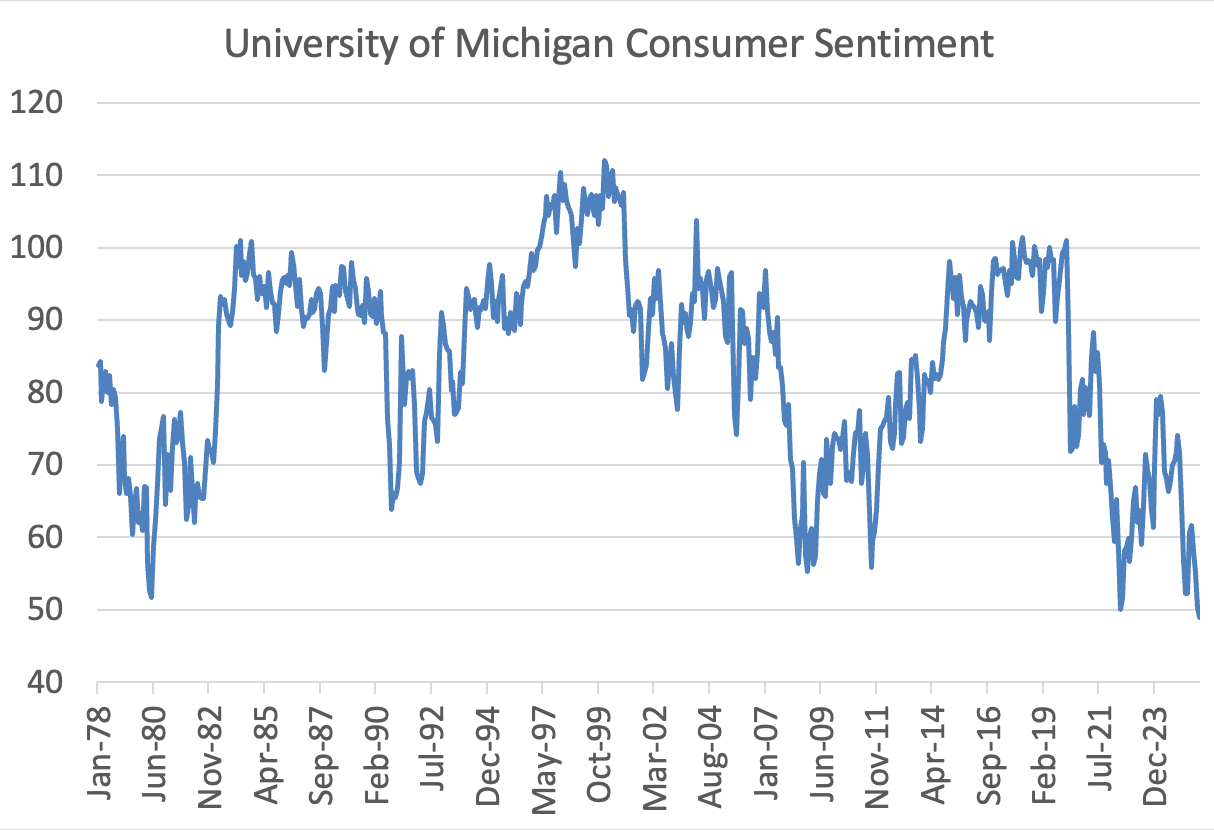
But, when it comes to consumer sentiment, it is at the worst recorded levels since the stagflation of the 1970s. And that is skewed by high confidence amongst the rich. Why are consumers so down about the economy when the likes of Google, Nvidia and OpenAI are betting on fantastical future profits?
Inflation
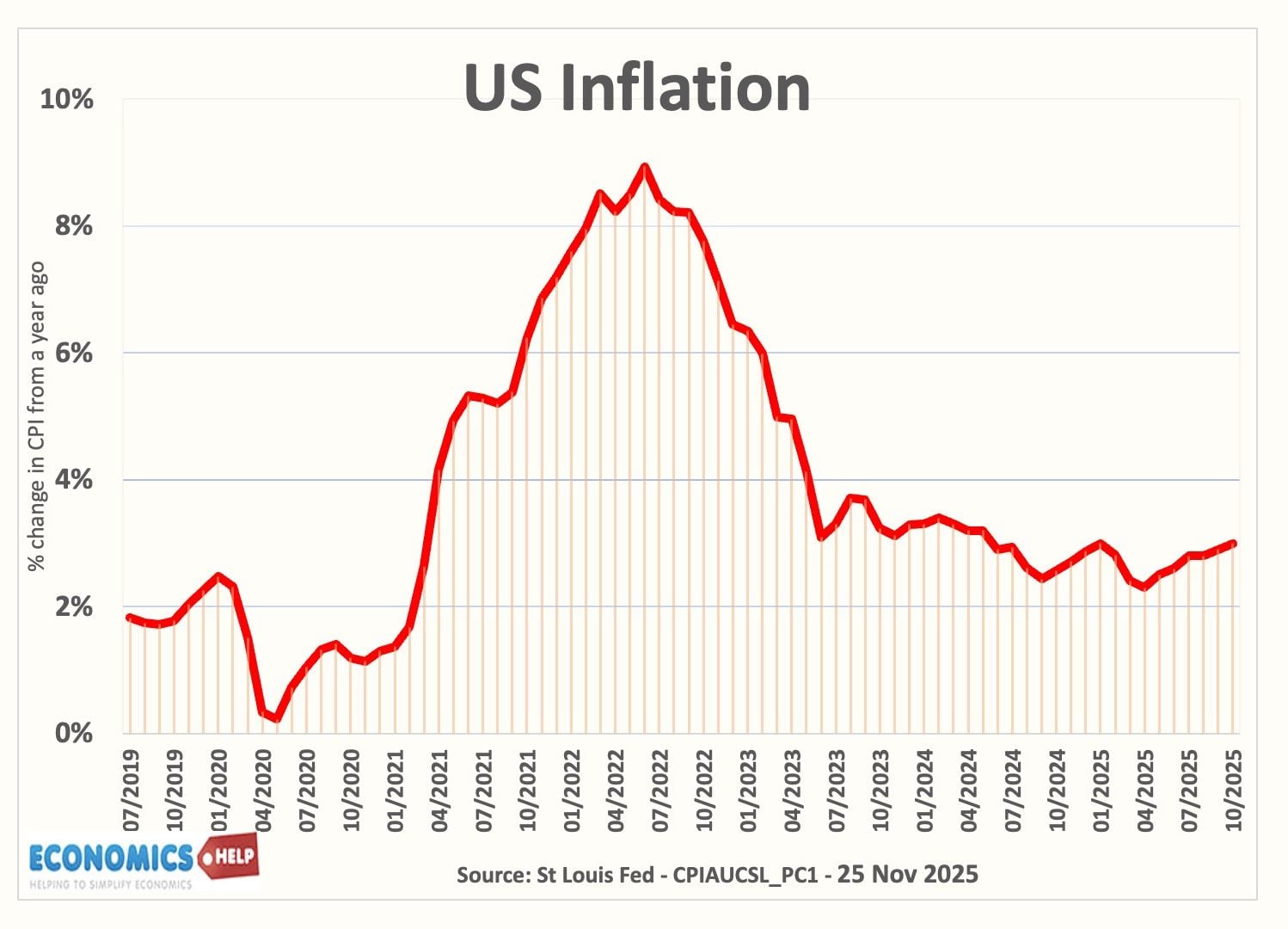
Inflation is once again on a four-year up cycle. Tariffs have pushed up consumer prices, with the effect on lower-income households three times more than the rich. But, more importantly perhaps, there is a rise in health costs. When Bananas from Brazil go up in price, you can decide not to buy; when health care costs go up, you have to pay. In 2025, health care costs are rising by 8% and with the removal of subsidies, some premiums could rise by over 100%. Not only that but inflation doesn’t fully count higher housing costs. Higher interest rates in recent years have been good for savers enjoying higher dividends, but, for homebuyers, mortgage payments have nearly doubled.

And homebuyers are still priced out by a housing market with house prices to income ratio higher than the 2008 crash. The generation that bought houses in the past or benefited from ultra-low rates of the 2010s have seen big wealth gains. But, for the outsiders the housing market is pretty grim. The US is just not building enough houses.
Manufacturing dip
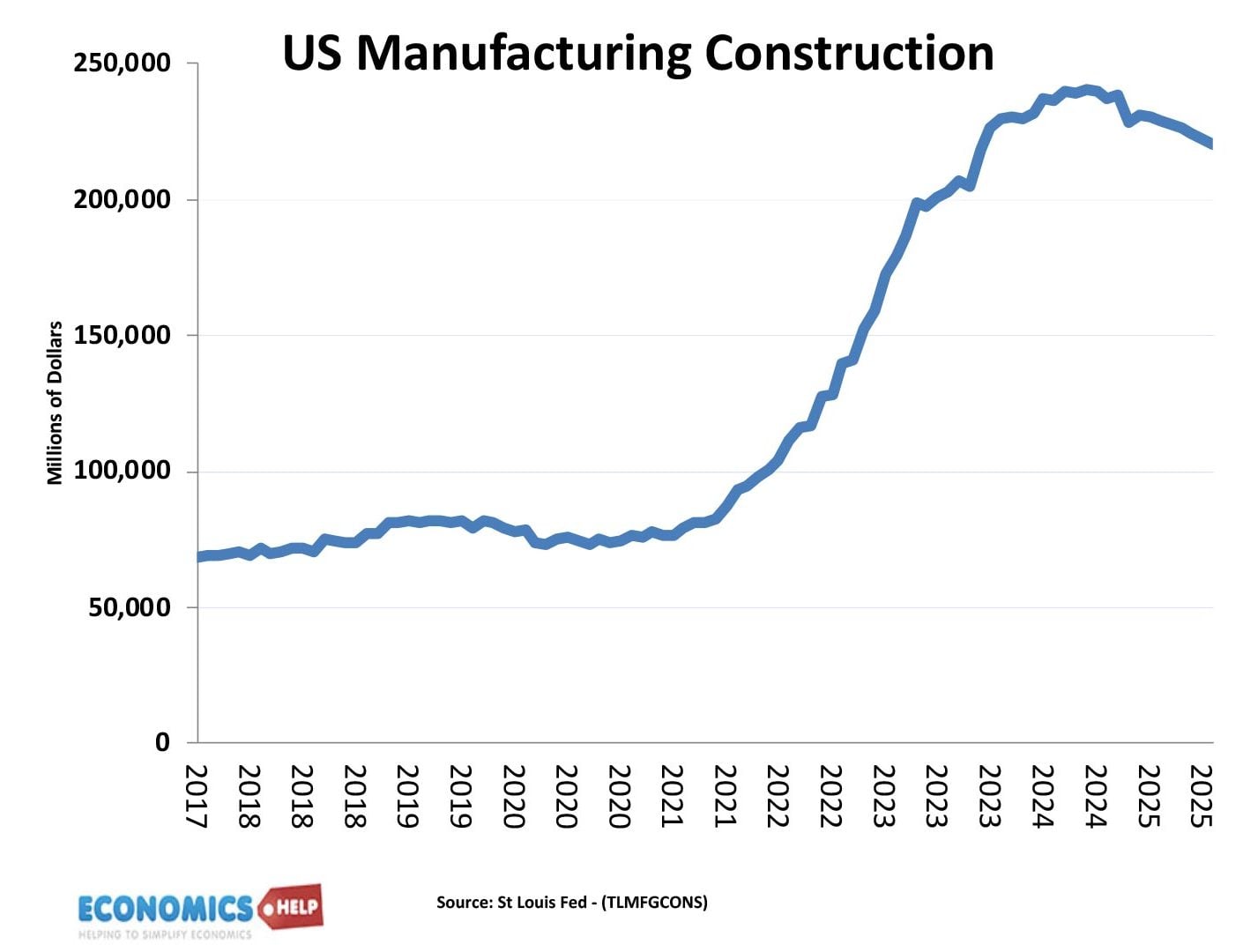
Tariffs haven’t just led to higher prices; they have also held back manufacturing. Manufacturing and construction saw a boom in the Biden years 2020 to 2024, but have gone into steep decline for three reasons. Tariffs on intermediate goods – raw materials like steel and timber- have increased costs for US manufacturing. Also, all the uncertainty of tariff changes doesn’t inspire confidence to invest. Thirdly, the expiration of subsidies for renewable energies has led to projects being cancelled which are no longer viable. And this decline in renewable investment comes at a time, when AI Power centres are hungry for electricity; in fact, they are blamed for part of the 30% rise in electricity prices, another cost of living pressure.
Growth Reliant on AI
In terms of economic growth, the US is heavily reliant on the AI boom. Investment in data centres, investment in capacity, the hope that revenues will soar to match the expectations. A three-year bull market has created unprecedented enthusiasm for buying shares – a new generation of young investors willing to take a risk; This doesn’t always end well.. It means the US has an unprecedented exposure to the performance of the stock market. Yet, savvy investors are nervous; the economy is unbalanced, it relies on the spending of the rich and the investment of big tech, but shares are overvalued. It means market sentiment has been swinging from greed to extreme fear. The CNN tracker last week swung to fear, which suggests market sentiment is turning. Certainly volatility is on the rise. Already, crypto is on the decline, the bubble is starting to pop.
In mid 2025, the top 10 percent of American households owned more than 87 percent of the country’s stocks and shares. Those households have benefited from equity gains of almost 74 percent since November 2022. It means the excess savings of the top 10% are far greater than the excess savings of the top 90%, who have seen a notable fall in the savings buffer since the end of Covid.
Job Market Turns
Another reason for record pessimism is the deterioration in the jobs market. The number of people finding jobs has decreased as jobs become in short supply. This is particularly affecting the young and recent graduates. With many blaming AI for reducing the number of entry level jobs. Whilst the stock of Nvidia continues to climb on the back of record profits, the problem is that the benefits of AI are becoming top heavy.

Record corporate profits but who gets the benefit? This has actually been a fundamental problem of the US economy for the past four decades. Starting in the 1980s, real GDP has increased far faster than median wages. It reflects the increase in inequality of US economy.
Strip away a booming stock market and an AI boom, what are the underlying strengths of the US economy? Small businesses have been hurt by tariffs, and low-end retailers like McDonald’s only report households cutting back. The confidence of AI firms know no bounds But the risk is that this AI-driven revenue generation comes more slowly than investors are expecting. Should AI hit an unexpected wall, a key piece of the Jenga tower of the economy would be removed, it would crash the stock market, reduce investment and slow down growth. After AI, there is no plan b.
Future Inflation
If inflation is a feature of the economy, voters really hate, there are good reasons to expect inflation to become more of a problem in the future. Global warming means rising insurance premiums. Reshoring manufacturing to the US means higher prices. In the past, the economy has been heavily dependent on migration both legal and illegal. As immigration falls, and illegal workers are deported, it will lead to labour shortages in unpopular jobs like fruit picking and meat packing. Which will push up prices.

In terms of underlying weakness to the US economy, one factor that hasn’t really hit home is the demographic crunch that will now come much quicker than expected. Without net migration increasing the working age population, the US faces a much faster increase in the dependency ratio. More retired to workers. This means of course, pressure on government spending. Even on current projections, US debt is forecast to soar to levels which will prove difficult to manage, but these projections are based on higher fertility rates. Recent evidence suggests like the rest of the world, this is falling at a faster rate. Given political division and the increased prevalence of government shutdowns, it is hard to see bipartisan efforts to bring the deficit under control.
Agriculture
Away from the headlines, American farmers claim the industry is in crisis, tariffs, lower prices, falling profit margins and a shortage of workers are all causing a real crisis. Output is down 10% since 2022. But, agriculture has its own K-shaped recovery with bankruptcies by small farm business reaching a five-year high, whilst the income of the big farms is rising.
Some would claim fears of other economic weaknesses are misplaced. The benefits of new tech will triumph over the costs of tariffs. Consumers are pessimistic, but the economy continues to grow for the moment. Even if there was a stock market crash, the rich have ao much excess savings, they may continue to spend. If the economy does slow down, there is the potential for lower interest rates to come to the rescue. Certainly, there have been many warnings of US recession that have not materialised.
Yet, even if the economy doesn’t come crashing down, it has become dangerously bifurcated and divided. An economy that relies so much on rising wealth, AI investment and spending from the rich is an unbalanced economy. It also means headline GDP statistics can be misleading to the economy ordinary Americans actually face.
Related posts
Sources:
- https://fortune.com/2025/11/07/what-is-the-k-shaped-economy-wealth-inequality-explainer/
- https://fortune.com/2025/09/17/economy-reliant-on-wealthy-consumer-moodys-consumer-spending/
- https://www.wsj.com/economy/consumers/us-economy-strength-rich-spending-2c34a571
- https://www.nytimes.com/2025/11/23/opinion/housing-crisis-america.html
- https://www.bbc.co.uk/news/articles/cnvee260n8eo
- https://www.pwc.com/us/en/industries/health-industries/library/behind-the-numbers.html
About The Author
