
Aggregate Expenditure function
The aggregate expenditure function (AE) measures total aggregate demand in the economy and is the sum of all its different individual components
AE= C+I+G+X-M
- C= Consumer spending
- I = Gross fixed capital investment
- X = Exports
- M = Imports

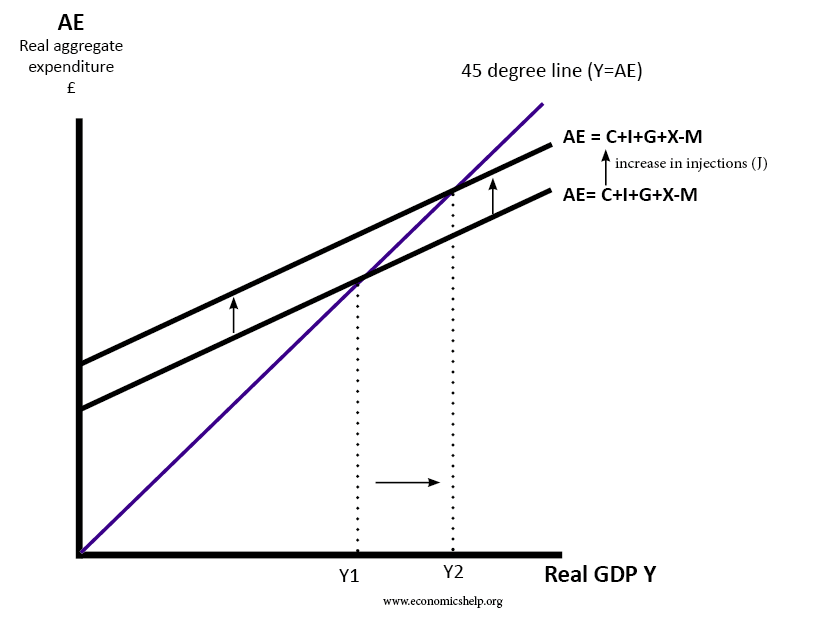
Equilibrium occurs where AE = Y. If AE is greater than total production, this causes firms to increase production.
(In a closed economy with no government, this simplifies to: AE = C + I.)
Impact of increase in injections (J)
If there is an increase in injections. For example, an increase in investment (I), then the AE curve will shift upwards, leading to an increase in real GDP.
Increase in withdrawals
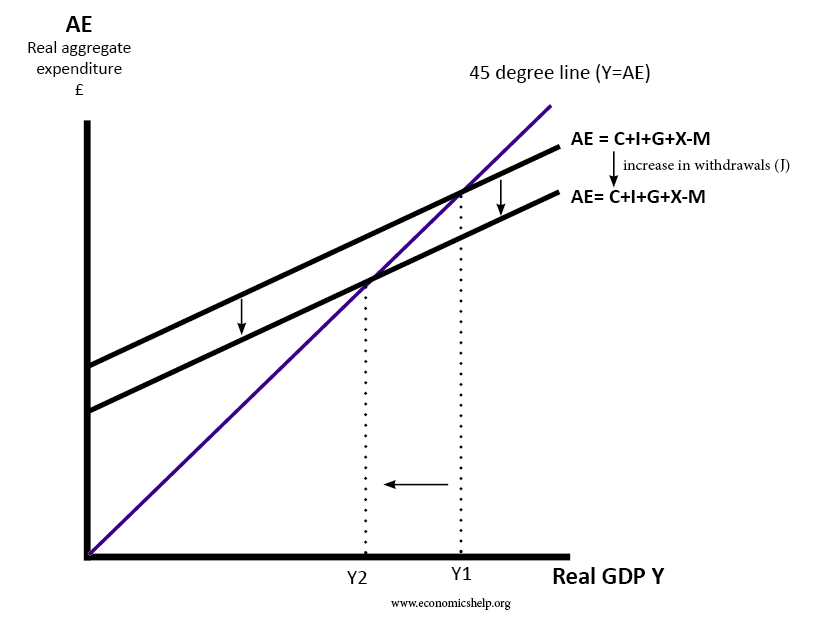
If there was an increase in withdrawals (W). For example, an increase in tax collected by government, this would reduce AE and shift the line downwards. This would lead to lower real GDP.
Slope of AE curve
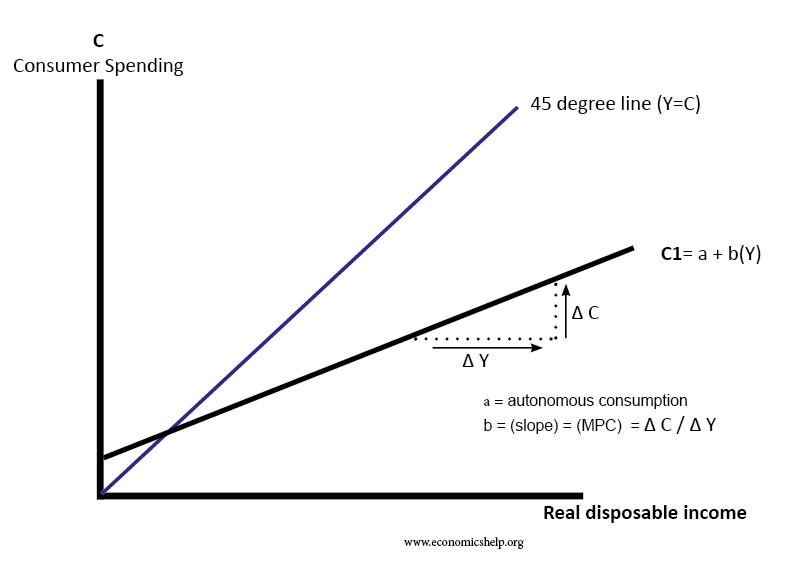
The Consumption function expresses the level of consumer spending depending on three factors.
- Yd = disposable income (income after government intervention – e.g. benefits, and taxes)
- a = autonomous consumption (consumption when income is zero. (e.g. even with no income, you may borrow to be able to buy food))
- b = marginal propensity to consume (the % of extra income that is spent). Also known as induced consumption.
- This marginal propensity to consume will determine the slope of the C function and therefore, the AE function.
- A higher marginal propensity to consume will lead to a steeper AE curve and therefore the impact of an injection will have a bigger impact.
- With a higher marginal propensity to consume – there will be a bigger multiplier effect.
Recession – negative output gap

In this case, real GDP is at Y1, which is below Yf (YF = full employment output)
- This is due to insufficient AE.
- There is a negative output gap of (Yf-Y1)
- To close the negative output gap would require higher AE, e.g. higher consumption or an increase in injections, such as higher government spending.
Inflationary gap (positive output gap)

Similarly, if equilibrium real output increases beyond potential real GDP (due to short term rise in demand, we will see inflation because firms can’t keep up with demand so put up prices.
The impact of an inflationary gap is that equilibrium output (Y1) is temporarily greater than Yf. But, this will tend to be unsustainable and cause inflation.
Investment
- Autonomous investment – this is the level of investment which is not related to income. For example, some firms will need to invest to replace worn out capital – whatever the state of the economy. Also, once a firm has started an investment project, they may want to complete it, whatever rate of economic growth.
- Induced investment. This is investment that depends on factors, such as economic growth, confidence and expectations of future growth.
Related posts
About The Author
