
Suppose you had a question discuss the effect of higher interest rates on the economy.?
The basic analysis is that higher interest rates reduce AD and therefore, lead to lower real GDP.
A good evaluation would be to say the effect depends on the state of the economy.
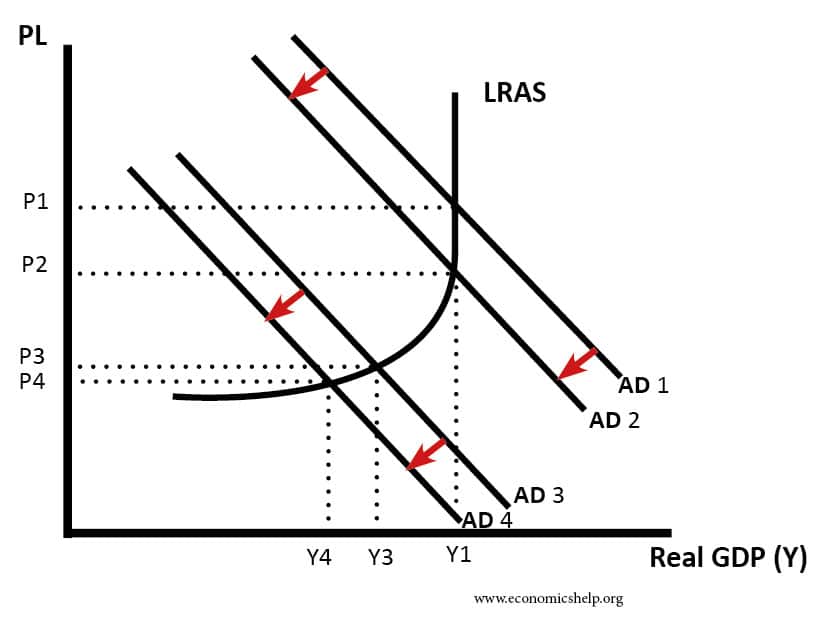
This shows the effect of a fall in AD depends on where the economy is. A fall in AD1 to AD2 reduces inflation with no effect on real GDP. But a fall in AD from AD3 to AD4 does cause a fall in real GDP.
How could you take evaluation to next level? Two suggestions
- Combine multiple types of evaluation
Example – effect of higher interest rates
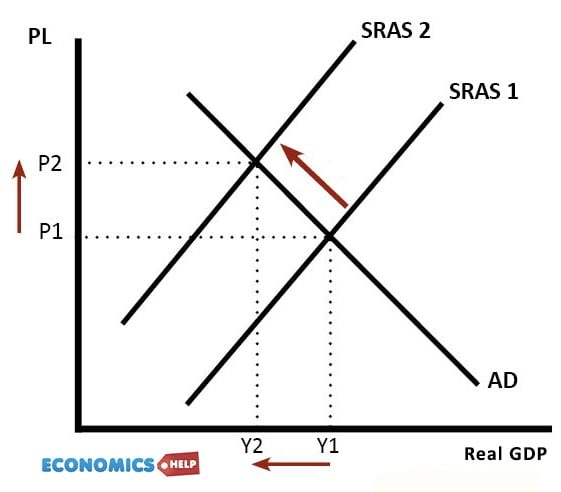
“The effect of higher interest rates depends on both the cause of inflation. If inflation is caused by cost-push factors, higher interest rates are unlikely to reduce the fundamental cause of inflation, which is rising energy prices. To reduce inflation by reducing AD would cause a big fall in AD
However, on the other hand, a rise in interest rates in theory is likely to cause an appreciation in the exchange rate, which makes imports cheaper and could lead to lower price level fairly quickly.
However, this appreciation in the exchange rate is not guaranteed. If the country is a net importer of energy like the UK, the oil shock may reduce the exchange rate because the cost of importing oil has risen, and this oil shock might outweigh the impact of higher interest rates on the exchange rate.
Therefore, with an an oil shock, higher interest rates are unlikely to solve inflation, at least in the short-term
2. Evaluate by using an example for the real world
Examiners love when you can use an example from the real world. For example, with regard to the effect of higher interest rates. You could use case of 2022, when interest rates rose, but it was too late to prevent inflation rising to over 10%

Inflation rose despite higher interest rates because
- There were multiple causes of inflation – rising demand, post-covid supply constraints and rising oil prices
- There were time delays between increasing interest rates and affecting mortgage rates
Discuss the effect of an increase in government borrowing?
One problem of increasing government borrowing is that it can put upward pressure on bond yields and interest rates.
“However, this is not always the case, in 2009 government borrowing soared, but bond yields actually fell because inflation was low and in a deep recession, there is usually a rise in savings and people have extra liquidity to buy government bonds as a result yields went down.
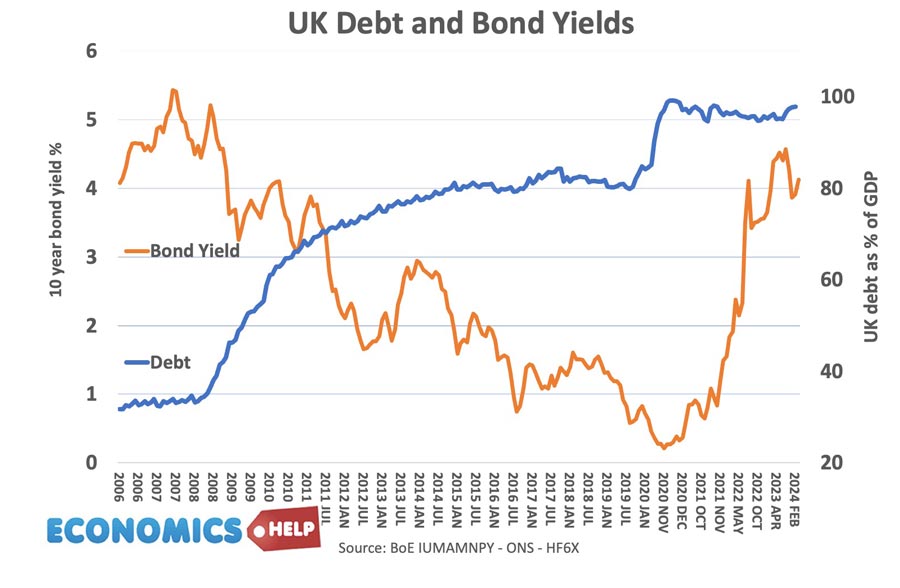
However, in 2022, high levels of borrowing, were a factor in causing bond yields to soar because at that time inflation was rising, the economy was still growing and so bond yields rose. In 2026, bond yields have reached 5%, making borrowing much more likely to cause inflation.
Lower interest rates usually increase aggregate demand. However, in 2009, they didn’t cause much increase in aggregate demand, because of the financial crisis, banks were short of liquidity and so didn’t pass the base rate cuts on to consumers and cut back on the amount of lending they were ready to do, therefore, the transmission mechanism broke down.”
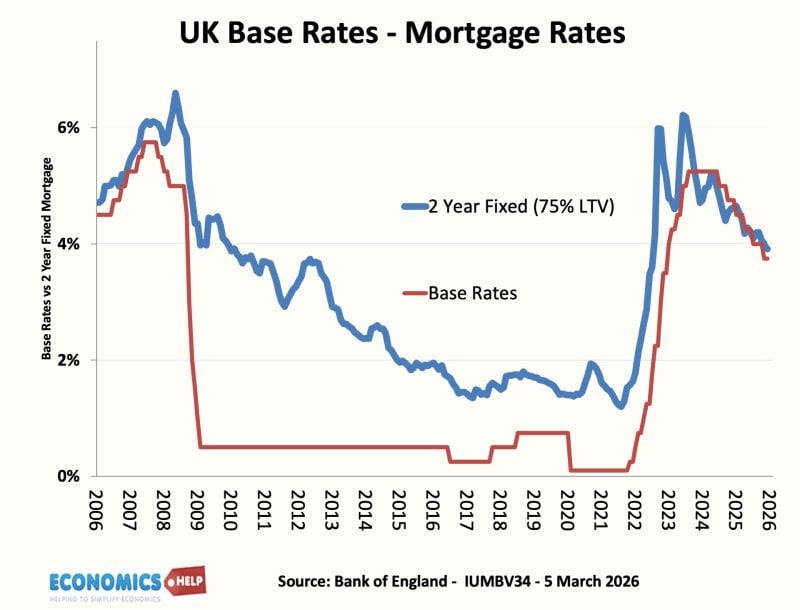
Today in March 2026, mortgage rates have gone up – even though base rates haven’t increased (and in fact may never increase)
Some of this content was included in a new revision product
AQA Economics exam skills – which includes a section on advanced A* evaluation

AQA Exam skills and model essays
AQA syllabus is very similar to WJEC and OCR, and mostly similar to edexcel.
But a more general evaluation skills is here.
About The Author
