
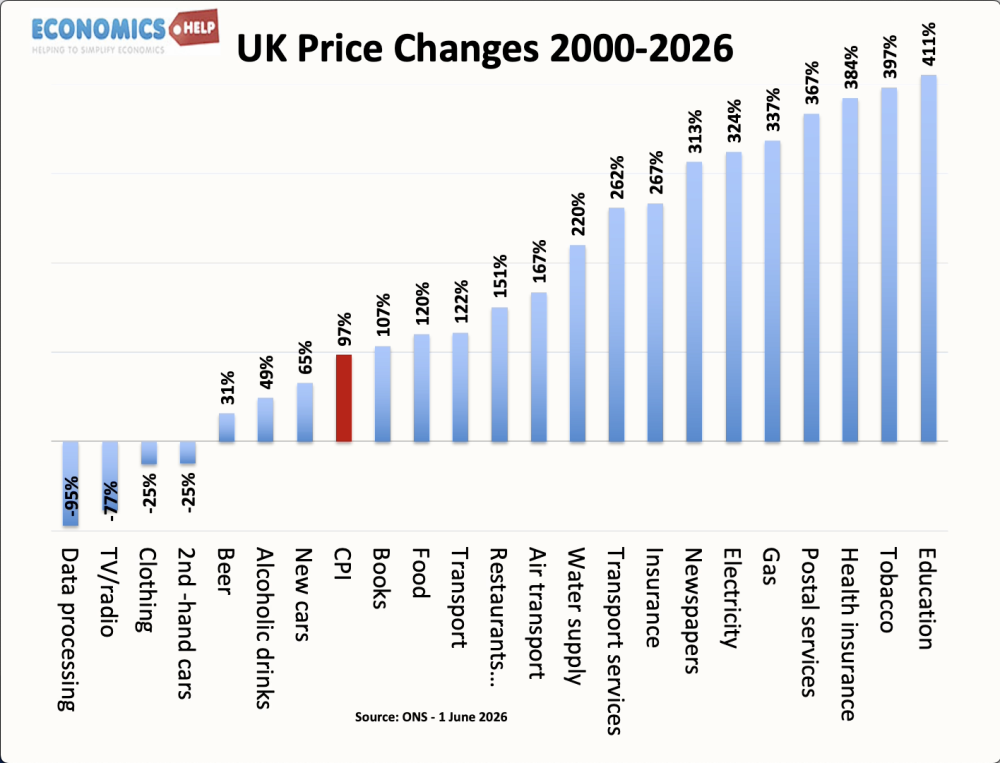
Since 2000, average prices in the UK have risen 98%, yet some goods like gas, electricity and education have increased at a much faster rate. This is the cost of living crisis, essential utilities, rising above inflation. We might also add items not fully covered by ONS inflation – council taxes, the rise of the subscription economy, higher volume of parking charges and critically, rent inflation.
Even when it comes to broadband and mobile phone charges, it seems the official stats show UK prices increasing much faster than European countries. Companies have taken advantage of loyal customers to put inflation busting rises in the very small print.
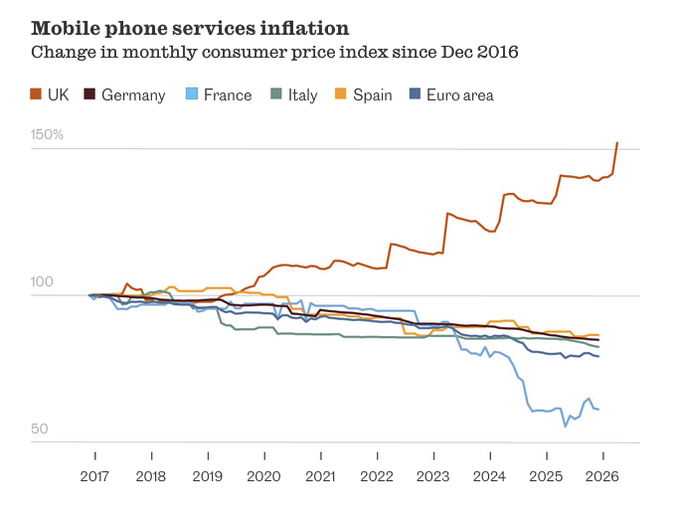 source: https://observer.co.uk/news/business/article/broadband-and-mobile-bills-are-soaring-in-the-uk-depending-on-who-you-talk-to
Now there are actually a small number of goods – clothes, 2nd hand cars and data processing equipment that are actually cheaper than 26 years ago.. And a quick observation is that this is mostly goods we import clothes, TVs, toys and electronic items that have become cheaper. Thank goodness for cheap Chinese imports, or UK inflation would be even higher. But it is services entirely produced in the UK that are more expensive.
The biggest rise in prices since 2000, is actually education, which primarily reflects the surge in university tuition fees and rise in private school feels. In 2000, the maximum tuition fee was £1,000. Today it is £9,500. And this has knock on effects, for a new generation of students who leave university with average debt of £50,000 and an effective tuition loan repayment of 6%. It’s not called a tax, but it is. It’s a permanent drag on living standards not fully reflected by inflation.
Since 2000, rents have increased just above inflation. But the difference is that since 2020, rents have increased 35%, faster than inflation. Rents have been squeezed higher by classic supply and demand side factors. Firstly house prices have risen 250%, much faster than inflation. This has pushed many people into private rented sector. Also, in the past 25 years, the UK population has risen 11 million, at a time of low housebuilding. This recent population pressure have been exacerbated by high net migration. Certainly, there is a very strong correlation between rental growth and net migration figures.
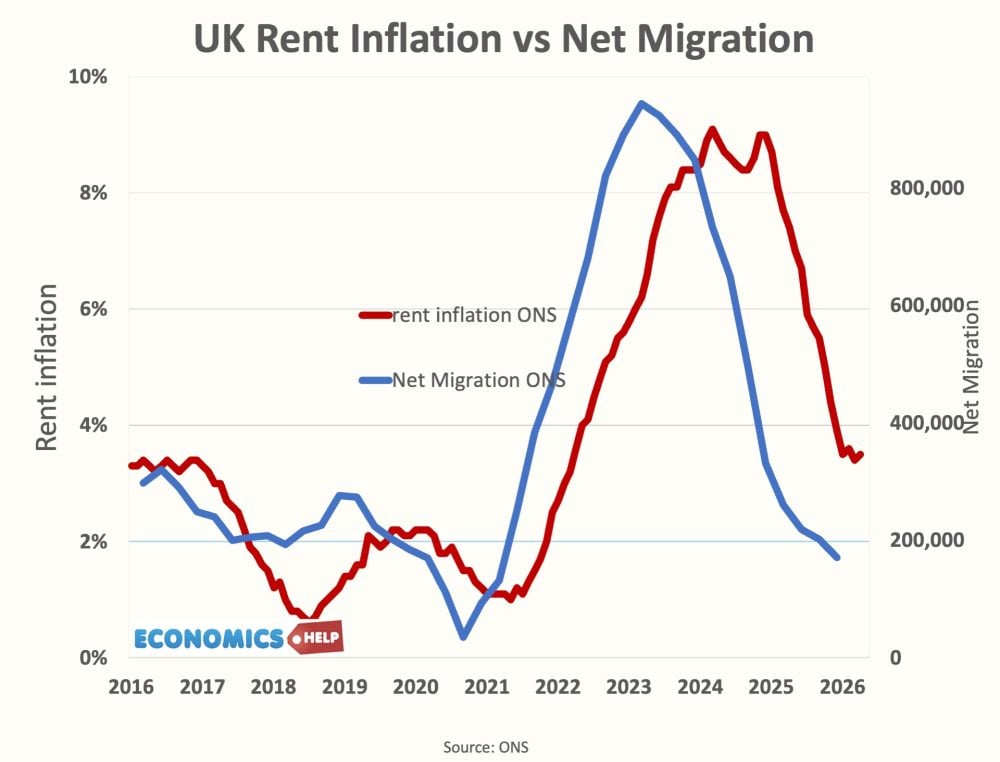 Correlation is not causation, but…
For the past 25 years, there have been calls to increase housebuilding, it was a target of every government, but nearly every government fails. One reason is that it is expensive to build housing. There is a reliance on expensive imported raw materials, rising labour costs. Building costs have risen 150%. According to one estimate, the cost of building a 3 bed house is £282,394. The Home Builders Federation argues that it is £76,000 has been added to the cost of building a new house since 2020. They point to the building safety act, biodiversity net gain, stricter energy-efficiency requirements, and electric vehicle charging points. In the early 90s, building regulations were hundreds of pages, now over 3,000 pages. And even when projects are put forward they can still be blocked by local councils. There have been efforts to reform this
Legal challenges
Also, a hidden cost throughout the UK economy is the potential cost of legal challenges. Whether it’s a new bypass, housing projects HS2, Nuclear power, infrastructure projects are prone to delays. What happens is that the UK planning system allows legal challenges, but this often causes delays in construction, and when construction is stopped, costs accelerate due to inflation and paying people to do nothing. These legal challenges can also lead to risk-averse behaviour by builders.
Electricity
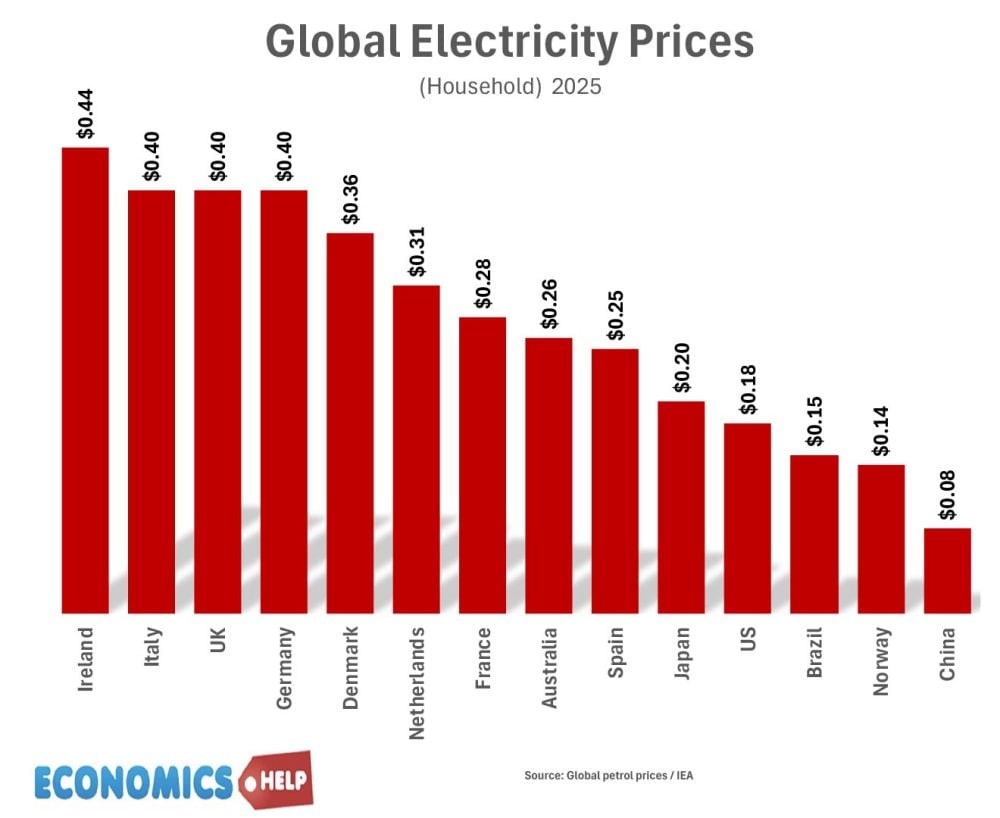
One of the biggest increases in household bills has been electricity, and this has been particularly damaging for UK industry. The UK invested heavily in renewable energy, but lower generation costs have not translated into lower prices for consumers.
The problem is that generating electricity is only one part of the system. Electricity also has to be transmitted, balanced and stored. The UK created strong incentives to build wind farms, but investment in the grid failed to keep pace. As a result, electricity is often generated where the network cannot easily transport it to where it is needed.
Privatisation and competition initially helped reduce prices, but the long-term challenge of upgrading the grid was repeatedly delayed. Today, billions of pounds are being spent on new transmission lines and infrastructure, with much of the cost ultimately ending up on consumer bills.
The cost of balancing the grid has soared, and this helps explain why falling renewable generation costs have not led to lower electricity prices. Consumers pay not just for generating power, but for the entire system.
Last year, hundreds of millions of pounds were paid to wind farms to switch off when the network could not accommodate their output, while more than £1 billion was spent managing constraints elsewhere in the system.
In 2022, France responded differently, using regulated tariffs and state ownership of EDF to limit price rises. UK consumers saw much larger increases in electricity prices and higher prof.
Another challenge is that electricity demand has not risen as quickly as expected. This means the large fixed costs of maintaining and upgrading the grid are spread over less consumption, increasing the average cost per unit.
Stamps and newspapers
You can see this effect with other goods. The decline in postal services has increased the average cost. The price of a stamp has soared more than inflation because the less post thatgets sent the more inefficient a national postal network is. The same with newspapers, the average price has really increased. But this does also raise the issue of how to measure the cost of living. Back in the day I bought stamps and newspapers which were much cheaper, but now I hardly spend anything on stamps or newspapers. The price of landline calls could go up, but I so rarely use it is less important. We used to buy things like calculators, alarm clocks, cameras and film processing, but now we spend nothing on it. So this is the positive aspect of technology, some items are less necessary to buy.
Subscriptions
However, one big change in the modern world, is the relentless rise of the subscription payment. I remember when you could buy Microsoft Word and that’s it, but now everything is an annual fee, and when you’re a captive customer, it’s easy to keep increasing price. It’s a real fight to avoid getting sucked into annual subscriptions. Netflix, Microsoft, adobe, AI, anti-virus, music, cloud storage, gyms. Even things that didn’t use to be subscription like printer ink, fitness trackers, security camera. Barclays report spending on digital content & subscriptions has increased by 47.5% since January 2020. Though if you want to subscribe to Economics help on Substack, that is absolutely tremendous value.
Another kind of expense is the rising cost of car parking. Many customers have seen prices rise faster than inflation. And DVLA report private operators have increased use of number plate recognition from 1.9 million in 2012 to 12.9 million in 2024. At the same time the number of fixed penalty notices for speeding have increased.
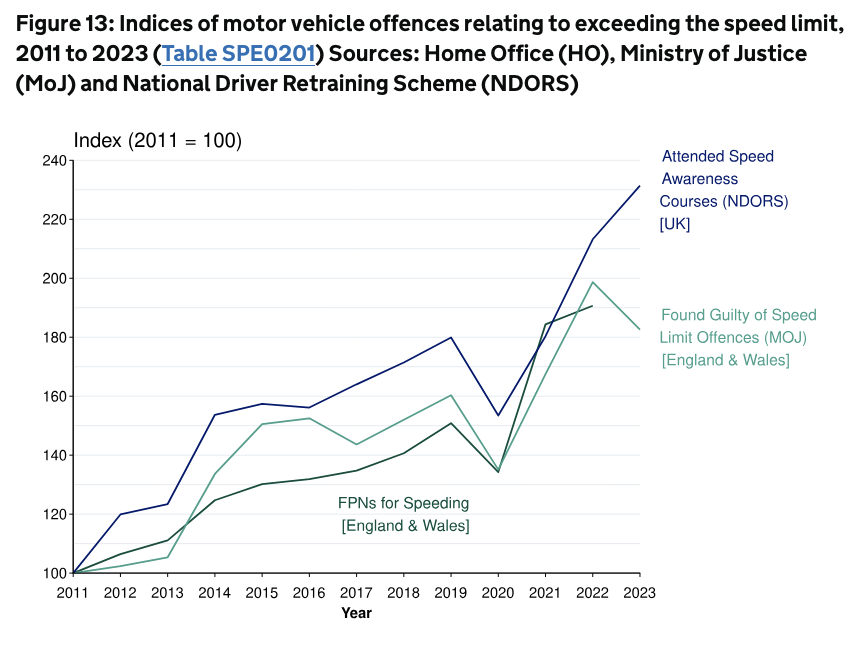
It is not just the price of goods, and fines, but how often they have to be paid. We are paying more in parking and speeding fines than ever. For some councils parking and traffic offenses have become a surrogate council tax revenue. Local councils also have a monopoly power in raising council tax, with falling central government grants,
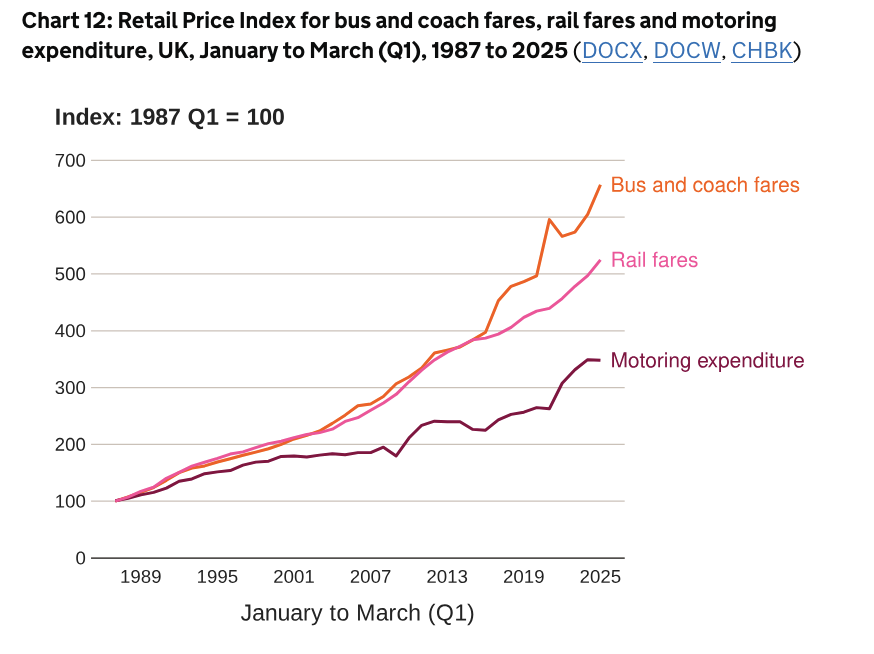
But, although fines have risen, it is bus and train users which have seen the biggest rise in expenditure in the past few years. Petrol has become relatively cheaper due to freezing of petrol duty. Also, cars are less likely to break down, though when they do more expensive to fix, which is why car insurance has increased faster than inflation.
A final cause for concern is the cost of raising a child has increased significantly; housing is expensive, childcare has risen faster than inflation and education has been the biggest % rise, is it any surprise, we are having less children?
Sources
https://substack.com/home/post/p-196087149
About The Author
