
Definition of efficiency
Efficiency is concerned with the optimal production and distribution of scarce resources. It means an economy makes the best possible use of its scarce resources to maximise welfare. Resources will not be wasted and it is impossible to make someone better off without making someone else worse off.
Different types of efficiency
- Productive – producing for the lowest cost. (lowest point on SRAC)
- Allocative – distributing resources according to consumer preference P=MC
- Dynamic – Efficiency over time.
- X-efficiency – incentives to cut costs.
- Efficiency of scale – taking advantage of economies of scale. (lowest point on LRAC)
- Social efficiency – taking into account external costs/benefits. (SMC=SMB)

1. Productive efficiency
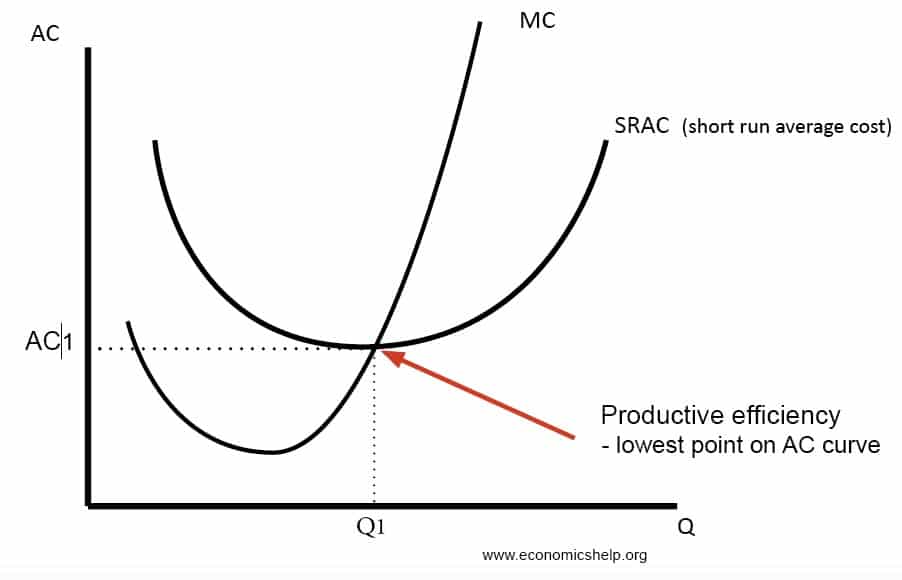
This occurs when the maximum number of goods and services are produced with a given amount of inputs. This will occur on the production possibility frontier. On the curve, it is impossible to produce more goods without producing fewer services. Productive efficiency will also occur at the lowest point on the firm’s average costs curve. (Q1)
2. Allocative efficiency
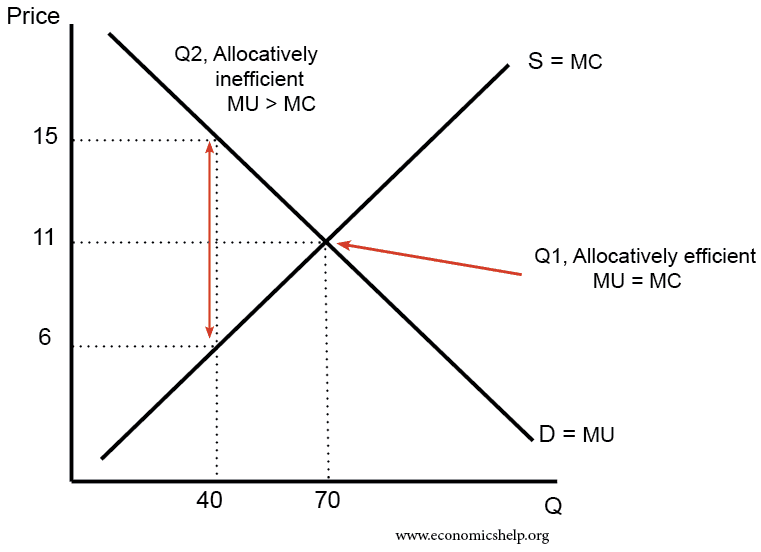
This occurs when goods and services are distributed according to consumer preferences. When resources go to the goods and services most valued by society.
- An economy could be productively efficient but if produce goods people don’t value this would be allocative inefficient.
- Allocative efficiency occurs when the price of the good = the MC of production. This occurs at an output of 70, where price £11 = MC.
- At an output of 40, The price of £15 is much greater than MC of £6 – there is underconsumption. People would value increased consumption
3. X efficiency
X-efficiencyt is wow well a firm controls costs when there is no competitive pressure. For example, a monopoly which makes supernormal profits may have little incentive to get rid of surplus labour and have little incentives to cut costs, therefore they become x-inefficient.
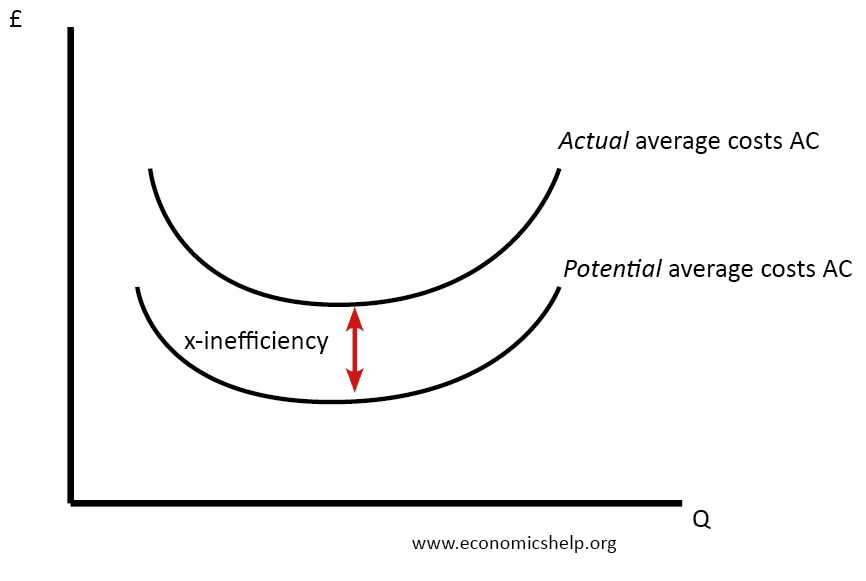
If a firm’s average costs are higher than potential – then we are x-inefficient.
See: X Inefficiency
4. Efficiency of scale
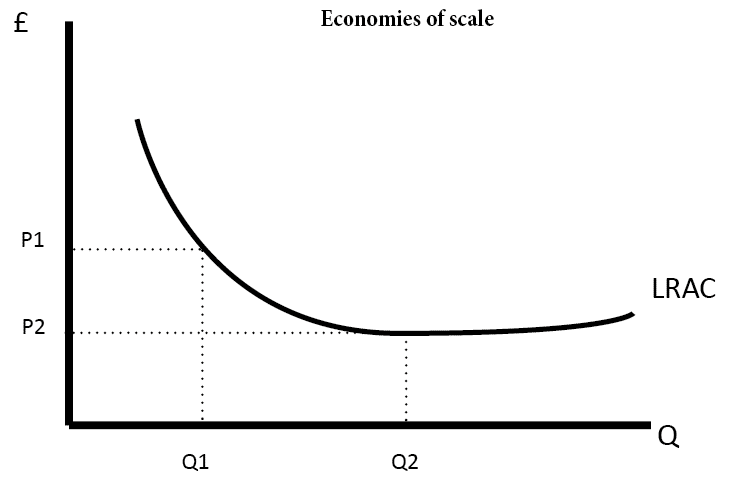
This occurs when the firms produce on the lowest point of its long-run average cost (Q2) and therefore benefits fully from economies of scale
5. Dynamic efficiency
This refers to efficiency over time, for example, a Ford factory in 2010 may be very efficient for the time period, but by 2017, it could have lost this relative advantage and by comparison, would now be inefficient. Dynamic efficiency involves the introduction of new technology and working practices to reduce costs over time.
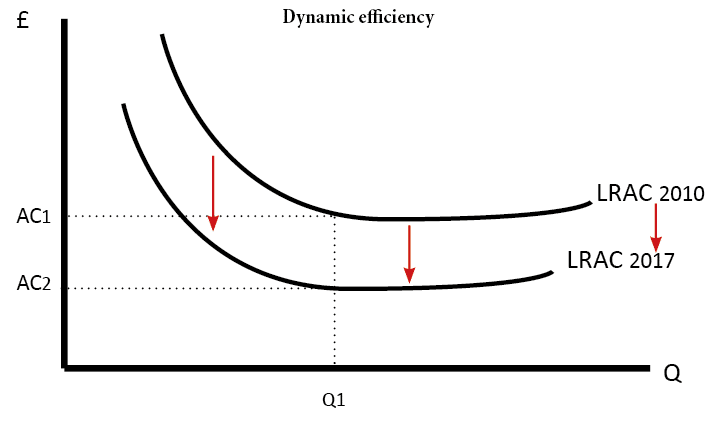
- Dynamic efficiency
- Static efficiency – efficiency at a particular point in time.
6. Social efficiency
This occurs when externalities are taken into consideration and occurs at an output where the social cost of production (SMC) = the social benefit (SMB)
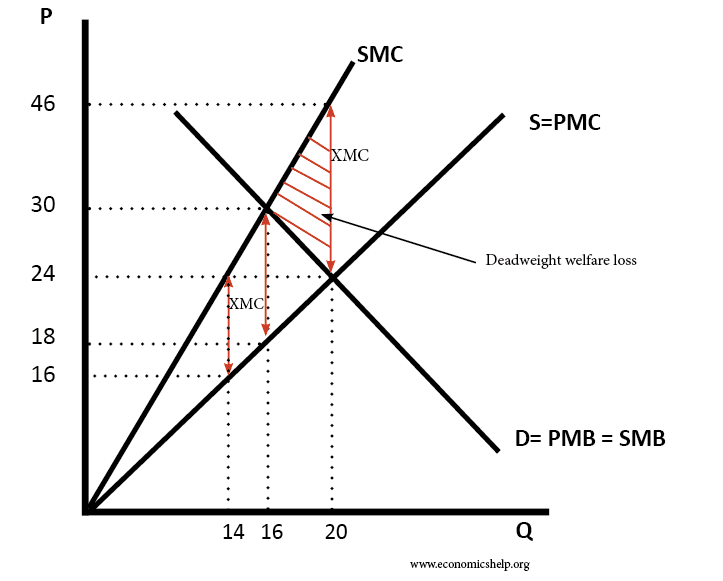
Social efficiency occurs at an output of 16 – where SMB = SMC
See: Social efficiency
7. Technical efficiency
This requires the optimum combination of factor inputs to produce a good: it is related to productive efficiency.
See: Technical efficiency
8. Pareto efficiency
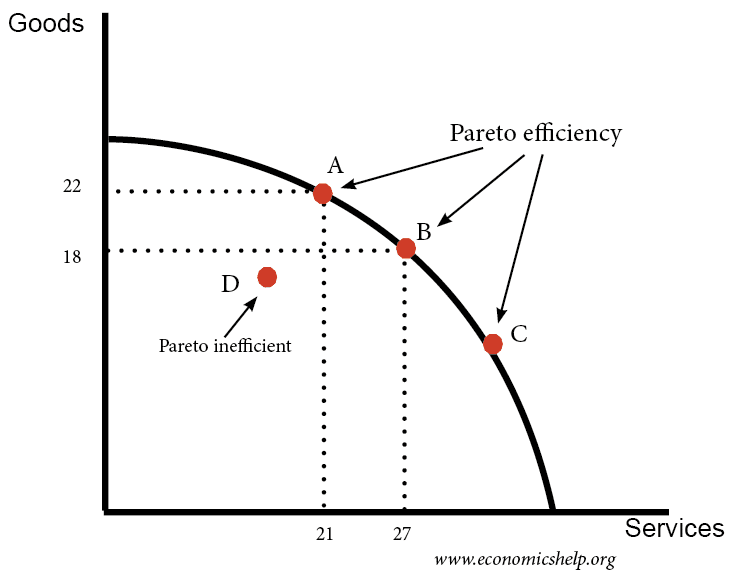
A situation where resources are distributed in the most efficient way. It is defined as a situation where it is not possible to make one party better off without making another party worse off.
See: Pareto efficiency
9. Distributive efficiency
Concerned with allocating goods and services according to who needs them most. Therefore, requires an equitable distribution.
Why Economic Efficiency Matters
- Increases output, productivity and leads to higher economic growth
- Enables people to have better living standards, lower prices and afford more goods
- Reduces waste and makes use of scarce resources in a better way.
- Allows governments to provide more public services with the same resources
- Efficiency does not always equal equity. A highly efficient allocation may still be unequal or politically unacceptable, e.g. sacking workers, closing down coal mines, may lead to structural unemployment
Related