How to calculate price elasticity of demand.

Price elasticity of demand = % change in Q.D. / % change in Price
- To calculate a percentage, we divide the change in quantity by initial quantity. If price rises from $50 to $70. We divide 20/50 = 0.4 = 40%
Example of calculating PED
- When the price of CD increased from $20 to $22, the quantity of CDs demanded decreased from 100 to 87.
- What is the price elasticity of demand for CDs?
Calculating a Percentage
- The price increases from $20 to $22. Therefore % change = 2/20 = 0.1 (10%)
0.1 = 10% (0.1 *100) - Quantity fell by 13/100 = – 0.13 (13%)
- Therefore PED = -13/10
- Therefore PED = -1.3
In this case demand is price elastic.
- Therefore Demand is elastic. Elastic demand occurs when % change in quantity is greater than % change in price; when PED >1
Test Yourself with PED Calculations
Price Elasticity of Demand (PED) – Interactive Self-Test

Click Show answer to reveal the worked solution. Use the Reset button to hide everything again.
Q1) Basic percentage method
Price rises from £10 to £12. Quantity demanded falls from 100 to 80.
Calculate PED.
Q2) Elastic demand example
Price falls from £8 to £6. Quantity demanded rises from 200 to 300.
Calculate PED.
Q3) Inelastic demand example
Price rises from £1.50 to £1.65. Quantity demanded falls from 1,000 to 970.
Calculate PED.
Example 2
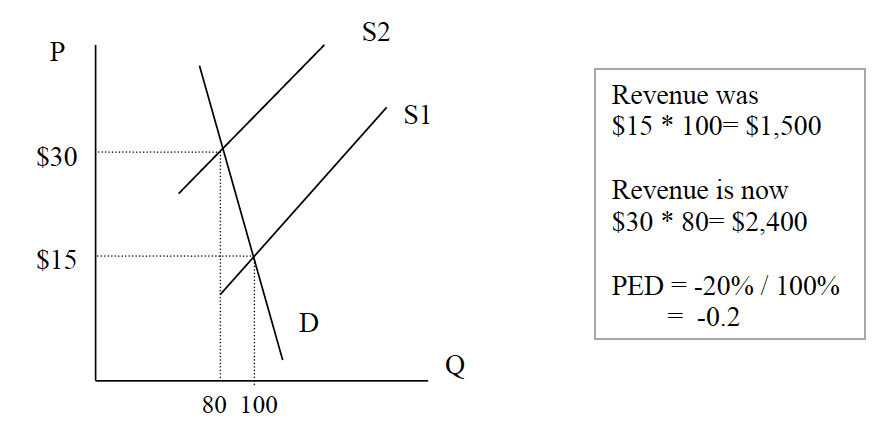
- Price rises from $15 to $30 (100% rise in price)
- Quantity falls from 100 to 80 (20% fall)
- PED – -20/100 = -0.2
Example 3
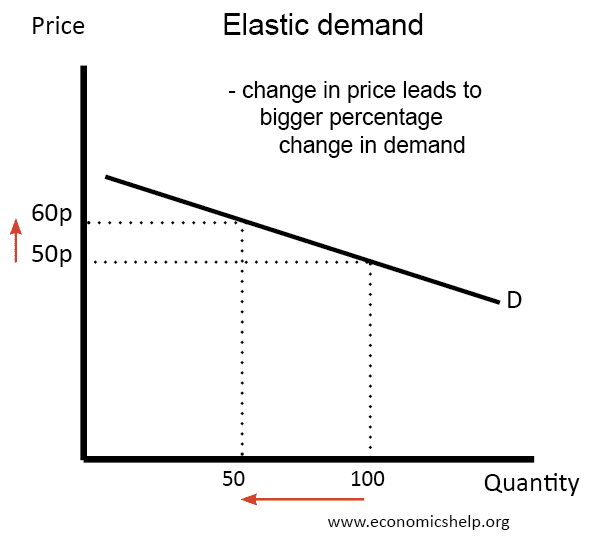
In this case the PED
- % change in QD = -50/100 = 0.5 = -50%
- % change in price =10/50 = 0.2 = 20%
- Therefore PED = -2.5
Example 4
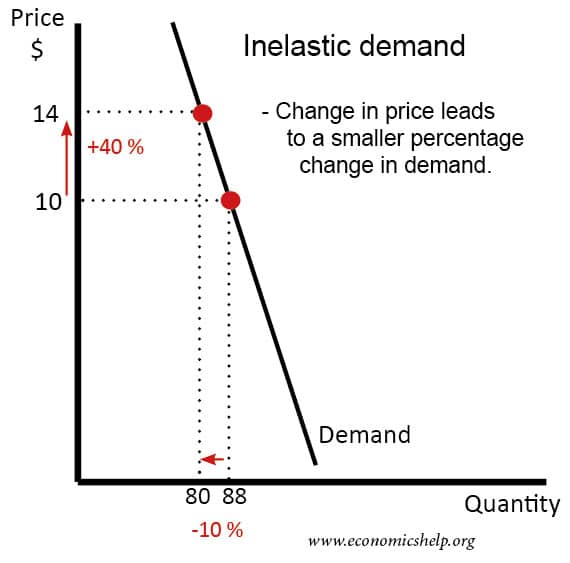
PED = -10/40 = -0.25
Advanced – the difference between point and arc elasticity of demand
- Point elasticity of demand takes the elasticity of demand at a particular point on a curve. (using calculus to measure slope of curve)
- Arc elasticity measures elasticity at the mid point between the two selected points:
Calculating PED Using the Midpoint Formula
The price of a product increases from £20 to £30. Quantity demanded falls from 60 to 40 units.
Midpoint means we have to work out average quantity and average price.
Calculate PED using the midpoint formula.
Answer:
- Change in quantity = 40 − 60 = −20
- Average quantity = (60 + 40) / 2 = 50
- Percentage change in quantity = −20 ÷ 50 × 100 = −40%
- Change in price = 30 − 20 = +10
- Average price = (20 + 30) / 2 = 25
- Percentage change in price = 10 ÷ 25 × 100 = +40%
- PED = −40% ÷ 40% = −1.0
- Demand is unit elastic.
See also:
About The Author

The answer is 0
Therefore the demand is perfectly inelastic
The demand and supply for an economic textbooks are given by q=20-p and q=3p,respectively. a.what are the equilibrium price and quantity.imagine that government imposes a per-unit tax of $4 on the sellers