
US stock market valuations are reaching record levels last seen in the dot com bubble – this time it’s just another type of tech boom, is history repeating itself?
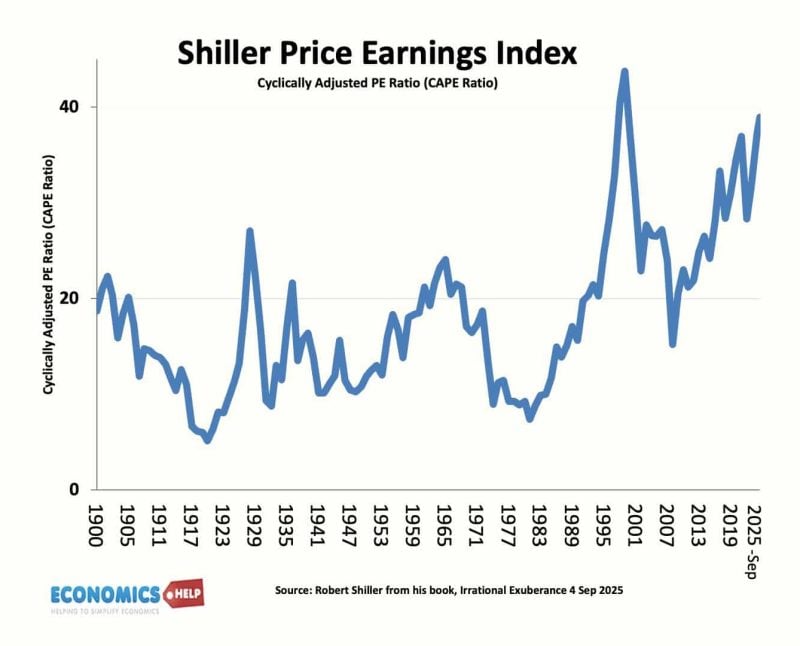
But whilst a few big tech firms are booming, at the same time the US has record tariffs, inflationary pressures, the dollar falling, debt soaring and and the independence of the Fed under threat, The NBER suggest a 71% probability the economy was already in recession in May.
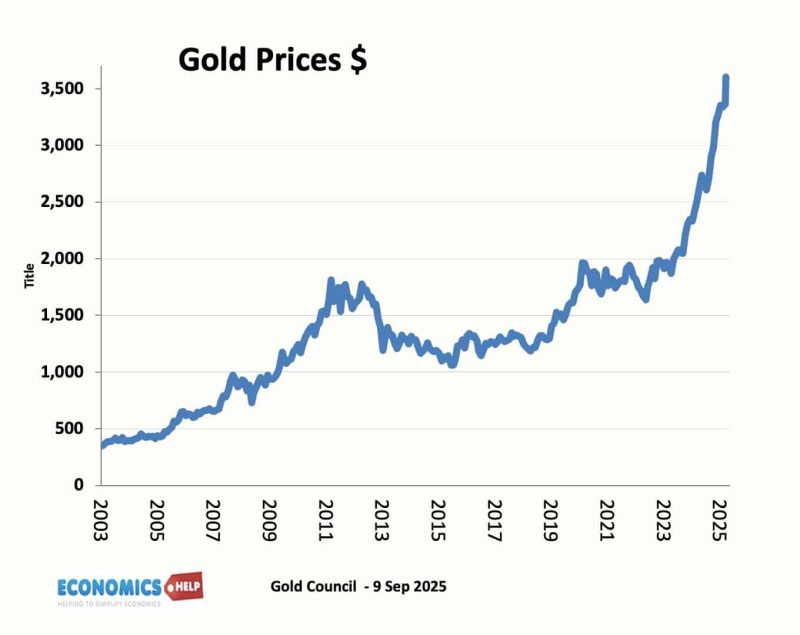
Gold is soaring to record levels as investors hedge against the dollar. There are two different explanations. Firstly, you can argue that the US economy is still relatively resilient and will shrug off all these challenges and continue its economic exceptionalism, where it has outperformed the EU. The second is that markets just don’t want to recognise the seismic changes hitting the economy, and therefore, prices are overvalued.
A Warning from Turkey?

In Turkey, President Erdogan railed against high interest rates. In 2019, he sacked the governor of the Central Bank and pushed for interest rates to fall from 19% to 9% claiming lower interest rates reduce inflation. But, you can’t rewrite the law of gravity. The cut in interest rates caused inflation to soar. Even in 2022, with inflation once again rising, Erdogan wanted lower rates. Again, it failed. Inflation soared, the lira devalued and Turkish people sought foreign currency. Ironically, it left Turkey with high inflation and interest rates of 50%, a falling currency, danger of debt default and an economic crisis. You might think that could never happen in the US, but markets are not contemplating the possibility. But anything is possible.
Erdogan’s intervention in monetary policy shows how quickly inflation can become a problem, and once you break confidence and credibility,y it is hard to get it back. The irony is that cutting Fed rates by 300 basis points would probably push up mortgage rates even higher. The Fed doesn’t set mortgage rates, and if inflation goes up, so will mortgage rates.
Tariffs

US tariffs have been up and down like a rollercoaster this year, but amidst all the noise, the basic fact is that they have gone up to levels last seen in the Great Depression. 17.4%. So far, firms have absorbed 67% of the costs, but this will drop to 8% by October. And ordinary households will struggle with the rise in prices. The chief of McDonalds has said lower-income households are skipping on breakfast. More than ever the US economy is reliant on spending by the richest households.
Inflationary pressures
Looking ahead, Input costs are rising faster than expected, and this is a guide to future inflation. Now in theory, tarifs could just be a one increase in prices. The Supreme Court could even strike down a large part of tariffs as illegal But, inflationary pressures are building for three other reasons. Firstly consumers in the US are still expecting higher inflation. The survey from Michigan University suggests 4.5% inflation is expected. This really matters. The stagflation of the 1970s lasted so long because people started to expect high inflation. This made it very difficult to bring it down. If Fed independence is reduced, this is likely to only increase expectations of inflation
Illegal Immigration
Another inflationary pressure comes from the crackdown on illegal migration. This is hitting agricultural production and meat processing which relies on immigrant labour. The result is that farmers complain about crops rotting in the fields, food prices are rising, creating inflationary pressures, especially for low-income households. Also, US energy prices have risen 7% rise in 2025 for two reasons. Firstly, AI data centres are causing a huge increase in demand. Secondly, the Federal government are blocking new renewable energy developments. For example Orsted wind farm in Rhode Island was forced to stop construction despite being 80% completed. Demand for electricity is soaring, but supply is not increasing. Even the US oil industry is struggling, ironically because of falling oil prices. Whichis worth pointing out is a big help in keeping a lid on inflation.

Why does all this matter? A key pillar of the international financial system is the stability of the US economy, and the value of the US treasury. If the US were to see a new cycle of higher inflation and loss of credibility, it would undermine the global economy. Already, Central Banks are diversifying away from dollar assets, with Central Banks holding more gold than treasuries. The last time this happened was in the 1970s. When we say markets are ignoring inflation risks, it’s not entirely true; gold prices continue to climb to record levels, a clear sign of hedging against the dollar.
Labour Market
Yet with some inflationary pressures rising, the economy is slowing down, unemployment is creeping up, job creation is down and the chance of a recession is increasing. The economy is increasingly reliant on AI and health care. Of the 600,00 jobs have been created in Trump’s second term. A staggering 515,000 — or 86 per cent of them — are healthcare and social assistance jobs. Take out health jobs and the outlook is concerning; employment is falling, a stark contrast to past decades.

Whilst stock markets may be reaching new highs, the bond market is down and importantly, the dollar is down. International investors are voting with their feet. So why does stock market keep reaching new highs?
Reasons for Boom
Firstly, the booming stock market is really highly concentrated in a few big tech firms. AI chip giant Nvidia accounts for a growing share. But, here a good question to ask is whether AI is a bit of a bubble itself? The levels of investment in AI suggests some think it is the solution to all our economic problems. But, whilst AI is being slowly adopted, there is a risk that the huge valuations and levels of investment are a bubble. It is reminiscent of the boom in investment in fibre optic cables around the dot-com bubble of the late 1990s. Fibre optic cables are actually useful, but there was a boom which turned to bust, when markets woke up to the overvaluation in tech. AI faces threats from cheaper models, the shortage of electricity, a downturn in the economy and also the general overvaluation of a technology which is not as revolutionary as some claim.
Markets and Risk
The big question is are markets good at pricing risk and real value? If you look at history, markets are more like a pool of conventional wisdom. Investors can look to short-term value and trends and ignore long-term risks. In the lead to the financial crash, markets were happy to keep buying mortgage assets, even as warning signals about falling house prices, and rising defaults. We can get what is called a Wile E. Coyote moment. The moment in cartoon where a character runs off a cliff and for a brief second is walking in air, until he looks down and realises there is nothing under him, then he falls to the floor. So mortgage stocks kept rising after house price falls, until one day, markets realised there was nothing of value underneath and then it crashed.
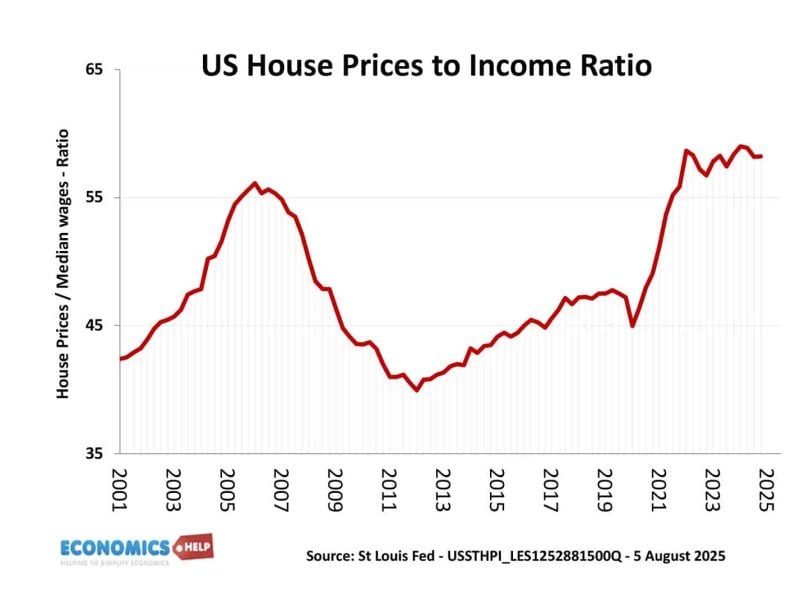
If you look at the early 2000s, the ratio of house prices to income reached record levels. Interestingly, US house prices have risen to a similar level of unaffordability. Now, some people do short stocks, and investors are attracted to gold. But, it is rare for people to want to short the whole market. Keynes and a famous saying that people prefer to be wrong with the majority than right in the minority. It is the wisdom of the crowd, safety in numbers. The herding effect – wanting it to be true.
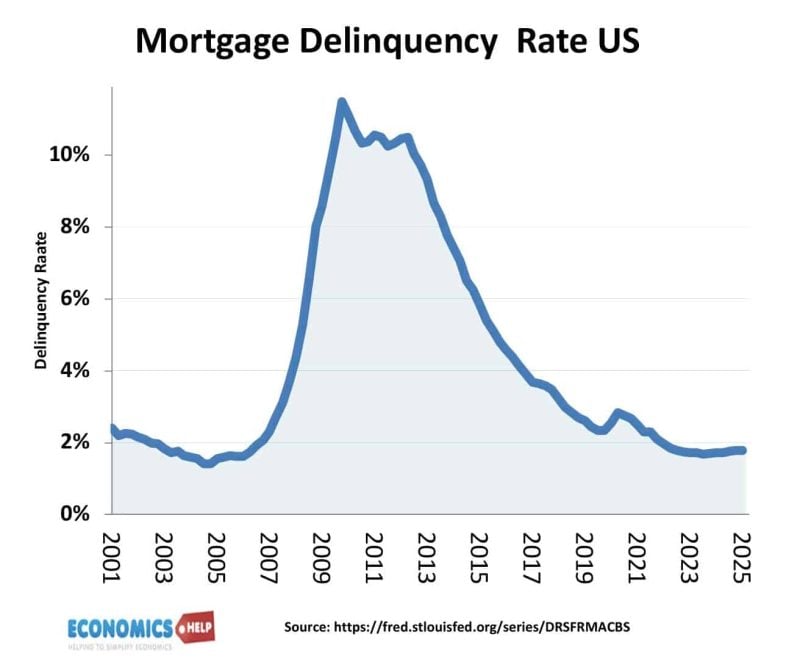
But, do we really face a crisis like 2007? True credit card debt levels are rising, but the level of mortgage default is nothing like 2007. For all the unorthodox economic policies, the US economy still retains many strengths, high corporate profitability, high levels of productivity and a large open economy. Given the economic slowdown, maybe a cut in interest rates is actually quite a good idea for stimulating investment and growth. Given that oil prices are quite low, it’s not all bad news on inflation, especially if rising unemployment curtails wage growth. True, there are inflationary pressures, but the actual inflation rate is 2.7% and it’s a long journey to inflation getting out of control, especially if growth remains low. Also, if you bought stock in Amazon just before the dot com bubble, you would be glad you did. True it fell in 2001 90% from $108 to $6, but it has more than recovered since and is now worth $22,000.
Also with regard to the stock market, company profitability is high, firms are using excess profit to buy back stock, pushing up prices. Also the rich have large sums of savings, which tend to end up in stocks. So there is some logic to amount of money going into stock market.
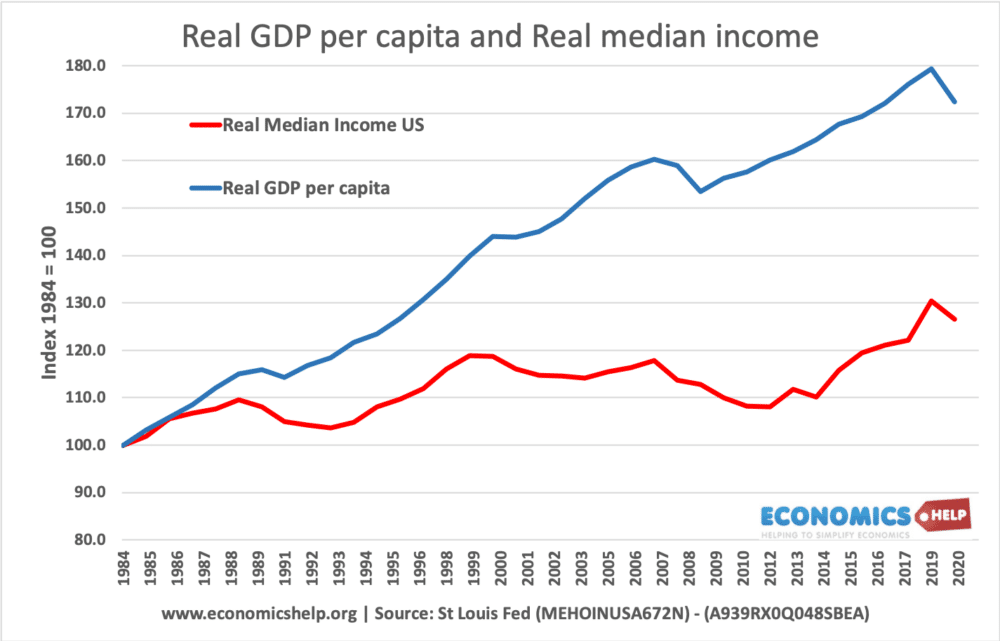
The US economy is increasingly two-speed. I’ve shown this graph before, but it does neatly explain the paradox of the US economy: GDP rising, but median wages stagnating. An economy that works for some but not others. Inequality is a real problem, but inequality does not cause a stock market crash on its own.
However, there is a realistic possibility the valuation of AI and tech shares may be inflated by irrational exuberance, and the rise in stagflation pressures are actually pretty bad news for the financial markets in both the short-term and long-term. If Fed independence is aggressively targeted, then we could start to see these small inflationary shocks push up inflation expectations and once inflation is more embedded, it could result in a 1970s decade of high inflation, with difficulty of reducing.
Links
- https://www.fabricatedknowledge.com/p/lessons-from-history-the-rise-and
- https://www.reuters.com/markets/us/trump-boxes-fed-with-extreme-rate-cut-calls-2025-07-16/
- https://www.ft.com/content/e9be3e3f-2efe-42f7-b2d2-8ab3efea27a8
About The Author
