
For decades, Germany was Europe’s economic miracle. Low inflation, high growth and a reputation for the best manufactured goods in the world. German engineering was part of the national identity. But, in recent years, it has really struggled, and the political fallout is becoming quite serious. Germany is at the heart of European economy and the EU, what happens in Germany is of real importance. Germany is by far the biggest European supporter of Ukraine. What happens if Germany continues to slide?
The Numbers Are Stagnant

But look at what has happened since 2019: real income per person is stagnant, compared to 23% growth in Poland and 11% growth in the US. It gets worse, because industrial production is down 20%, and the once-great car firms are shedding jobs and losing market share to the Chinese. It’s no longer BMW so much as BYD. Back in 2012, it was Germany waving the austerity stick at Greece, Italy and Spain, but now these “problem” economies are growing faster than Germany.

It’s Not Just Gas

This isn’t a blip, but a sustained decline. Germany is deindustrialising, and it’s causing shockwaves in the labour market. The German economy was built on cheap gas, and undoubtedly the rise in gas prices from 2022 hit industry hard. It’s hard to stay competitive when your electricity costs rise faster than your rivals’. Look at energy-intensive industries like chemicals and metals, and the decline is even stronger. But the decline didn’t start in 2022 — it only accelerated an existing decline, as Robin Brooks has argued. So if it’s more than gas, what’s going on?
The “Black Zero”

For most of the 2010s, German economic policy was built around the “black zero” — the idea that you must run a balanced budget, no exceptions. It might sound responsible, but with a sluggish economy and interest rates near zero, it led to chronic underinvestment in public infrastructure. A country where trains were once a byword for punctuality has become more of a national joke.
Overregulation
Another national trait has been regulation. In Germany, it’s illegal for most shops to open on Sundays, a hangover from a law whose legal justification is literally the Third Commandment — even though online shopping never closes. Break it, and you can be fined, but often businesses prefer to break the law and pay the fine, because it’s worth the extra sales. And it’s not just Sunday trading. Laws like GDPR are rigorously enforced, imposing significant compliance costs, especially on small and medium-sized firms that don’t have the legal departments to absorb them.
Losing to China

But while businesses may point to onerous regulations, they can’t put all the blame on the government. The truth is, top executives made some strategic mistakes of their own. Since the diesel emissions scandal, the appeal of German brands has steadily diminished. In 2019, German car firms took 26% of China’s market — that has fallen to 18.7%. Chinese brands have improved beyond all recognition and are winning the electric war. China’s dominance extends far beyond cars — cheaper labour and economies of scale mean the centre of gravity for innovation and battery technology has shifted east. Confident in their mechanical engineering, German manufacturers missed the electric revolution.
The Export Addiction

Germany’s growth increasingly came from exports. Since the mid-1990s, German exports as a share of GDP have roughly doubled to 43%. That’s four times the share of the US, and twice as high as China. It gave Germany a current account surplus of over 5% of GDP. Some might think this looks like Germany winning — but actually it masked an unbalanced economy and chronically weak consumer spending. It also left the German economy dangerously exposed to something like Trump’s tariffs, which arrived just as that export dependence was at its peak.
A Crisis of Confidence

Tariffs, war and industrial decline have all badly shaken confidence. Numbers only tell part of the story — Siemens’ own CEO put it bluntly this year: Germany is “losing competitiveness day by day.” Germany’s business confidence survey has spent years bouncing along levels that would have been unthinkable a decade ago. It’s similar with consumer confidence — very low, reflecting pessimism and a belief that real wages will struggle to grow.
Trapped in the Eurozone

Germany sits at the heart of the Eurozone, but doesn’t control its own interest rates. Monetary policy is set for the whole Eurozone, which may not suit Germany now other member states are growing faster. Germany’s low-inflation, high-savings instinct also clashes with the interests of the Eurozone’s higher-debt members, like Greece, Italy and France — a tension sharpened by Germany’s own stalling growth.
The Energy Bet That Failed
In 1990, nuclear power supplied a quarter of Germany’s energy. After Fukushima, Germany panicked and replaced that capacity by importing Russian gas, hoping this would draw Russia closer to the West. Now Germany depends heavily on importing LNG from Norway and the US instead — trading one dependency for another.
An Ageing Workforce
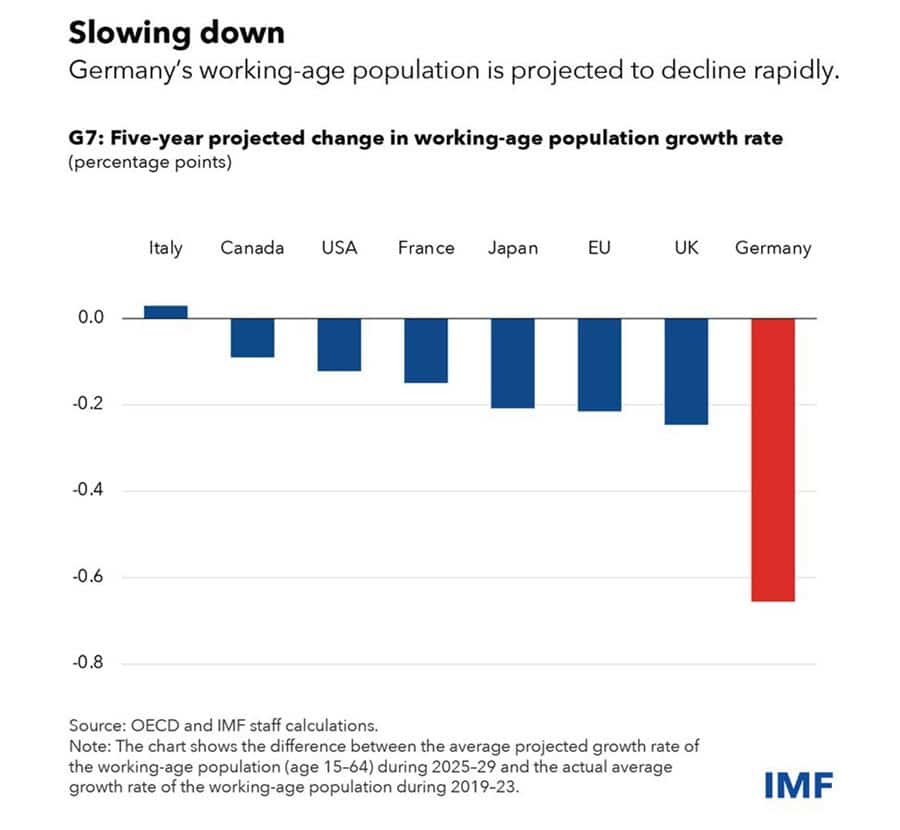
Like many Western economies, Germany’s working-age population is shrinking — but in Germany, the decline is happening faster than almost anywhere else. The old-age dependency ratio — the number of retirees for every 100 people of working age — has climbed from 24 in 2000 to nearly 38 today, and it is expected to rise to 48. (A former forecast was 60%, but that was reduced by high immigration.)

The one big boost was Angela Merkel’s decision to admit large numbers of migrants in 2015, but that’s politically radioactive now and won’t be repeated at that scale. An older, shrinking workforce structurally means lower growth and mounting pressure on local state finances.
A Borrowed Recovery

Now, despite all these long-term factors, the German economy isn’t collapsing. Since 2021, there’s been an unexpected boost from consumer spending, which has helped drive economic growth of 0.3% in the second quarter and 1% year on year. Foreign direct investment has also risen 50% in 2025, and startup formation is booming, with over 3,000 new startups in the first half of the year alone. That gives some hope that other parts of the economy can grow as heavy industry declines. But there’s a catch. Clemens Fuest, head of the Ifo Institute, warns this recovery is largely “borrowed.” It’s being driven by government spending — on energy, defence, infrastructure — and public spending is now around 50% of German GDP. Private investment has actually shrunk. And to deal with future pension costs, the government has announced reforms that will raise social security contributions by 2 percentage points, which will start to squeeze consumer spending just as it’s been doing the heavy lifting.
Eastern Germany Never Caught Up
Even as taxes rise, there are still growing demands placed on the state. The Eastern German economy never fully caught up. More than 35 years after reunification, the former East is still poorer, older, and losing people. Wages and productivity in the eastern states remain below the western average, and younger, skilled workers have been draining west for decades, leaving behind an older population and a shrinking tax base. It’s also the region where economic frustration runs deepest, which is part of why the political centre has struggled there more than anywhere else in the country.
Local Government Is Buckling

As big industry declines and workers leave, it leaves local government with a big fall in tax revenue. The Economist reported how German municipalities have gone from budget surplus to a deficit of €32 billion. It’s not just falling tax revenues — it’s mandatory spending on youth and disability benefits that keeps rising regardless. That’s forced big cuts to discretionary outlays: across Germany, schools and sports halls are falling into disrepair as local authorities make emergency cuts. The municipal investment backlog now stands at €231 billion. But while local government struggles, the federal government is in much better shape — German debt is lower than many advanced economies, giving it room for more expansionary fiscal policy than France or the UK.
Conclusion

And just when it looked like the energy crisis was behind them, gas prices surged again in early 2026, spiking close to €70 per megawatt hour — the highest level since January 2023 — as conflict in the Middle East disrupted supply. For an economy still finding its footing after the last energy shock, it’s a reminder of just how exposed Germany remains. The model isn’t just broken. It’s still being tested. German economic strength has long underpinned the European project — and as it struggles, that ideal of European unity may falter too.
Not all is lost. For all its problems, Germany has the structural capacity to reinvent itself. It’s been here before: in the early 2000s, tough labour-market reforms turned “the sick man of Europe” back into a competitive economy. The question now is whether Germany still has the political will for a repeat.
Sources
- Robin J Brooks, “What’s Wrong with Germany?”, Substack
- IMK, on German private consumption and the 2028 pension reform, Substack
- The Economist, “Can Germany’s economic recovery outrun the AfD?”, 10 September 2026
- BBC News, on German carmakers’ declining share of the Chinese market
- The Telegraph, “Germany mulls sacrificing Sunday sanctity to rescue economy”, 19 July 2026
- The Telegraph, “VW’s woes are the tip of the iceberg in a crisis-hit car industry”, 22 September 2026
- Trading Economics / Eurostat, Germany current account balance
- Destatis, production index and demographic data
- ifo Institute, Business Climate Index
- KfW Research, municipal investment backlog
- Hans Böckler Foundation, East-West wage data
- World Bank, World Development Indicators (GDP per capita growth, old-age dependency ratio)
About The Author
