
Readers Question: When would you want to own a business that sells price-elastic products? Why?
Price elastic products mean that if there is an increase in price, there will be a bigger % fall in demand. Therefore, with elastic goods, there is little incentive to increase the price because there will be a bigger % fall in demand. Elastic products suggest the good is in a competitive market and therefore it is more difficult to make profits. If demand was price inelastic a firm could put up prices and make profits, for example, a firm with monopoly power is likely to have inelastic demand.
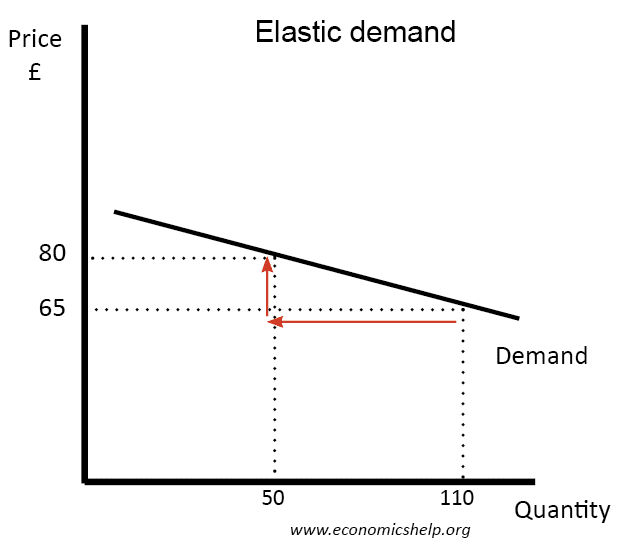
When Price Elastic products are Beneficial
1. For a Sales Maximising Firm.
If a firm wishes to increase market share and increase its sales then price elastic means that cuts in price will beneficial in increasing sales.
- However, it depends on how other firms react. If one firm cuts its price, demand may be elastic, but if all the other firms follow suit demand is likely to be inelastic and the price war only causes a small increase in sales (see Oligopoly Kinked demand curve)
2. Economies of Scale
If a firm is producing a good with economies of scale. Cutting prices will enable lower average costs because output can increase, this could even increase profitability.
3. Elasticity is not the Most Important Factor in Determining Profitability.
Having inelastic demand goods (e.g. trains) doesn’t make a firm profitable. Similarly having price elastic good doesn’t mean you are unprofitable. The key is whether Revenue is Greater than Costs. For example, confectionery is quite elastic, there are many different types to choose from, but the market is still quite profitable.
Note demand for chocolate is inelastic. but demand for individual bars is price elastic.
Cigarettes have very inelastic demand, but, individual brands are still elastic because there is choice for consumers.
Most goods have elastic demand unless there is a pure monopoly.
Related
About The Author

a business sells a product whose demand is relatively price inelastic. what is the effect on sales and revenue of a price increase?
affordable ( lower value) items are more price sensitive than the valuable items such as gold and jewellery. A wife spent more bargaining time at vegi shop than at the goldsmith ?
Thanks for writing on this topic. I am anew student in economics and I was gathering information about this topic. You really did a great job answering my question. What other people would do without your kind help? We need people like you in this world, not only for helping others to accomplish their needs, but with knowledge, to guide America where it needs to go.
Thanks so much, God bless you!
OK, I have a question for you. This was the example which popped to mind as I was reading your entry.
Here in my Middle Eastern country, sheep are sold for meat. Each year, prior to the Festival of the Sacrifice (Muslim holiday where every family buys a sheep to butcher at home in the house), families go shopping for their sheep. In the weeks prior to the Festival, the price of sheep goes UP, UP, UP. Sometimes the prices seem to reach scandalous levels. Of course, after the Festival, the price falls back to normal.
It appears that according to your explanation, this would be a PRICE INELASTIC good. However, this is NOT a monopoly, as there are MANY, MANY sellers of sheep in the market-place. It looks more like a collusion of price-fixing among the many sellers, to me.
What do you think about this?
Eileen
Dedicated Elementary Teacher Overseas (in the Middle East)
elementaryteacher.wordpress.com
Thanks, that helped quite a bit.