

The Nasdaq is close to record highs. US tech stocks are booming. And a wave of AI investment is holding together what’s otherwise a fragile and uneven American economy.
While ordinary households struggle with the cost of living and falling job opportunities, tech giants are spending at levels not seen since the dot-com bubble. The optimism is fuelled by the belief that artificial intelligence will unleash extraordinary gains in productivity, efficiency, and profits.
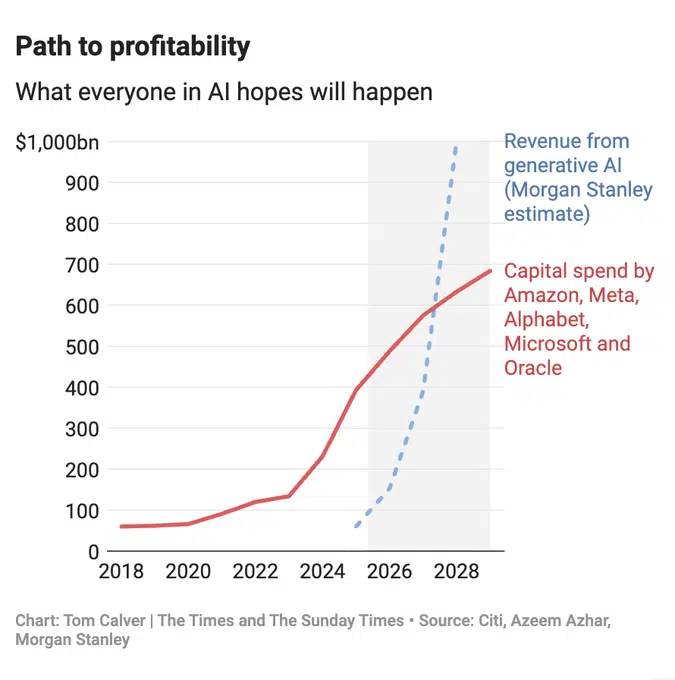
Spending on AI data centres alone is expected to reach three hundred and ninety billion dollars in 2025. Yet the total revenue from generative AI so far is only around sixty billion. Morgan Stanley predicts that figure could soar to one trillion within a few years. If that happens, it might justify today’s huge investment and record valuations. But what if those expectations are built on sand?
The Bank of England has already warned about the risk of a sharp market correction. Jamie Dimon at JP Morgan says many assets now look like they’re entering bubble territory. And there are already warning signs: large firms have seen a decline in AI adoption rates, and when OpenAI hinted that the government might need to support investment in AI infrastructure, investors were briefly spooked. It’s exactly the kind of small event that can puncture a bubble.
Costs of a Crash
If the bubble bursts, the consequences could be severe. A former IMF chief economist recently warned that a market correction on the scale of the early-2000s dot-com crash could wipe out twenty trillion dollars in wealth — roughly seventy percent of US GDP. And this time, the stakes are much higher. The stock market is now a far larger share of the economy. More Americans are exposed to equities through pensions, mutual funds and mobile trading apps. Consumer confidence is far more tied to market swings.
A crash of that size could cut consumption by more than three per cent, and shave roughly two percentage points off GDP — enough to push the US into a deep recession. And that’s before the secondary effects on investment, bank lending, and credit markets.
The US economy today has become two-speed: a booming tech sector on one side, and households under pressure on the other. Without tech investment, US growth this year would be closer to one percent. Analysts estimate that AI and technology may account for almost half of all American growth in 2025. It’s as if the entire economy is being balanced on one narrow, unstable plank.
The fallout from a crash wouldn’t stop at America’s borders. Foreign investors could face losses exceeding fifteen trillion dollars — around one fifth of the rest of the world’s GDP. The US stock market now makes up nearly sixty percent of global equity value, which shows just how dependent the world has become on US tech.
Slowing Global Growth
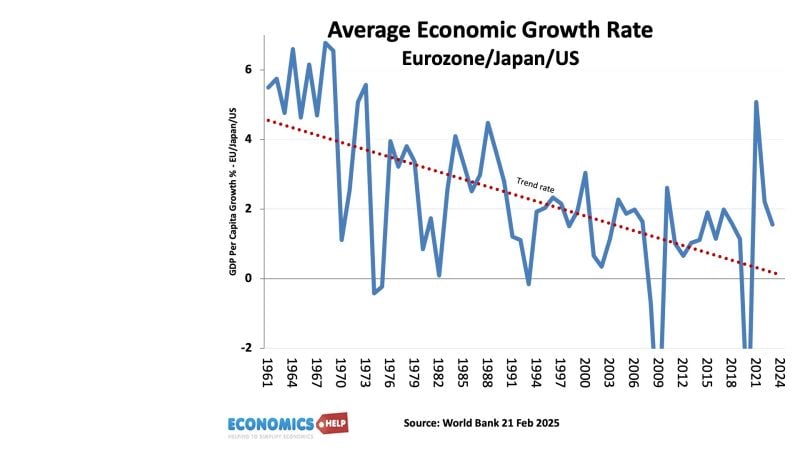
Also, global growth has been declining for decades, with average growth rates falling. One of the few successes is productivity growth in the US. It means global growth is unbalanced and ironically reliant on the US. But, with tariff wars and uncertainty rising, a crash would have a powerful ripple effect. A crash, which led to a slowdown in global credit, would also
Recent Falls
Last week, shares and tech stocks slumped to one of their worst weeks in months. The more speculative an asset was, the bigger the drop. Palantir, one of the most expensive stocks in the world, fell 8%. The big seven tech stocks fell 2.2%. Also, small penny stocks, beloved of small retail investors, fell heavily. One of the big changes in the stock market in recent years is the recent growth in small-scale young investors who have relatively low income. J.P.Morgan found that despite constantly low saving rates of 4-5%, retail investment in shares has increased 300% since 2015. Young, low-income people are attracted to buying shares for a few reasons. Firstly, with house prices out of reach, dabbling in stocks is seen as a way to try and increase wealth. Secondly, the growth of mobile apps has made it really easy, almost addictive to play the game. The concern is that these new traders have poor financial education and limited savings. It means that a stock market crash could really create a negative wealth effect and reduce spending in the economy.
Margin Debt
An additional problem is that margin debt is at a record high. This means the amount investors borrowed from their brokers to purchase more stock. Finra report in September 2025 this reached a record $1.13 trillion. It means that a fall in shares would lead to big losses, with knock-on effects to the banking system. It could lead to lower lending, fall in money supply and a decline in capital investment. Also, it is important to stress the importance of confidence. As shares fell last week, it had a knock on effect for crypto values with any concerns about state of stock market adversely affecting crypto. Far from being a secure investment, crypto has a strong correlation to stock values, so we could end up with a double crash – fall in shares, causing fall in speculative crypto, which many see as a one-way bet. The problem is that the US economy is much more dependent on speculative investments than say the late 1980s or even dot com. There is a new generation of speculation, almost gambling. Professional short-sellers have often been burnt by this new breed of internet savy investors. Like the famous example of GameStop where small-scale red burnt short-sellers. But, it might not just be professional investors getting burnt by stock market crash.
US Weakness

In past crisis, the US dollar and institutions were like a rock of stability. But, since the unorthodox tariff policies and loosening of Fed independence, the dollar has been in an unexpected decline, indicating a weakening of confidence in the dollar as a source of stability. It’s not just a bubble in tech stocks, there is a side event of rising US government debt, forecast to reach record levels, at a time, when political paralysis prevents adequate control.
Other Effects
What other effects would happen if there were a stock market crash? A fall in pension values would lead to lower payouts by pension funds, causing a decline in spending by pensioners. Secondly, with so much exposure to the stock market, a carsh would cause a big drop in consumer confidence. US savings rates are actually quite low, around 5%, a crash would make people risk-averse, increase savings and reduce spending. It would be likely to increase unemployment significantly, and could have knock on effects to business lending, credit and a full blow recession.
But, Not Everyone Agrees – Bull Case
Now, not everyone is convinced there will be either a crash. Firstly, the big tech firms are incredibly profitable, with big profit margins, and they fund a lot of the capital investment. Secondly, AI adoption is still in its early stages and can continue to increase. It has potential to significantly reduce costs and increase revenue for firms, which would mean the investment is justified.

Although people point to high valuations of stock markets today, for example case Shiller index is near a record, it is worth bearing in mind that tech stocks do not have the same overvaluation as in the 90s.
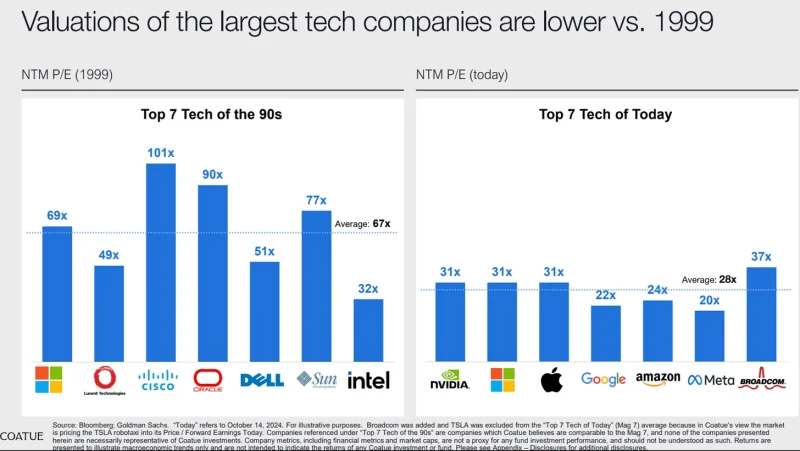
Back then, Cisco was 101 times earnings. Microsoft 69 times. Today Nvidia, Microsoft and Apple are 31 times earnings. High but given potential growth not ridiculous bubble territory.
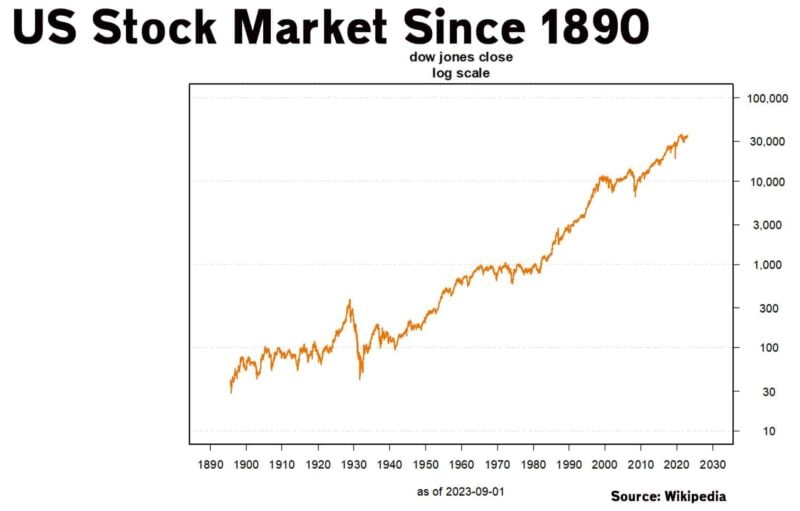
Also, even if there is a stock market crash, it doesn’t necessarily crash the economy. The 1987 crash barely registered in terms of economic impact. The dot-com crash caused a blip in GDP, but nothing major. The real crash, which devastated the economy, was the credit crunch of 2008. Here it was much more than share prices falling, but banks losing bad money from mortgage defaults.
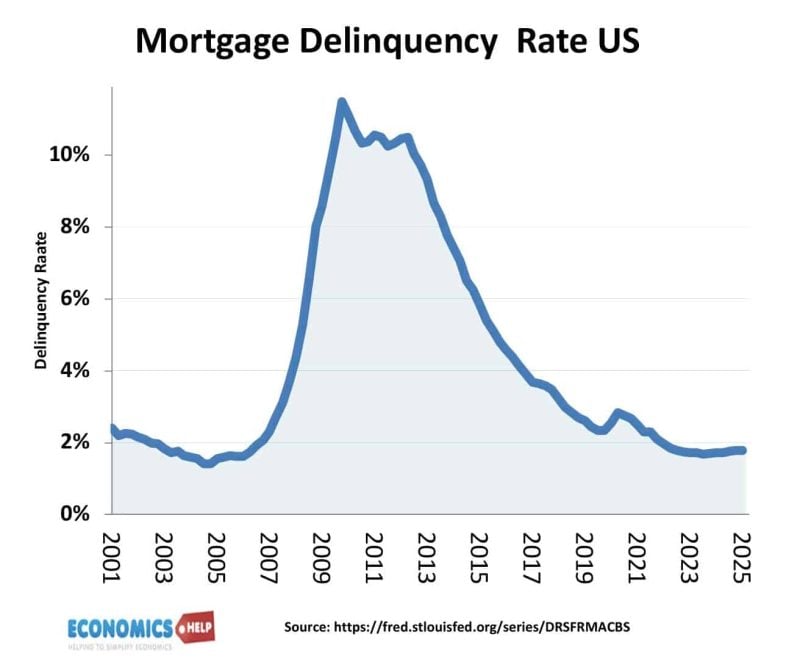
Although the US housing market is broken, mortgage defaults are nothing like 2008, because the 30 year fixed mortgages have effectively avoided the interest rate crisis of 2008. Also, if there was a stock market crash, and a negative wealth effect, you could expect the Federal Reserve to significantly cut interest rates, which would help to promote economic growth and make shares relatively more attractive compared to bonds and gilts.
So there are reasons to be concerned about the state of the US economy; it has become heavily tilted towards big tech. Also, the economy is much more exposed to the stock market than in the past because of the growth in small scale investment by relatively low-income groups. However, although AI and crypto and entering bubble territory, at least with AI there is some real world application, whether they can get business to pay what they hope is another matter. This is ore on whether Ai is a bubble.
Sources
https://www.currentmarketvaluation.com/models/margin-debt.php
https://www.apolloacademy.com/ai-adoption-rate-trending-down-for-large-companies/
https://drive.google.com/file/d/1Y2CLckBIjfjGClkNikvfOnZ0WyLZhkrT/view
About The Author
