
The time value of money (TVM) is the principle that £1 today is worth more than £1 in the future.
Money today can earn interest, be invested, or used to generate returns — so delaying receiving money has a cost.
Why money today is worth more than future money
Opportunity cost — you could invest it and earn a return.
Inflation — prices typically rise, reducing purchasing power.
Risk/uncertainty — future payments may not be certain.
Preference for liquidity — people value having cash available now.
- Behavioural theories – the we discount future utility and place greater value on present utility. If you offered someone £10,000 now or £1 million in 10 years time. Even if interest rates were 5%, many would chose £10,000 now. Why is this?
- People may not trust you will get.
- They may be short of cash now.
- They may not work out present value.
- They may fear they could die in next 10 years.
- They give very little importance to future.
1. Future Value (FV)
“How much will money be worth in the future?
- PV = present value
- r = interest rate (decimal)
- n = number of periods
Example
You invest £1,000 in a savings account that pays 5% interest per year, and you leave it untouched for 3 years.
- PV = £1,000
- r = 0.05 (5%)
- n = 3 years
FV=1000×(1.05)3³ = £1,157.63
Present Value
“What is a future payment worth today?”
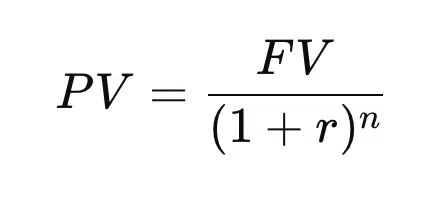
Discount Rate
A discount factor tells you how much a future amount of money is worth today. It converts future value to present value using the time value of money.

Examples
If the discount factor for 5 years at 4% is 0.8219, then:
- £1 in 5 years = £0.8219 today
- £1,000 in 5 years = £821.90 today
What Factors Change Time value of money?

1. Interest Rate (Discount Rate)
The most important factor. A higher interest rate increases the future value and decreases the present value.
- Higher rate → money grows faster → future money is worth less today.
- Lower rate → money grows slower → future money is worth more today.
2. Time Period (n)
The longer you wait, the greater the TVM effect.
- More time → greater compounding → bigger future value
- More time → lower present value of future money
3. Inflation
Inflation reduces purchasing power over time.
- Higher inflation → future money buys less → greater discounting
- Low inflation → money retains value → smaller TVM effect
Inflation is often built into the discount rate.
4. Risk and Uncertainty
Future payments may be uncertain. More risk → higher required return → higher discount rate.
- Risky payments are worth less today
- Safe payments are worth more today
Example: government bonds vs risky business loans.
5. Liquidity Preference
People value having cash available now. If cash is needed quickly (illiquid situations), the discount rate rises.
Higher liquidity preference → lower PV of future money
6. Compounding Frequency
How often interest is added: yearly, monthly, daily, continuously. More frequent compounding increases future value. Example:
- 5% annually
- 5% compounded monthly
- 5% compounded daily → daily gives the highest FV.
7. Size and Timing of Cash Flows
Bigger or earlier cash flows increase present value. Delayed or smaller cash flows decrease it. Example:
£1,000 today ≠ £1,000 in 5 years.
Investment Project Example (CBA)
A local council is deciding whether to build a new cycle lane.
Costs:
- Construction cost today: £5 million
- Annual maintenance from year 1–10: £200,000 per year
Benefits:
- Reduced congestion, fewer accidents, health benefits
- Estimated social benefit: £900,000 per year over 10 years
Using TVM in CBA
You cannot just add up costs and benefits across years — future values must be discounted to present value. Example with a 3.5% discount rate:
PV(benefits) = £7.0m
PV(costs) = £6.2m
Conclusion: The project passes the CBA because discounted benefits > discounted costs.
TVM matters because a £900k benefit in year 10 is worth much less than £900k today.
Flood defence
Government considers a scheme to reduce flooding risks.
- Cost today: £20 million
- Reduced flood damage worth £3 million per year for 15 years
Benefits must be discounted. Even if the raw benefits are 3 × 15 = £45m, the discounted benefits might be closer to £32–35m depending on the rate.
TVM converts future environmental benefits into today’s values so policymakers can compare them fairly.
Worth going to University?
A degree increases salary by £3,00 a year But the cost of university is £45,000. Discount rate of 5%
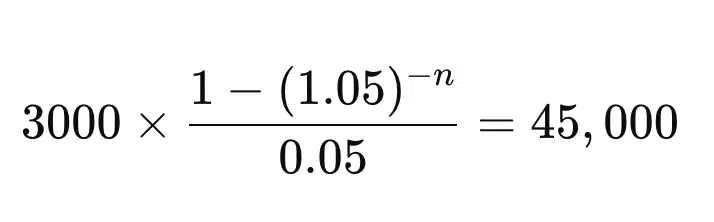
With a £3,000 annual salary increase, the degree pays off after about
⚡ 28–29 years (discounted at 5%).
Note, if the increase in salary was £2,000 – going to university would never pay off.
About The Author
