
I have been using Chat GPT for a while and was initially shocked at what it produces. For years I have been teaching the Luddite Fallacy to students, but now for the first time in my life understand what it means to fear how technology is coming for your job.
The Luddite fallacy is the mistaken belief that new technology leads to higher overall unemployment in the economy. New technology like Chat GPT may cause disruption and some workers to lose their job, but the improved technology will also create jobs in other sectors of the economy – balancing out any jobs lost.
When I ask ChatGPT an economics question, I get the unmistakable feeling it is giving me what I have already written on my website, but without any credit. It is not perfect, but many of answers are genuinely good. Its displays are easy to read and scan, similar to my website.
And this is one thing I don’t like about Artificial intelligence, it is benefiting from the sum of human knowledge contributed to the internet, but those who contributed get no recognition. It is, in essence,e taking our content, repackaging and in the future selling it back to us. The internet was fairly democratic; anybody could set up a website and earn a little revenue. But, the nature of AI technology is that it will be owned by very large multinational companies. The risk is increased monopoly control over knowledge and search.
This is why I’m worried. My main income comes from my website economicshelp.org. People search economic questions, such as “What is the Luddite Fallacy” and google link to the website. From millions of visits, I get a little advertising revenue and also sell some books.
But, will people keep using google search and websites when you can get the answers direct from an AI app? On Chat GPT, there’s no links to click no cookie notices to discard. It’s quick and direct.
Now my page is still better, and I’m not just saying that, it has visual diagrams, and ideas AI doesn’t automatically give you. You still have to know the right follow-up questions to answer. But, AI is just starting, in the last five years it has improved beyond many expectations. In the next five years, it will only get better and better to the point, where it could be a one stop shop for answering all questions. Already, local newspapers are starting to use AI to write articles. Waterstones have said that they will sell books, written by AI.
Suppose a student has a homework question. “What is the effect of an increase in interest rates? AI immediately gives a pretty good basic answer. No diagram, but the points are valid and easy to understand. I would give it at least a B+. It is similar to what I have on my website. And in recent months, it has become even better.
If I ask it harder question, Evaluate the effect of higher interest rates, it doesn’t do so well. Evaluation means it depends on the state of economy, consumer confidence, maybe a time lag, e.t.c. So for the time being, you are definitely much better off going to economichelp rather chat GPT. But, it is only a matter of time, before AI learns more complex answers and improves. There is huge potential for AI to get better.
In my graph for web traffic at economic help. There was strong growth from 2006 to 2020. But, has tailed off in the past two years. This partly reflects ever increasing competition, but also a sign that web traffic may have reached the end of its massive growth phase, and in future we will move to AI chat boards
Chat GPT increasing productivity
But what about some good news. What about increased productivity? Chat GPT will definitely increase productivity in some areas. For example, I make a lot of excel graphs. Searching on google for answers on how to do things, is surprisingly slow, difficult and often I fail to get what I want. In this regard, Chat GPT is a revelation. It solves problems quicker than anywhere else. It is now my default place to go for answers to excel questions. This will save me time, increase productivity and help produce better content. But if you have a website or youtube channel explaining how to use excel, prepare for falling demand.
A new skill will be making Chat GPT and AI work for you. For example, coding, creating visual elements and interactive elements. Something that would take a long time manually, but with AI, you can write code much quicker.
Will Chat GPT and AI take your job?
So will Chat GPT take my job? Let us revisit the Luddite fallacy. In the eighteenth century. Skilled craft workers smashed up machines that were taken their jobs. We can understand their frustration, but as economists are fond of pointing out, it is a fallacy to think that new technology destroys jobs. The new machines increased productivity, reduced the price of clothes, increased living standards, and enable people to buy more goods. Therefore, for every job lost in hand made clothes industry, new jobs were created in others. Nobody wants to go back to eighteenth century living standards just to save jobs in hand making clothes. Any technological revolution, invariable causes fear of job losses, but the economy is adept at shifting employment patterns. In the 1920s, the UK had one million working in the coal industry, today there are less than 1,000. But is that a bad thing? No.
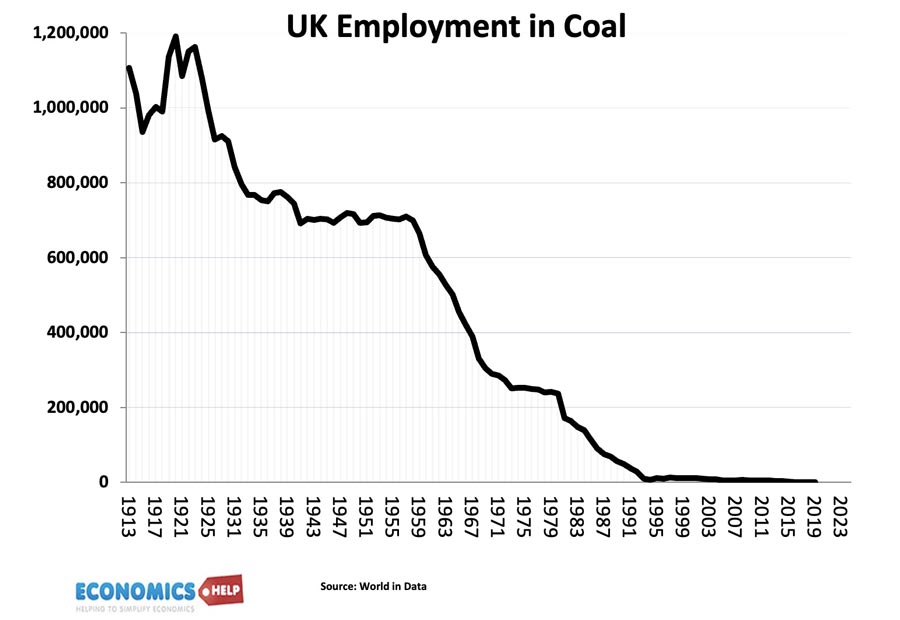
By the way it is similar with typists. In 1980, the US had one million people employed as typists, but today it is very small – replaced by technology.
Temporary unemployment
However, it is not quite as clear cut as economic textbooks may always make out. Technology can cause temporary unemployment and is very disruptive for those affected. New technology led to job losses in manufacturing, and those unskilled workers often found it difficult to get new employment elsewhere, leading to areas of depression, like America’s rust belt..
The interesting thing about Chat GPT is that for the first time, those in the firing line are white collar, educated, creative workers. Economists have been teaching about the Luddite fallacy applying to manual workers, we never thought we would be applying it to ourselves!
Now, if you want to submit an article to the Economist, you can’t knock something up on AI, but it won’t be too long before, you can write a basic explanation book on economics using AI which is a similar standard to paying a human author. There will be a job in curating AI, but less opportunities for writers.
Recently I made a video about what I earn (or more accurately don’t earn) on youtube. I made the observation, I have to pay £95 an hour to my local plumber, but on youtube was earning around $20 an hour. From a financial point of view, you could say I made the wrong career choice. Young people should seriously consider being a plumber or electrician rather than going to university, being lumbered with debt and maybe less value in the labour force than they would like. I can’t see how a plumber will be replaced by AI in the foreseeable future. And by the way, AI has a terrible sense of humour. I asked it for jokes on economics and as number 1 gave Why did the economist refuse to go on a roller coaster? Because he was afraid of the ups and downs.
If you don’t’ get it, neither did I. The next six jokes were equally lame and I will spare you from hearing them. If you’re a comedian or plumber you can sleep tonight, but if you’re a writer and content producer by ready for big changes.
Is the Luddite Fallacy really a Fallacy?
On my own page, I have a section asking whether the Luddite Fallacy is really a Fallacy. It’s a complex point, AI didn’t consider. The point is this. Suppose new technology improves productivity and increases overall income in society. In theory, everyone should benefit from this, we should be able to increase wages and reduced hours for workers. However, suppose this new technology is owned by a few very powerful and profitable monopolies. In theory, they could capture all the gains, and many would be left worse off. This is the fear of AI, it will increase overall economic welfare, but will the benefits be equally distributed or will they be a divide between the owners and gatekeepers of AI and the rest of us.
What about Youtube videos? I have to be honest. I didn’t find Chat GPT particularly useful in making youtube videos. I ask it to suggest titles, but rarely use them. It can write scripts, but it doesn’t really help. I can still write better. I’m sure there will come a time, if it’s not already here, when it can perfect the art of knowing the perfect title and click bait thumbnail. But, at least with video, there will always be a human element that can’t entirely be replaced.
Should we be worried? The history of new technology suggests that usually we worry too much, and the outcome is better than we fear. When a disruptive new technology comes onto the market, it is easier to see the negative effects, the positive effects are less visible, but come over time. Personally, I am not worried about AI, even though I was quite shocked at the quantum leap in ability. However, with technology progressing very quickly, there is a need to be very adaptable. What worked in the past may not work in the future. This is part of the reason why I diversified away from relying solely on a website to youtube too. Also, the fear that AI will be dominated by a few monopolies may also be misplaced.
Also, to take a quick detour from economics, in my spare time, I give free meditation classes – no charge. But, in meditation, you go to a place beyond the reach of the mind and AI, AI will never have soul or spirit. Even in economics, we need a human touch, and not just a mental explanation.
Related
About The Author

Wow, this article is good, my younger sister is analyzing these things, therefore I am going to tell her.