
Recently a viewer asked why are so many of your videos about negative stories? Can’t you do more positive stories? It is an interesting question. Firstly, I do make more optimistic economic videos, but youtube is much less likely to show them. I’ll explain why later.
But, at the moment, the economic outlook is genuinely pessimistic. There are real economic problems and crisis. It’s hard to put a positive spin on falling real wages, recession, inflation and a cost of living crisis. One fair comment is the UK situation is relatively worse than many other economies, so this perhaps colours my perspective a little.
The big question is why do Youtube videos have a tendency towards ‘crisis/collapse e.t.c.
Last summer I made a good video “Problems of the Chinese economy”. It got a 1,000 views, which I thought was OK. But, at the same time I saw other videos on Youtube “Chinese economic collapse” which had over 1 million views. When I watched those videos, I started to realise Youtube were rewarding click bait type headlines.
BTW: Just a little detour, the idea the Chinese economy is going to collapse is absurd. True there are real problems, and it is a real crisis in property market, but the real Chinese crisis is that economic growth is less than in the past. There’s not going to be a collapse
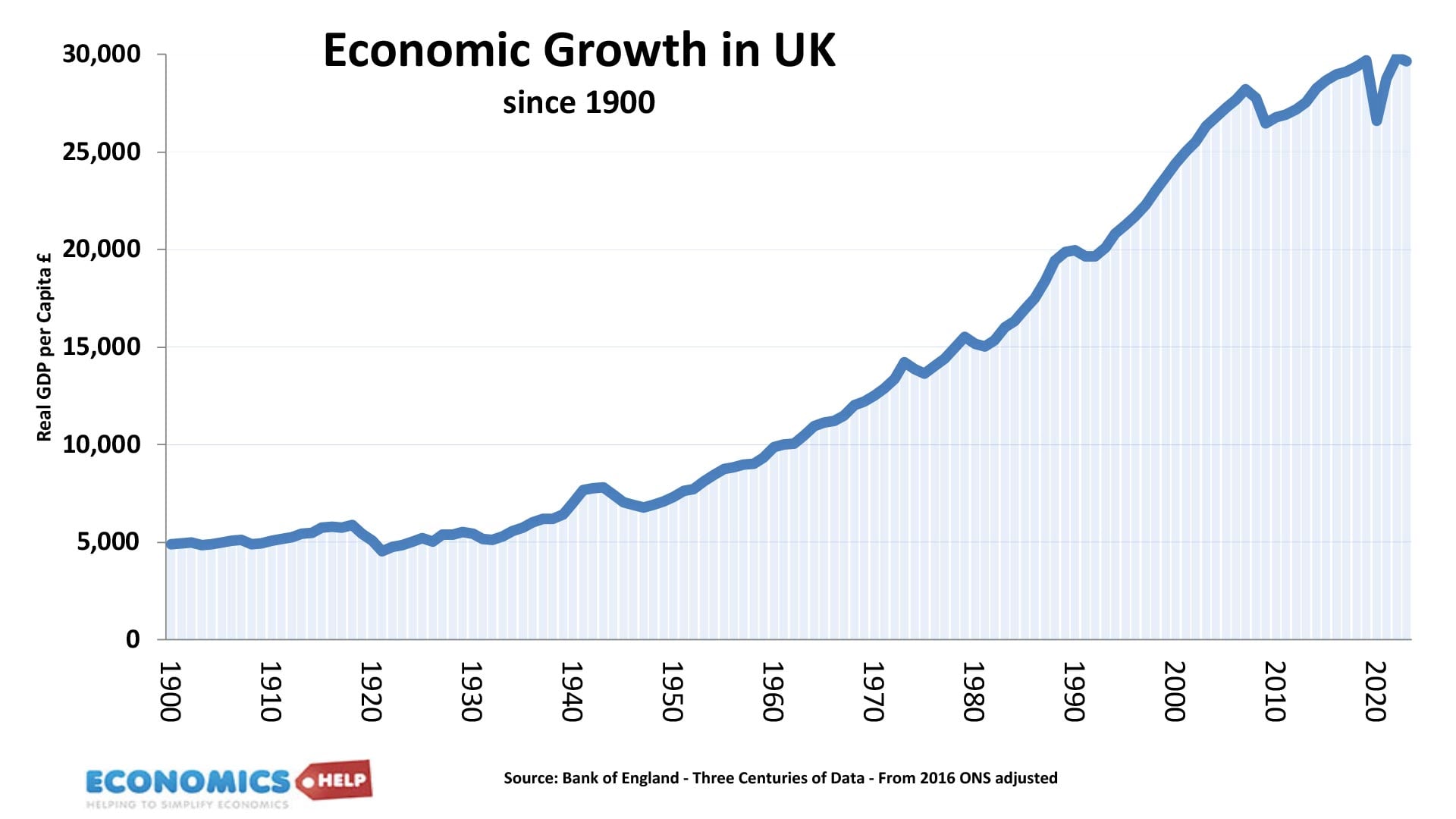
Let me show you a graph to highlight past UK economic crisis. This is UK real GDP since 1800. We can see the slump after the first world war, the Great Depression, the 1970s oil crisis e.t.c. But, the point is despite these crisis, living standards continued to improve significantly. China will go through something similar, – set backs, but no collapse.
As a youtube creator, you soon learn that the click through rate is incredibly important. This is the percentage of people who click on a thumbnail shown on the home page. Last November I made a video “Good economic news you’ve probably not heard about – 5 Reasons to be hopeful” This video had a click through rate of 4%, which in Youtube terms is quite poor. Therefore, youtube do not want to show this video to many users. After 6 months, the video got 1,600 views.
Now compare this to a more successful video. UK Housing Crash? Are Prices set to Fall? This was getting a click-through rate of over 10%, so youtube started sharing the video to a much wider audience. After a similar time period, it notched up 400,000 views.
This is a huge variation – and it perhaps shows we are more drawn to the prospect of falling house prices than reasons to be hopeful.
Economics of Youtube
Now what about the economics of making a YouTube video? I love economics and I like making videos, but the truth is they are very time-consuming, maybe 12 hours per video. As a very rough rule of thumb 1,000 views will make you £3. The first video on reasons to be hopeful made £5. Which is an hourly rate of around £0.40. By contrast, If you get 100,000 views you can make over a £300, a good hourly rate. Now I should add click through rate is not everything. The video also has to be good, and keep viewers engaged. But, if you have a low click-through rate, the video will soon become hidden by youtube, and so there’s less incentive to make them.
Generally videos on economic crisis and potential collapse, all trigger our brain to be curious or fearful. Therefore we are more likely to click on them and so youtube are more likely to recommend them and so content creators are more likely to make them. It’s a self-reinforcing loop.
Now there is a danger that if there is a financial motivation to make videos about crisis, you can start to cherry-pick data to fit a certain narrative. I could, if I forced myself, make a video about a Chinese economic collapse but it would be very unbalanced. In the last video about UK housing market, I looked at reasons prices are likely to fall, but also the factors supporting prices, preventing a bigger collapse. Clickbait is good, but in long-term, most people want a fair summary without bias.
However, I will make one confession. I made a video about the costs of Brexit. I quoted a statistic from Mark Carney former governor of the Bank of England. In FT, he claimed in 2016, UK GDP was 97% of Germany GDP. But in 2022, had fallen to 70%. This makes it look a spectacular decline in GDP. But, I agree the statistic is misleading. It stems from a relative decline in Pound, rather than different growth rates measured in PPP. I should have been more wary about this statistic. There are many good examples of the costs of Brexit –but this Mark Carney statistic is not a good one.
I actually started this YouTube channel back in 2009, with embarrassingly low-quality videos. They actually got a few views, but I then did nothing for 13 years. But, in the past 2 years, I’ve enjoyed the process of making videos and working out what works on this platform. I planned to make videos explaining economic concepts, but youtube algorithm has imperceptibly moved me onto making more topical videos, especially about the big challenges facing the world economy. The good news is that I find this very interesting and enjoyable and I hope this enthusiasm comes across. Ultimately, that is important.
In the future, I will definitely be choosing good youtube titles which attract clicks, but I will try keep the content unbiased and fact based.
About The Author

HULLO SIR,
very good indeed, esp point abt immigration adding to gdp
i started with the suggestion to cabinet office about taking a modest slice such a 12% off imports and splitting it both ways to eco-needs such as barrages protecting land (eg Swansea+ with tidal lagoon other side too and linking them to protect both Gloucestershire and Somerset forever into the future also a road-rail link wales to the southeast.
“loss and damage return” and other STEER innovations could boost UK’s productivity by lowering costs and creating real-value intermediate-tech jobs, less immigration pressure too due to the overseas buying power.. i feel sure this would add value at your economics help site. Thanks (and the one below, maybe a greater boost..)
The next one also found some favour at Treasury – slice off some part of commercial-bank-created money (so no increase in deficit, green and public good principle) now suggested more easily as 20-year money. For GreenER deal – enveloping properties and Modified (internal to buildings) Ground-Source boosted with solar roof-heat. A great boost – up to £20m p.a 250,000 jobs and more, both for 30 years – at least for 30 years.. Can we please discuss on 07702 569 077?