
Financial dysmorphia is a psychological phenomenon where individuals have a distorted perception of their financial situation. People may feel financially inadequate or insecure even when their objective income, savings, or assets are stable or above average.
Key characteristics
- Persistent feeling of being “behind” financially
- Underestimating one’s own income, savings, or net worth
- Overestimating how well others are doing
- Anxiety or guilt around spending, even on necessities
- Avoidance of checking bank balances or, conversely, obsessive monitoring
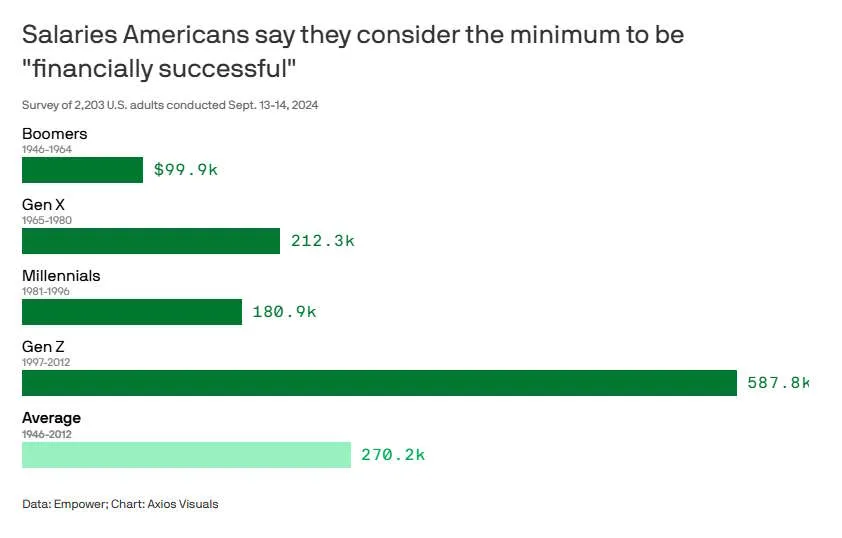
This shows the min salary Americans consider to be successful. The striking thing is how Gen Z believe it is $587,000 a year – a very unrealistic salary – clearly in the top 1% and thirteen times higher than the median salary.
Causes
Social comparison: Exposure to curated lifestyles on social media exaggerates perceptions of wealth.
- Negative bias of media/ youtube overstates how bad the economy is doing. Negative sells and so influencers have an incentive to say how bad the economy is doing.
Rising living costs: Inflation, housing costs, and energy prices increase insecurity even if real income is stable

There really has been an increase in inequality, with median wages failing to keep up with the rise in GDP.
Economic uncertainty: Recessions, job insecurity, and volatile asset prices heighten fear. In particular cost of housing is damaging for young people, who have little hope of buying at the high income multiplers.

Record unaffordability of housing. But housing is a key element of the social contract. If you can’t afford to live, you feel left behind.
Cultural pressure: Norms equating success with visible consumption (houses, cars, holidays) This has always been there. See Conspicious consumption, but social media has heightened it.
Economic interpretation
- Relative income hypothesis: Well-being depends on income relative to others, not absolute income. Keeping up with the Jones’s has always been important, but social media makes it easier to see ‘successful lives’ on Tiktok.
- Behavioural economics: Cognitive biases such as loss aversion and availability bias distort financial judgement
- Utility vs perception gap: Actual consumption possibilities exceed perceived ones
Effects on behaviour
- Excessive saving and under-consumption. Saving levels have risen since Covid.
- More likely to give up on labour market, or if in labour market more willingness to phone in sick or not seek promotion. The UK has seen rise in sickness levels and growth of mental health conditions.
- Reluctance to invest due to fear of losses. Firms are holding back from investment because of lower consumer confidence. This is exacerbated by the ageing population
- Stress-related reductions in productivity and well-being
- Poor long-term decision-making (e.g. staying in cash despite inflation)
- Evaluation
- Financial dysmorphia may be rational in periods of genuine macroeconomic instability and rising inequality
- However, distorted perceptions can worsen welfare by reducing consumption and increasing anxiety
- Highlights limits of assuming rational agents in traditional economic models
- Policies and personal responses
- Financial education: Emphasise real vs nominal values and long-term trends
- Transparent benchmarks: Median income and wealth statistics to reduce misleading comparisons
- Behavioural nudges: Default pension enrolment and investment plans
- Personal strategies: Track net worth over time, limit social media comparisons, set objective financial goals
About The Author
