
We have never had so much information at our fingertips. But is it making us smarter — or just distracted and confused?
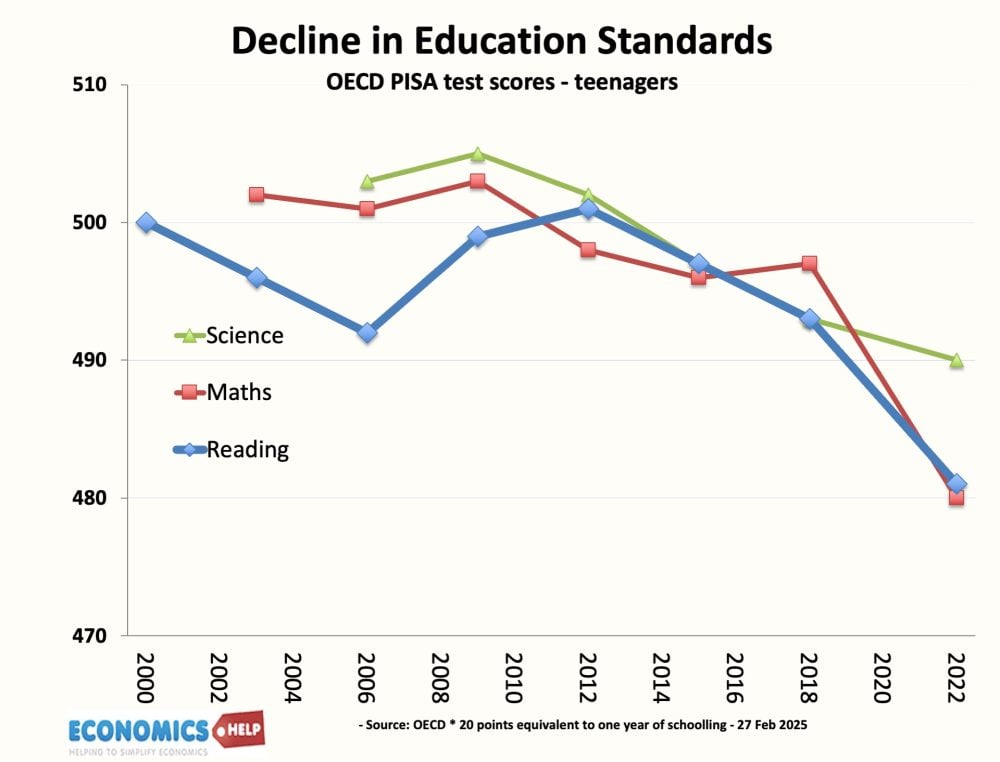
Across the world, educational attainment is falling. The OECD reports declines in reading skills, science and maths.
The past two decades have seen an unprecedented experiment. We now spend nearly seven hours a day looking at screens, and scientists say this is rewiring our brains in negative ways. At the same time, anxiety and depression are rising, especially among the young.
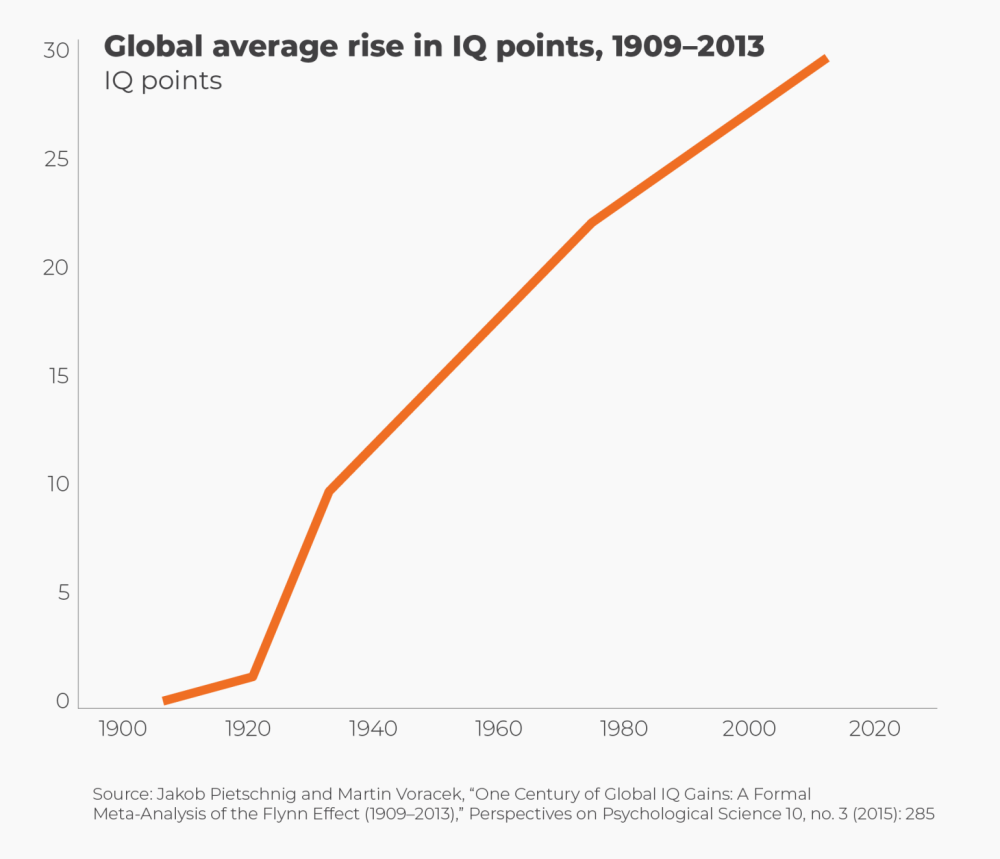
But it wasn’t always like this. During the twentieth century, average IQ scores significantly increased. Better education, improved nutrition, smaller family sizes, and advances in healthcare all played a role. Whatever the reasons, educational attainment soared on several metrics. This phenomenon became known as the Flynn Effect.
However, in recent years, research suggests this trend is going into reverse. Studies in Norway and the US show something unexpected: IQ levels are falling — particularly logical reasoning and spatial skills.
And these studies don’t even begin to capture the impact of the exponential rise of AI, which means things could be about to get much worse.
Use it or lose it
If you don’t exercise, your muscles become weaker. If you don’t exercise your brain, the same thing happens — cognitive ability declines. The problem is we are reaching a stage where AI can think, research, and decide for you. As we outsource decision-making and thinking, we lose the capacity to do it ourselves. AI can save time, but the more we rely on it as a crutch, the more we risk losing our intuition and cognitive capacity.
One of the great benefits of technology is GPS navigation. Gen Z will never know the stress of driving around London with nothing but a London A–Z atlas on your knee. But while GPS is convenient, my own ability to remember where I’m going has definitely declined. You might say that’s not a big deal — but what happens as AI increasingly enters writing, music composition, and innovation? Apparently, AI even has a sense of humour now.
The problem with humans is that we tend to prefer the easy option. Why work hard to produce thoughtful writing or a well-crafted video when a computer can generate something that is “good enough”? The result is more AI-generated content and a rise in mediocrity.
The digital world is reducing the need to practise memory. As a child, I memorised many landline telephone numbers. Today we don’t need memory — we only need to know where our phone is. As we remember less and less, is it a coincidence that dementia cases are rising? Perhaps. But if you want to reduce your risk of dementia, keeping both brain and body active is one of the best things you can do.
Even before the arrival of AI, mobile phones and social media were already damaging our attention spans. One study found that the mere presence of a smartphone in the same room reduces cognitive capacity by 9%. The more visible the phone, the greater the reduction. Even when switched off, the brain expends energy resisting the temptation to check it.
I notice this myself when researching videos online. It’s hard to resist taking a quick break to scroll. Before you know it, a five-minute break becomes twenty minutes, and your concentration is gone. Even while working, you have to resist switching to something easier. The internet has enormous potential to save time — but it also makes it easier than ever to waste it. If you never waste time online, I admire your discipline. But are you reading this as a distraction from work?
Tech companies are becoming increasingly sophisticated at creating addictive content. The entire business model of TikTok and other social media platforms is to keep you scrolling and prevent you from doing something productive. The observed fall in educational attainment closely correlates with rising screen time and social media use.
AI chatbots threaten to take this even further. Last year, 88% of students reported using chatbots to help with academic assessments. University lecturers speak openly about the rapid deterioration in essay quality over the past two years. They bemoan the loss of originality — fewer personal insights, fewer unique perspectives. Instead, there is a flood of mediocre AI-generated work. If anything, students likely under-report their AI usage.
Reading is in decline
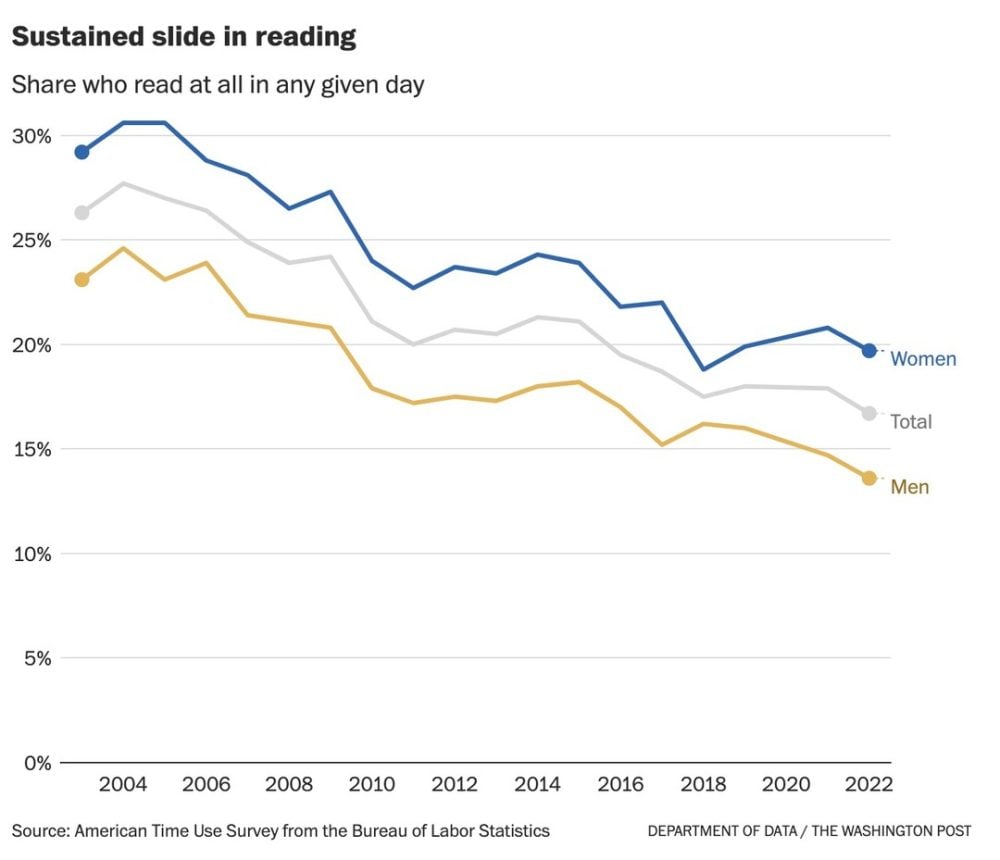
I remember when I was sixteen and began reading books by George Orwell, Tolkien and Shakespeare. It was a revelation — a new world of ideas that challenged my assumptions and broadened my horizons. But what is happening now? Reading time is collapsing. In 1985, 13% of people hardly ever read. Today that figure is approaching 50%. Even as sentences grow shorter, we are losing the patience or ability to sit with a book.
What is replacing it? Many young men spend hours gaming; many young women are immersed in TikTok and Instagram. Short-form video, in particular, damages attention spans. Fast, endlessly scrolling content disrupts attentional stability and forces constant cognitive reorientation. Longer tasks begin to feel unusually difficult.
This attention deficit is now affecting television. Executives are aware of multi-screening habits. Scripts are simplified and “dumbed down” for audiences only giving partial attention.
But the issue goes beyond concentration and memory. As we retreat into social media bubbles, people socialise less in person. Evidence suggests this correlates with declining emotional intelligence and rising mental health problems, especially among young people. Depression and anxiety are increasing. More young people are inactive and claiming sickness benefits. Rapid technological change is even cited as a factor in falling fertility rates — reshaping relationships and long-established social patterns.
The speed of change is unprecedented. For thousands of years, human life evolved gradually. Then, in just 30 years, everything shifted. AI has existed for only a tiny fraction of human history, yet its impact is immense.
Brain Rot
“Brain rot” was voted Word of the Year in 2023 — a fitting phrase for a media environment lacking calm reflection, creativity and critical thought.
But is this simply moral panic?
When the printing press was invented, people feared memory would decline. Calculators reduced mental arithmetic. Yet cognitive ability didn’t collapse — it adapted.
Interestingly, the term “brain-rot” was first recorded in 1854 by Henry David Thoreau. He worried that modern American life encouraged shallow thinking, conformity and obsession with trivial news. He urged people to rediscover curiosity and wonder.
If Thoreau worried in 1854, what would he think of the 24-hour news cycle, outrage-driven social media and algorithms designed to keep us hooked?
Perhaps we need a day each week in the woods, as Thoreau did. But could we cope with silence — and nature — without our phones?
Encouragingly, experiments where young people give up their phones show a familiar pattern: initial anxiety and withdrawal, followed by a surprising sense of relief and improved wellbeing.
It may be true that the modern world is rotting our brains. But ultimately, the choice is ours. Technology can dominate us — or it can serve us.
Thoreau warned against obsessing over society’s decline and instead urged personal self-improvement. Perhaps that advice is more relevant than ever.
Related
About The Author
